

This is the second of a series of essays focused on enhancing scientific progress by rethinking how we do academic science. Throughout my fellowship with the Roots of Progress Institute, I will be writing several more. Thank you to Michael Larabee for assistance editing this essay and to other RPI fellows for valuable feedback.
In the 1950s, the lion’s share of highly impactful research papers across fields of science, engineering, and social sciences were published by single authors. A half century later, this dominance had flipped. Large teams of scientists are now far more common than small teams or solo scientists, and this trend has hardened into an untouchable dogma. I’m not convinced that collaboration has actually earned its place as the default way of doing science. The solo scientist may offer some overlooked advantages.
It is certainly understandable to think that collaboration equals better and more science. Bringing together diverse experts allows teams of scientists to tackle more ambitious and interdisciplinary problems. Many hands also make light work—the Human Genome Project testifies to the value of large consortia of scientists working on the same problem. The sharing of resources and knowledge surely offers efficiency gains over individual scientists hunkered down in a lab somewhere.
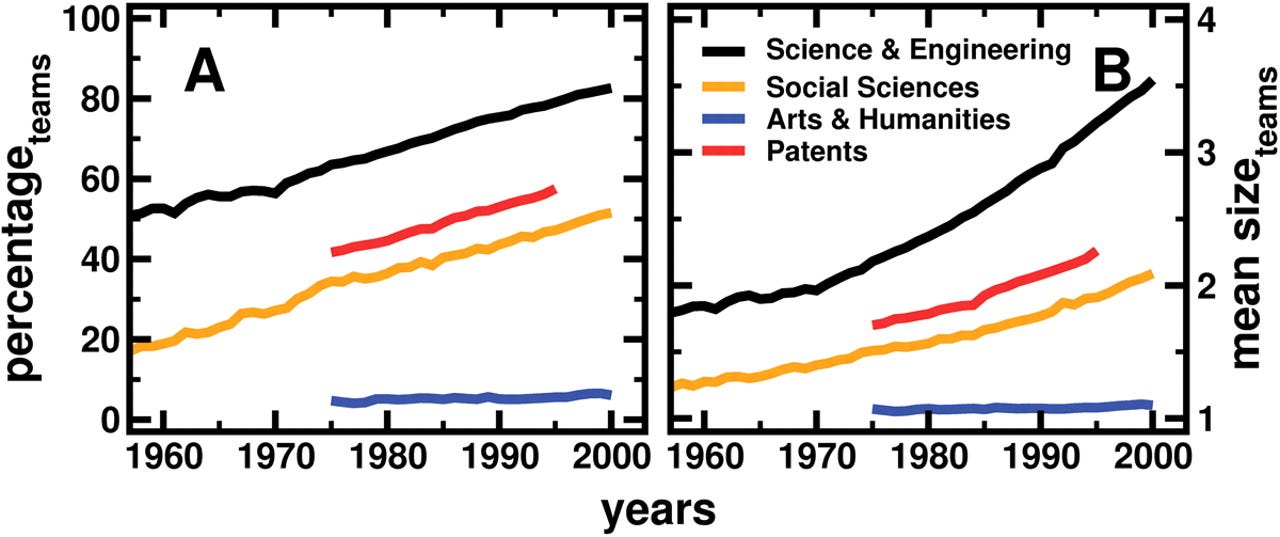
And the early data would seem to support that view: A 2007 study looked at published academic papers and patents and found that teams of more than one scientist produce more highly cited work than single authors. This was later backed up by a 2014 study of bibliometric records, which also found that larger teams produced more highly cited work. Such papers contributed to the meta-field of “the science of team science,” which emerged in the 2000s, now has strong influence within federal funding agencies, and dictates agendas within many research institutions.
The trouble is that these data may add up to less than they seem. Nobody has actually tested solo scientists versus large teams in a randomised controlled trial, which would be the correct way to tease apart correlation from causation. Scientific team size has been growing steadily since at least the 1960s—long before proponents of team science could claim credit for driving the change. I doubt that the correlation between larger teams and more “impactful” research is a causal one. In fact, there is likely reverse-causation at play: High-impact, talented scientists are able to leverage their high impact to win more grant money, which they then use to hire more talented people, form more collaborations, and grow in team size. There is also the question of whether citation count, used in the aforementioned studies to assess scientific output, is the best metric for scientific progress.
What about projects like the Manhattan Project? The nuclear bomb was a groundbreaking accomplishment, of course, but it is a poor argument for team science because it wasn’t really an example of science at all. The goal-directed Manhattan Project is better described as a feat of engineering. The project required execution, not ideation. Au contraire, the ideation and discovery was done by individuals acting alone or in teams of two or three.1 Large teams were only brought in to scale the already-known science for industrial application. And yet, it was after the Manhattan Project that we decided to disregard the solo scientist and preferentially fund more and bigger collaborative teams. Of course, teamwork can make sense, particularly in engineering, but it is not without its tradeoffs.
In 2015, the US National Academies of Science, Engineering, and Medicine produced a consensus study report, titled “Enhancing the effectiveness of team science,” wherein they highlighted seven problems inherent to large teams. These included poor communication within highly diverse teams, poor knowledge integration within highly interdisciplinary teams, and goal misalignment between team members. There are more issues they do not identify, though.
The pace of science can be slowed by collaboration among team members. If every experiment requires consultation among groups of disagreeing scientists before it can happen, experiments get delayed. If the interpretation of every bit of data gets jostled over by scientists with different opinions, data gets sat on for months and publishing gets delayed. Moreover, additional people in the decision-making hierarchy, as with highly collaborative science, adds layers of risk aversion. Scientific instinct, too, is eliminated, since it’s quite hard to justify a gut feeling to one’s team members in a rational way. It is often the instinctual, high-risk, high-reward science that actually advances fields conceptually.
Publications that stem from teamwork also have a different quality to those produced by individuals. All idiosyncrasy is greyed out. Speak to any scientist and they will tell you how scientific literature these days all has the same voice, making for duller, less inspiring papers. Individuality offers an opportunity for creativity to poke through. “The Starry Night” wouldn’t be the same if it had been painted by van Gogh et al.
Arguably the most successful scientific research institute of all time, Bell Labs, emphasised very small teams of scientists to reduce all of the problems inherent to collaboration. What about the smallest team size possible, one? Archimedes’ bathtime flash of insight about measuring volume via water displacement is probably just an entertaining legend, but closer to our time Newton, Darwin, Einstein, and the widowed Curie would all make the case for the solo scientist.
An even better example comes from outside of science. The U.S. State Department’s little-known Bureau of Intelligence and Research is 47 times smaller than the CIA, and yet has an incredible track record of accurate intelligence research. Key to its success is the fact that their research is done by individuals, not committees, which eliminates groupthink and generates more clarity of thought. This solo-researcher strategy has consistently allowed them to get things right, including being the only intelligence agency to correctly call out the fishy evidence for a nuclear weapons programme in Saddam Hussein’s Iraq.
At the human level, all scientists really want is their own “eureka!” moment. I know I’m more motivated to work on a project that I am solely in charge of. When I’m put on a project as a small cog within a larger machine, I know I won’t receive that much credit for the final product, and dilution of credit reduces motivation. I feel no ownership of the project. This in turn reduces the pace and diligence with which us scientists work. Dilution of accountability, though, can be even more detrimental. Scientific fraud, which is a significant problem within academic research, is harder to pin down and punish when done by an individual within a large team.
The one indisputable advantage of team science is the benefit of aggregating knowledge from across diverse spheres. Interdisciplinarity. However, this advantage is less relevant in the age of generative AI. It has never been easier to learn things. Solo scientists are now more empowered than ever to learn across disciplines and curate an information environment within their minds from which discovery can spring. Instead of spreading the intellectual ownership across many heads, solo scientists could ideate independently, while outsourcing technical work to core facilities run by technicians or contract research organisations. Within the next decade, robots in labs may take much of this load anyways, leaving us only with bloated team sizes that offer few advantages.
Perhaps polymaths and solo-author Nature papers are relics of the past, but just because science has been trending towards larger teams for decades doesn’t mean this is the right direction to go. Indeed, some of the more recent “science of team science” research has begun to show cracks, with one 2023 study demonstrating that geographically dispersed collaborative teams are much worse at producing disruptive science. Too many cooks do indeed seem to spoil the broth. We might have overestimated the advantage of team science and underestimated the capacity and ingenuity of the solo scientist. Dogmata can be difficult to break, but perhaps we should try a little less collaboration going forward.
Becquerel discovered radioactivity alone in 1896. Einstein discovered mass-energy equivalence alone in 1905. The atomic nucleus was discovered in 1911 by Rutherford, Geiger, and Marsden, and eight years later it was Rutherford alone who first transmuted an atomic nucleus into a lighter one. Chadwick alone discovered the neutron in 1932. Hahn and Strassman were the first to achieve proper nuclear fission in 1938, which was followed a year later by a theoretical explanation by another duo: Meitner and Frisch. Finally, it was Frisch and Peierls in 1940 who discovered that the amount of fissile material for a bomb was actually quite modest, which set the scene for the A-bomb to be engineered.
You know I'm not a big fan of group work in schools, either - it gives a reliable illusion of collaboration or soft skills building with precious little objective payoff (except perhaps for the teacher...)
What would it take to nudge things back into the solo author direction at this point? Anything institutions can do or just hope the winds blow back the other way? (e.g. maybe will happen naturally as AI takes over assistant type stuff?)
Another problem in teams is that those who hold de facto clout in a research hierarchy (whether as part of the formal hierarchy or not) have a de facto freedom to confuse their heuristics and intuitions on the one hand with evidence and scientific principles on the other, while those who lack clout can either play along, or take a principled position and thus end up not being a co-author.
In design and operation teams, those at the bottom of the totem pole can suck up and snitch (and claim credit for others' work) to climb, or 'lead from below' while taking flack to keep the operation going. Of course, the latter option provides no guarantee against the boot.