

No topic is quite as politically inflammatory as immigration. The open-borders leanings of the political Left and the detain-and-deport penchant of the Right may seem like defining political positions of our time, but it has not always been so.
Back in 2015, Ezra Klein (then editor-in-chief at Vox) interviewed Bernie Sanders leading up to his 2016 run for President. At one point, Klein, on the frontier of the woke takeover of the American Left at the time, put to Sanders that, if we are to take global poverty seriously, then we ought to “sharply [raise] the level of immigration we permit, even up to the level of open borders”. Shocked, Sanders responds:
“Open borders? No, that’s a Koch brothers proposal … I mean that’s a right wing proposal which says essentially there is no United States. … It would make everyone in America poorer: you’re doing away with the concept of a nation state, and I don’t think there is any country in the world which believes in that.
…
“What rightwing people in this country would love is an open border policy. Bring in all kinds of people, work for two or three dollars an hour, that would be great for them. I don’t believe in that.
…
“Do you think we should open the borders and let in a lot of low-wage workers? Or do you think maybe we should try and get jobs for [unemployed young Americans]?”
It’s a fascinating exchange between a classical Lefty and a more progressive/woke Lefty. The difference in opinion comes down to a widening of the moral circle that has begun to alter traditional left-wing politics over the past few decades. This phenomenon was captured by a now-famous and often-misinterpreted 2019 study that gauged the effect of political ideology on the expanse of one’s moral circle—finding that conservatives morally prioritise their family, community, and country significantly more than progressives, who instead report to love “all others” more than they love their own family.

In 2025, it seems that Klein’s position has won out for the Left, despite Sanders holding on to his principled position a decade on. Most Lefties, particularly young ones, think strong borders reeks too strongly of nationalism (which equals Hitler), and calling for them demonstrates a lack of compassion for the third world. But is it true that the most compassionate thing to do for the global south is to open the borders to the West?
Some would argue that our compassion shouldn’t be magnetised by people who have nothing to do with us and don’t share our values, culture, or genes. In other words, our compassion should be first-and-foremost allocated to people with which we have personal or familial relations. This is the conservative position, and it is not one that I flippantly dismiss—it is defensible in its own right by invoking evolutionary psychology, game theory, or common-sense moral intuition that is the product of these two things.
Then there is the argument that our compassion should be focused on the working class within our own country. This is Sanders’ position. Sanders’ case is obviously a liberal (in the non-classical, American sense) argument against immigration, but it is one that I won’t be arguing here. His points should be obvious to most, but I find his position to be a halfway house. The logical conclusion of wanting to punish the privileged and uplift the “oppressed” is to make the mission global—which is what Klein was getting at in that interview.
Instead, I wish to lay out three arguments against immigration:
Immigration leads to exploitation of immigrants
Relatedly, immigration violates the free market
Immigration cripples the third world via brain drain
I implore progressives with a wide moral circle to take points 1 and 3 seriously, while the second point should strike a chord with classical Liberals or libertarians.
Colonialism 1.0: stool servants and gondoliers
Colonialism is defined as the “domination of a people or area by a foreign state or nation” and “the practice of extending and maintaining a nation’s political and economic control over another people or area”.
Note the “people or area” here. Colonialism is agnostic of location.
Most iterations of colonialism—from Roman colonialism in 1st Century Judaea (renamed “Palestine” by the colonialists), to the present day situation in Tibet—involved not only initially conquering another peoples through war, but also subsequently ruling over them via a totalitarian and oppressive regime.
The most familiar iteration of colonialism to the university-educated westerner is that by the Europeans. The British, French, Belgians, Spanish, Portuguese, Dutch, and Italians all sailed to lands anew, set up settlements there, and subjected locals to their laws and customs—in many cases treating the locals as an ethnic underclass whose only purpose was to serve the European overlords.
Taking advantage of their maritime supremacy, the Europeans would also extract and transport resources back to their homelands. These resources included people, who were taken as slaves both to the New World and back to Europe itself.
For example, black Africans bought as slaves were used as “stool servants” by wealthy European families, particularly in Spain, Portugal, and Italy. This is exactly what you might imagine: the servants would accompany their masters to the lavatory and, if requested to, assist with undressing/dressing and post-plop wiping—particularly useful for an elderly or immobile aristocrat.
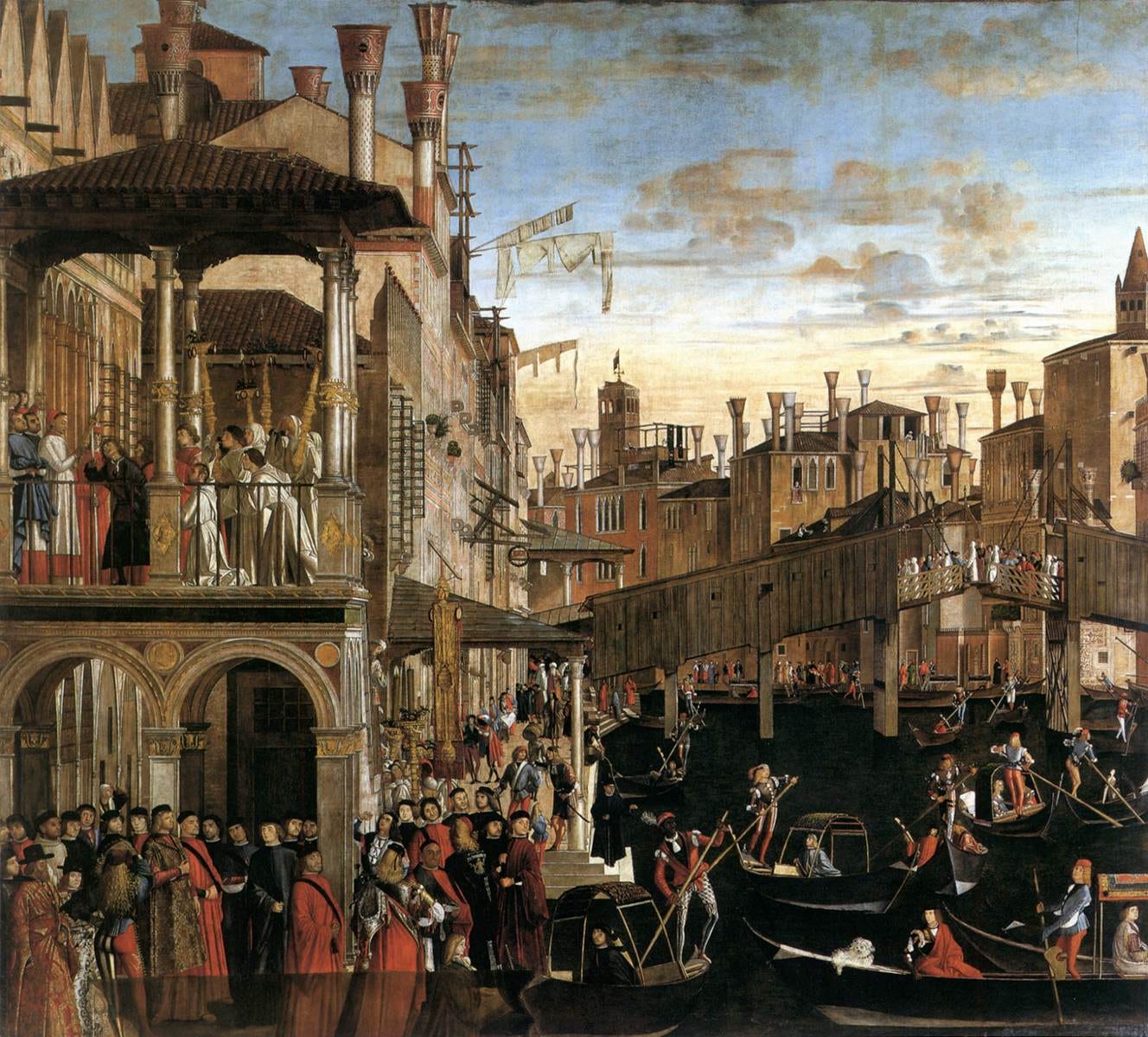
Bum wiping wasn’t the only useful task that imported slaves would do though. Any task that the local working class wouldn’t do without fair pay could be performed for free by a slave. For example, a plurality of gondoliers in 15th Century Venice were African slaves.
Indeed, this “occupation” offered a path to freedom for African slaves in Venice if the slave outlived their master—how fantastic! You might imagine a gaggle of Venetian women justifying their exploitation of blacks to each other:
“Oh don’t worry, Caterina. My husband treats his slaves very well. Besides, I don’t know about you, but I don’t particularly want to wipe my old husband’s bum and I’m very grateful for the people who do this work. The Paduans and Veronans are far lazier than the Moors—and they demand wages!”
Colonialism 2.0: bum wipers and Uber drivers
If you pay attention to British politics, that imaginary exchange between Venetian aristocrats might sound eerily familiar. That’s because Zack Polanski, the leader of the UK’s Green Party, expressed this exact sentiment when trying to justify mass immigration into the UK on BBC’s Question Time last month:
“One in five care workers are foreign nationals. I don’t know about you, but I don’t particularly want to wipe someone’s bum, and I’m very grateful for the people who do this work.”
And there is it. A momentary mask slippage and all of a sudden the pro-immigration stance of Britain’s hard left reveals itself as not being driven by compassion for foreigners at all, but by the utility of their exploitation. Even the left wing Guardian was shocked—both at the statement itself and the lack of criticism from Polanski’s base, who normally define themselves by their overflowing compassion.
Is this any different from 15th Century Venice?
In most European or American cities nowadays, you’ll find a concentration of foreign nationals and ethnic minorities in jobs that Zack Polanski wouldn’t particularly want to do. Before 2012, London’s Black Cabs were the dominant mode of private hire vehicle in the city. Their drivers were highly skilled (having spent 3+ years studying for the notoriously difficult “The Knowledge of London” examination) and almost all were white British men. Since alternatives like Uber have come about, these taxis are becoming obsolete, and the demographic of the workforce is being replaced by less skilled and cheaper imported labour. In 2023, 94% of Uber drivers in London were ethnic “minorities” or migrants.
Classical Lefties like Bernie Sanders might object to the dispossession of the cockney working class here, and he would have good reason to. The same argument is cropping up among the MAGA Right across the pond, where low-skilled immigrants—often entering the country illegally—are displacing the native working class by taking wages below the legal minimum.1
“So what?”, chime woke Lefties and fiscal conservatives in unison. If the migrants choose to do the job then they aren’t exactly being exploited. It’s not as if they were forcefully imported in the same way Moors were in 15th century Venice. And clearly the low pay is worth it to them. The natives are just too lazy or too spoiled to work for such low wages2. Isn’t this just free market economics giving us the best price for goods and services?
A tempting but flawed argument.
Regarding exploitation, it is obviously true that one can be coerced into choosing an exploited existence if the alternatives are worse. In the case of ethnic Uber drivers, the human toll of sitting in a car for long hours at any and all times of day with little job security or salary guarantee has been well-documented by leftwing sociologists. On the other hand, any degree of labour is, arguably, “exploitative”, so where do we draw the line? Are Elon Musk’s 100+ hour work weeks an example of him being exploited by Tesla share holders?
If the labour market were truly a free market, then I wouldn’t have any qualms with perceptions of exploitation. A free labour market means that workers are free to quit and find another job, and thereby dodge or reduce poor treatment. But, when immigration into western countries is concerned, the labour market is anything but free.
Mass immigration violates the free market
Libertarian economists all the way back to Adam Smith have strongly supported fluid borders as being instrumental to a free labour market. Free labour markets, like free goods markets, produce very efficient economies which raise the material wealth and welfare of everyone. Smith pointed to the open borders of New England (and its massive birth rate) to explain America’s meteoric rise in wealth.3
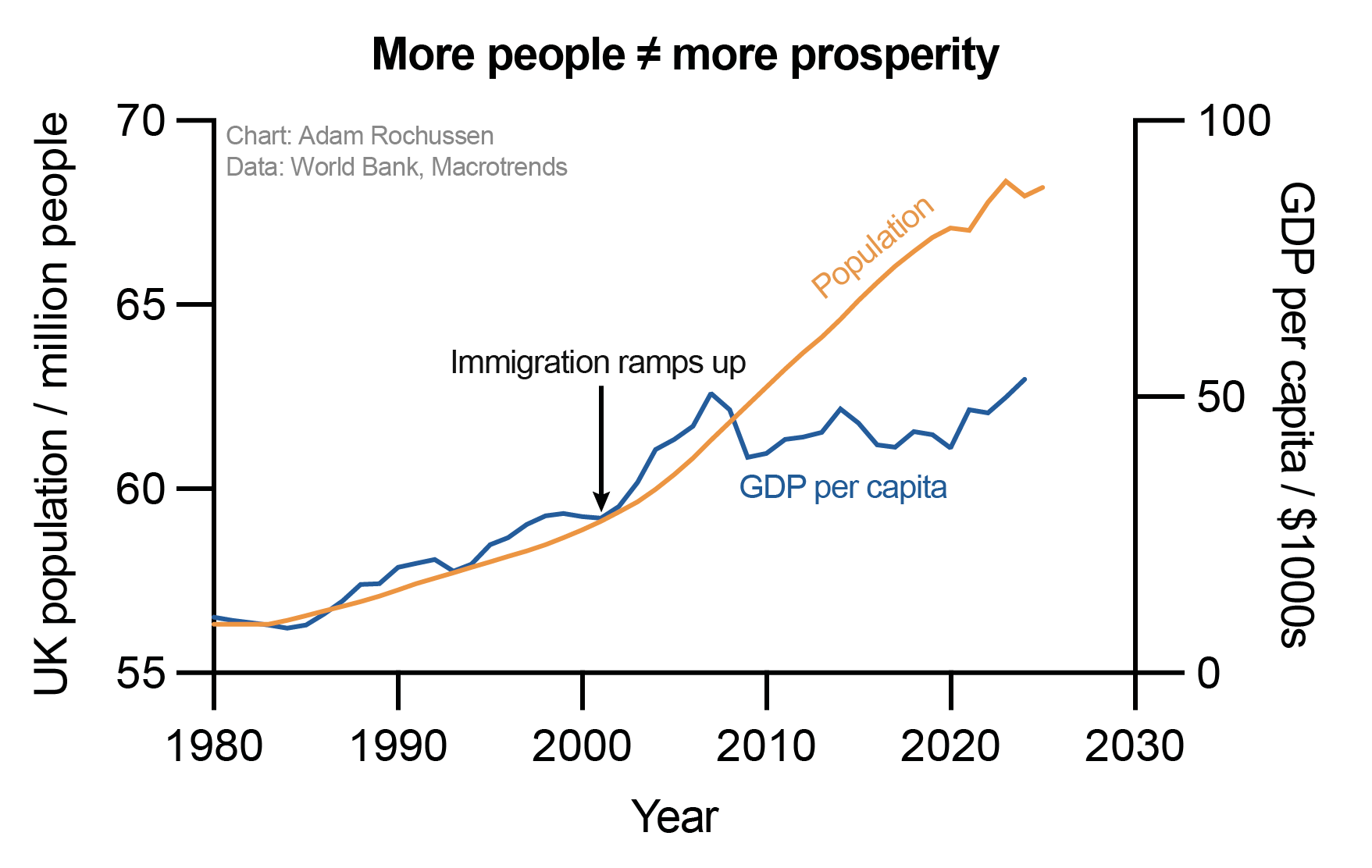
The “more people = more prosperity” dogma here has clearly been strongly adopted by Europe and, to a lesser extent, America over the past 30 years or so. And while it may hold true that more people raises total GDP, it doesn’t have any relation to material welfare and prosperity of people, as demonstrated by the UK’s completely stagnant GDP per capita since Tony Blaire threw open the borders.
The mistake being made here is equating people with goods—equating immigration with trade, that is. When we talk about “free markets“, what we mean is that individual transactions are controlled by the buyer and the seller (or the sender and the recipient), free from any government intervention. The key here is that transactions are agreed upon by both parties. There is mutual consent and individuals have the freedom to transact on their own terms.
Immigration, on the other hand, does not involve a decentralised, consensual agreement because people can move of their own accord, while goods and services cannot. Thus, there is no “free market” for immigration whereby recipient and sender get to agree on the transaction. This false equivalence of goods and people was highlighted by economist Hans-Hermann Hoppe in his landmark 1998 paper “The Case for Free Trade and Restricted Immigration”. Hoppe points out that the use of the word “free” when referring to trade or immigration mean categorically different things, and that the logically consistent position for a libertarian (or classical Liberal) to take is one for free trade and against “free” immigration:
“[W]hile someone can migrate from one place to another without anyone else wanting him to do so, goods and services cannot be shipped from place to place unless both sender and receiver agree. Trivial as this distinction may appear, it has momentous consequences. For free in conjunction with trade then means trade by invitation of private households and firms only; and restricted trade does not mean protection of households and firms from uninvited goods or services, but invasion and abrogation of the right of private households and firms to extend or deny invitations to their own property. In contrast, free in conjunction with immigration does not mean immigration by invitation of individual households and firms, but unwanted invasion or forced integration; and restricted immigration actually means, or at least can mean, the protection of private households and firms from unwanted invasion and forced integration. Hence, in advocating free trade and restricted immigration, one follows the same principle: requiring an invitation for people as for goods and services.4
In addition to disregarding the consent of citizens to immigration onto their property (it is theirs in the sense that publicly owned goods and property belong to the citizens of the country), the differing laws of different countries also creates a plethora of non-economic incentives for immigration.
For example, if an Iranian wishes to escape theocratic laws, they might immigrate to the US but compete in the US labour market with a much lower requirement for wage or economic incentive—because there is such strong political incentive for their immigration. This means that the Iranian immigrant would put up with considerably lower wages and considerably worse working conditions than a non-immigrant simply because doing so enables them to relish in America’s superior political climate and laws. The net effect of this is to depress wages in the US by mixing in non-economic incentives. The free market becomes heavily skewed by political differences between countries. Throw in a generous welfare state that hands out goodies to immigrants—illegal and legal alike, as many Western governments do—and any semblance of the immigration being “free” in the libertarian sense of a free transaction goes completely out the window.
Employment visas exploit immigrants
As well as pricing out natives, the skewed labour market produced by immigration is highly exploitative of the immigrant worker. Take the H1B visa system.
Employing someone on an H1B visa gives you, as their employer, complete power over their right to be in the country. This creates a skewed hiring incentive: to get away with offering lower wages and to acquire more power over their employees, companies will preferentially hire H1B visa holders. It’s a lose-lose situation for native and immigrant employees—while the companies enjoy power over their employees’ immigration status. It is a fact that H1B holders’ careers stagnate relative to residents’ because they have no leverage with which to ask their employers for promotions, and no means by which to switch employers. It’s modern day corporate serfdom that we should oppose on moral grounds.
Closing the borders would prevent western companies from having a disproportionate grip over the lives of immigrant workers. If immigrants are instead encouraged to work in their own countries, they will find themselves with much greater power as an employee, all else being equal.
Of course, “all else being equal” is easier said than done, but it doesn’t have to be so. Let me put it to you that it is immigration itself that ensures that other countries remain worse places to be than western countries.
Immigration keeps the third world dependent and poor
The concept of brain drain should be a familiar one to most readers. Since the 20th Century, America has enjoyed its position as the recipient of brain drain from many countries—from Nazi-occupied Europe to Starmer-occupied UK (yes I’m referring to myself here). Attracting the best and brightest from across the globe is obviously a good thing for any country, but rarely do people consider the other side of that equation: it is catastrophic for the country being drained.
India has tremendous potential as a country. Its huge, relatively young population combined with its high quality educational institutions make it a rich source of talent that the US keenly exploits. In 2024, over a quarter of a million H1Bs were awarded to Indians—71% of all H1Bs. Every year, a large portion of the Indian crème de la crème emigrates from the homeland and is put to work for US companies or academic institutions. This is great for the US companies (as I’ve explained) and also seemingly for the individual immigrants, who now get to chase the American dream. But what about the Indians who weren’t so lucky in the H1B lottery, and what about India as a whole?
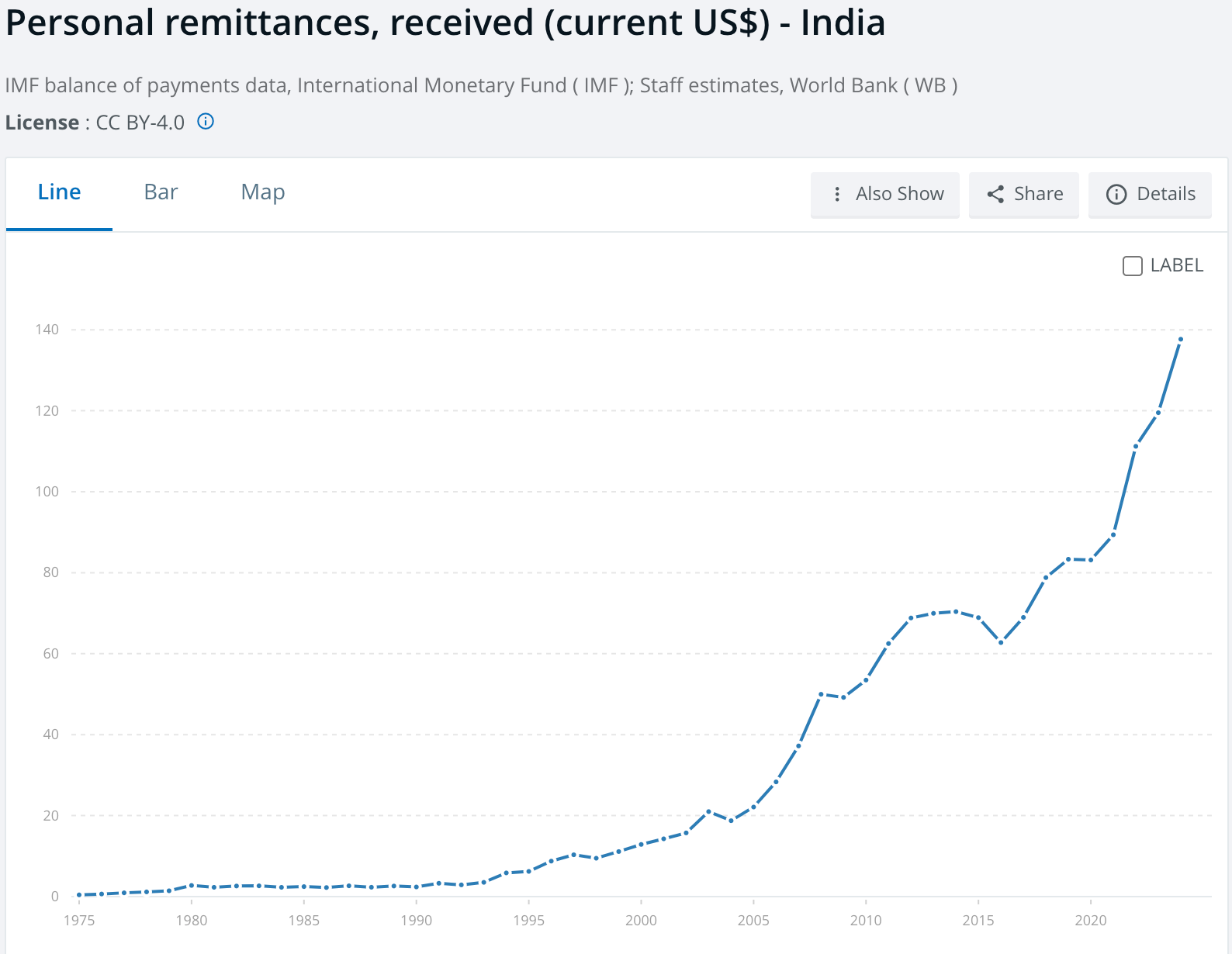
One supposed benefit of this immigration is the ability to spend US-earned wages with Indian spending power back home. India receives the most remittances of any country in the world—over $137B in 2024 per the World Bank. On the surface this seems great for India—they get to extract wealth from America. Yet this injection of emigrant-earned dollars is massively inflationary, and contributes to the rapid outpacing of domestic wages by asset prices in India. This makes life very difficult for the Indian domestic middle class, who are finding it increasingly difficult to buy homes, for example.
Further, it makes India geopolitically subservient to America. If their economy relies on billions coming back to India from America every year, then it’s hardly surprising that Modi bends over backwards for Trump. Modi’s obsequiousness was, of course, not sufficient to prevent Trump from significantly constraining the H1B program.
Most importantly, though, the brain drain from India to America prevents India from fulfilling its own potential as a country. It lets Indian-American CEOs become points of Indian pride, rather than actual Indian companies in India. Ruchi Gupta put it well last year in an opinion piece for The Indian Express:
“The true cost of this talent exodus extends beyond the immediate brain drain. It perpetuates an outward focus that weakens the urgency for domestic reform, allowing the state to neglect its responsibility to create equitable opportunities and an environment conducive to growth and innovation. The question is no longer whether Indians can succeed globally — they clearly can — but why India struggles to replicate this success domestically and equitably for its masses.”
Thus, the H1B system holds India down by bolstering American hegemony and preventing homegrown talent from investing time and effort in India itself.
Indian migration to the US is a particularly voluminous example, but the same dynamic holds true for other countries. It is simply the case that, whatever the country being emigrated and whatever the reasons for said emigration, the most likely to be able to leave are the most competent. It is as true for Indian H1B holders as it is for illegal immigrants crossing the English Channel on small boats. It is no coincidence that the latter are almost all military-aged men. That’s because this demographic is the most agentic and resourceful among their compatriots. It is this demographic that would otherwise be the most able to find or create solutions in their own countries.
Skimming the upper tail of the talent pool away from third world countries every year is a surefire way to prevent those countries from independently developing and become richer of their own accord.
To conclude
If we care about the rights and welfare of immigrants, we should consider that their presence in western countries is incentivized by those, like Zack Polanski, that wish to exploit what they have to offer us. Arguing for immigration because of the yucky jobs that immigrants will put up with is a disgusting line of argument that is tantamount to colonialism 2.0. If Piers Morgan happens to be reading—yes, arguing for immigration because it means you get to try out diverse cuisines is also rooted in a fundamentally colonial mindset.
If we care about free markets, we should care about ensuring that movement of people involves a free transaction whereby the citizens of a country are free to say “no” to the deal. This is simply a matter of consent and sovereignty. Any libertarian who equates free immigration with free trade is simply not a serious thinker.
Finally, if we care about the sovereignty and prosperity of third world nations, we should care about limiting the emigration of their most competent into the west. Self-sufficiency is the true opposite of colonialism, and is what we should hope for for all countries.
Of course, the concept of a “minimum wage” is economically incongruent and clearly contributes to the problem here. If the market were free, natives would be able to compete with immigrants without breaking the law themselves.
See: Adam Smith, The Wealth of Nations; Book I, Chapter VIII (“Of the Wages of Labour”)
Hoppe, Hans-Hermann. “The Case for Free Trade and Restricted Immigration.” Journal of Libertarian Studies 13, No. 2 (1998): 221–233.