

Earlier this month, Tonbridge School—one of the few remaining all-boys English boarding schools—announced that they will be introducing girls to sixth form in 2028. A longterm but closely-guarded project of the Board of Governors, the announcement came out of the blue and without the consultation of Old Tonbridgians, donors, parents, teachers, or pupils.

I loved my time at Tonbridge—in large part due to my experience of the all-boys boarding house. Over the past 473 years, Tonbridge has imbued boys with healthy competitiveness, respect for hierarchy, fierce camaraderie, love of truth, hunger for excellence, and a sense of duty beyond oneself. As a beneficiary of these masculine alchemical ingredients, I know that boys of future generations would certainly be lesser without them.
Given the direction of the cultural trade-winds, loss of beneficial masculine environments and ideals is a particular worry in 2026. It seems the word “masculinity” rarely appears nowadays without its epithet “toxic”, and I’m sure many consider the two words to be practically synonymous. It might be easy to think, therefore, that the introduction of girls into Tonbridge School is yet another incursion launched by the woke managerial class in their unrelenting war against masculinity, tradition, and all things good and true. This is certainly the position of one Old Tonbridgian, who took to the pages of the Telegraph to lament the “death of an entire English institution”.
While I understand the temptation towards scorn and nihilism here, such a response seems decidedly irrational. Does the presence of girls at Tonbridge equal the disintegration of its ethos and the evaporation of the segregation-derived benefits for boys? I don’t think so.
The primary locus for my exposure to a beneficially masculine social environment while I was at Tonbridge was the boarding house. With the addition of day girls in 2028 and, by 2030, the construction of an all-girls boarding house, the unique environment of the all-boys boarding house isn’t going anywhere. Sports teams—another crucible of Tonbridgian masculinity—will remain sex-segregated too. Further, the introduction of girls will be gradual (an initial brave cohort of ~20 will join a 150-strong boys’ year group). To suggest that these girls could degrade the ethos of the school admits a lack of faith in the fortitude of said ethos.
In practice, mingling between girls and boys at traditional boarding schools primarily occurs during lessons and non-physical co-curricular activities. Here, sex segregation seems less beneficial than in the boarding house. While some studies have purported to show a benefit of single-sex schooling on academic performance, a 2014 meta-analysis of 184 individual studies found that this effect was largely due to selection bias: parents of smarter kids tended to choose single-sex schools. Randomised or controlled studies (which mitigate this bias) showed a trivially small benefit of single-sex schooling for either boys or girls.
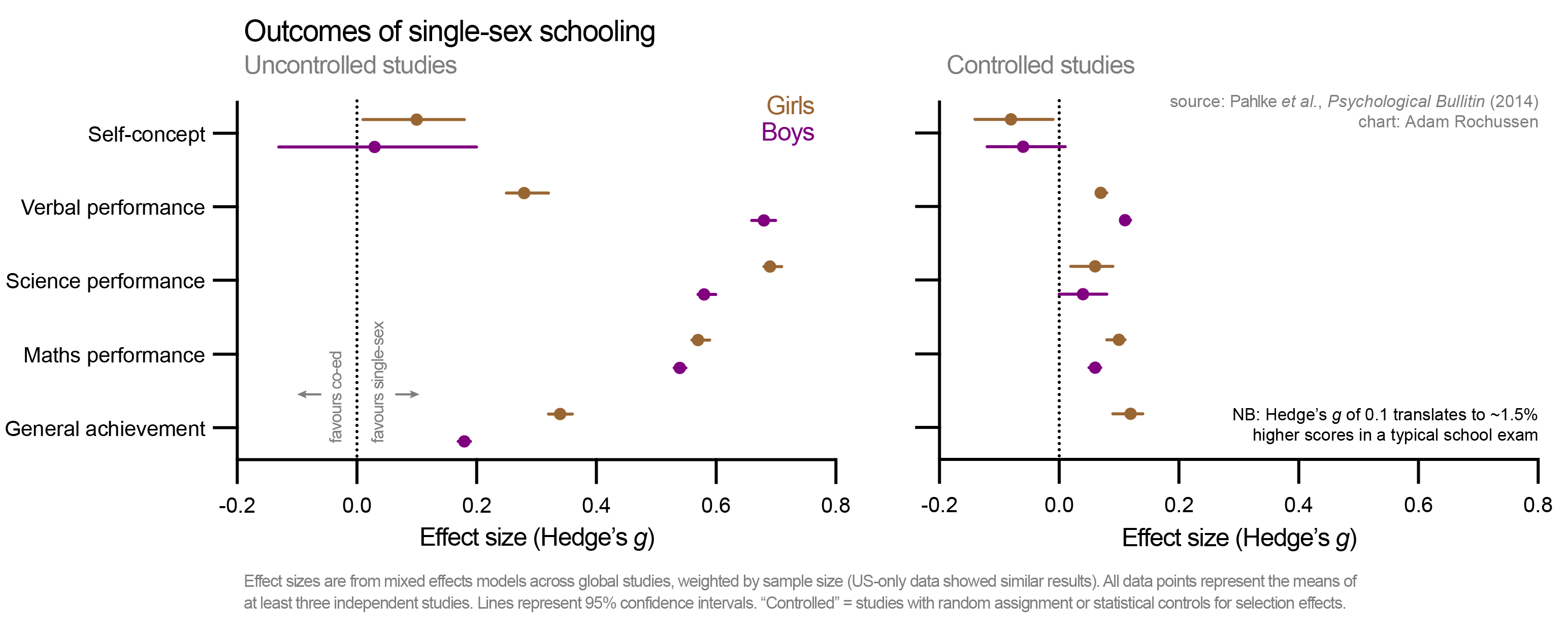
On the social side of things, the benefits of co-education seem clear. Yes, there are unique benefits to an all-boys social environment, but there are trade-offs too. In my experience, Tonbridgians who had attended co-educational primary schools were notably less distractible by girls while also being better at forming both platonic and romantic relationships with them. A single-sex secondary education risks propagating this disadvantage as boys become men. If a Tonbridge boy does not adjust well during his undergraduate years, eventual workplace relationships with the opposite sex, too, might be strained (I suppose this could be circumvented by becoming a priest or something). By maintaining healthy microcosms of sex segregation (like the boarding house and sports teams), moving to co-education allows traditional boarding schools to maximise masculine enrichment for boys, while minimising the inter-sexual social deficiencies inherent to single-sex education.
This aligns with the Headmaster and Chair of Governors’ claim that girls at the school will “enhance the educational experience of pupils at a pivotal stage of their development”.1 The school’s statements, however, omit a deeper motivation.
When I joined the school as a novus in 2010, full school fees were £40,000 per annum in today’s currency. By contrast, parents of a boarder starting in September 2026 will pay £64,251 annually (unless their child wins a scholarship or bursary—which the school does generously award). Fees across British boarding schools have seen similar dramatic rises, reflecting the suffocating economic reality these schools face—including dealing with the government’s recent rescission of VAT exemption for school fees.
While fees have increased by over 50% in real terms since 2010, median household disposable income has crept upwards at minuscule increments (see below). Moreover, inflation-adjusted incomes within the top half of earners have actually fallen slightly.2 The net result is that, while a top 20% earning household in 2010 could afford sending a child to a top British boarding school, 2026 prospective parents are in the top ~5% of earners. The pool of prospective parents for these historic institutions is being squeezed out of existence.

When viewed through this lens, the move to co-education becomes an economic necessity. These ancient British institutions are struggling to survive. One strategy is to create foreign outposts that funnel money back to the centre of the empire. Rugby School, for example, has schools in Thailand, Japan, and Nigeria now (in addition to England). Another strategy to maintain numbers and balance the books is to market themselves to wealthy international parents willing to send their children to England to be educated (this method has been wholeheartedly embraced by Harrow and Eton, among others). Tonbridge, though it enjoys some international diversity, has largely resisted the allure of foreign money. By introducing girls to the school now, the Board of Governors has protected the school financially while preserving its cultural ethos and enhancing the experience of its pupils.
It’s also important to note here that Tonbridge is not venturing into the unknown. Many other similar schools have done the same. For example, Wellington College, an historic boarding school in Berkshire, first introduced girls in 1975 and, having—sensibly—made the demographic change slowly, finally reached parity just last year. Not only does such precedent allow Tonbridge better to forecast outcomes, but also to learn from any logistical hiccoughs that the pioneers might have encountered. Tonbridge could leverage its late-coming to co-education to optimise the experience of, in particular, the girls who will soon be roaming its grounds.
I am not sure whether I will be able to afford sending my (currently non-existent) kids to Tonbridge, but I am confident that the option will at least exist in twenty years’ time. For those who can afford it, their sons or daughters will likely receive an excellent and uniquely English education similar to the one I did.
It’s probably worth disclosing that said Chair happens to be my father (not that this affects what I think or write—my family members and I typically disagree quite pugnaciously)
The income distribution has been compressed downwards: Income inequality, measured either via Gini co-efficient or 90:10 ratio, is lower now than it was in 2010. Comparing the median and mean lines in the chart below is also insightful. The mean is pulled up by high earners, so the fact that it is more or less completely flat over time, while the median rises slightly, is because of this downwards compression of the income distribution.
Succinctly said, Adam! A good summary of the facts