

I have never believed in God. It’s simply never made sense to me to believe in something for which there is no tangible evidence at all. As a teenager, like many Zillennials, I was enamoured with the new atheist movement. Public debates on YouTube between atheists and Christians/Muslims were my Roman colosseum where I could reliably go to see my champion come out on top time and time again. It felt good to be on the winning side.
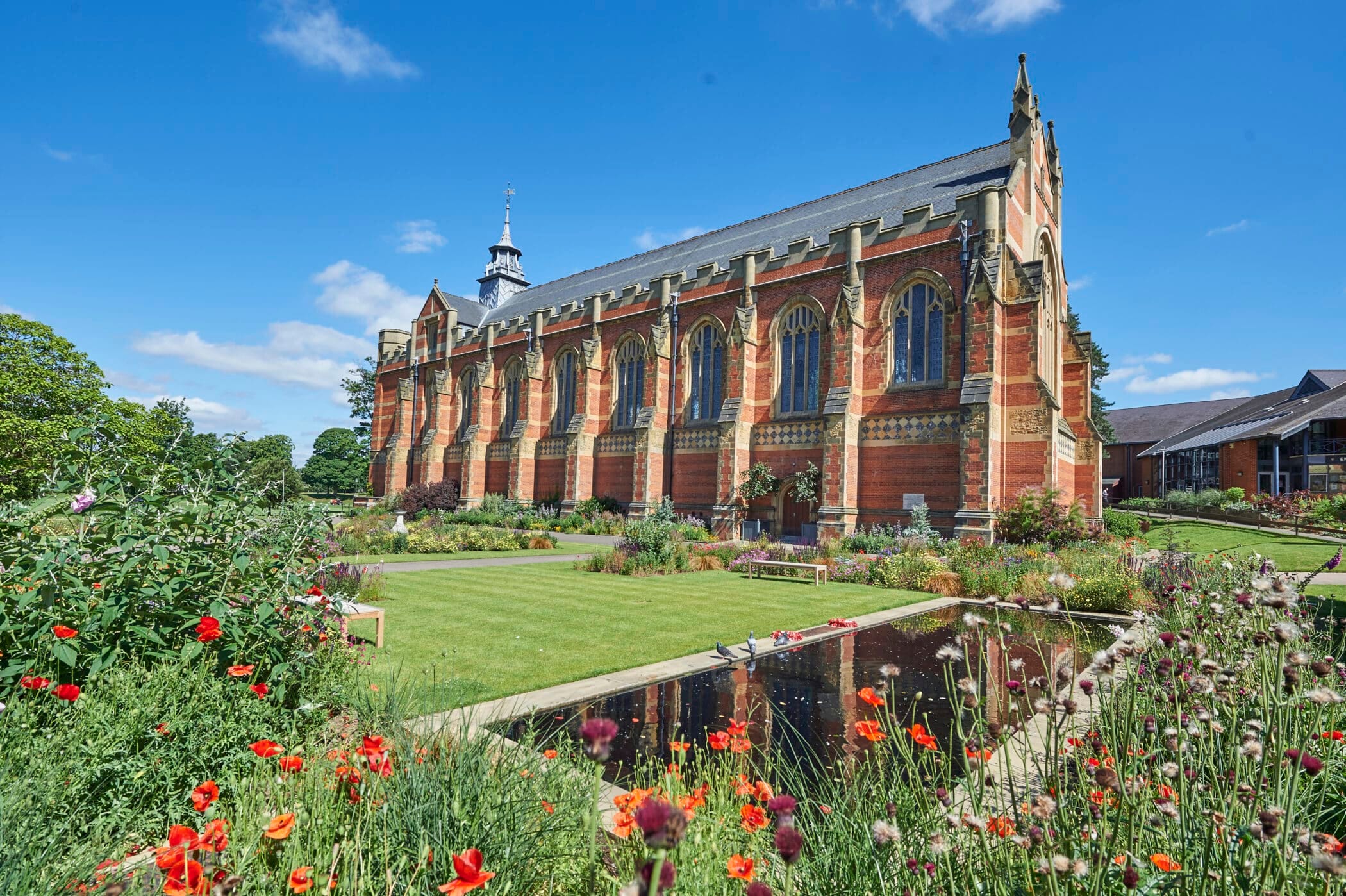
As a fairly precocious schoolboy, the simplified theology that I was exposed to at Catholic primary school and Anglican secondary school never cut the mustard for me. I recall standing in the Tonbridge School chapel deliberately keeping my hands separate, deliberately gazing upwards at the beautiful stained glass windows, and deliberately keeping my lips firmly pressed together as the rest of the school chanted the Apostles’ Creed. I was like Rosa Parks if Rosa Parks was a young white boy who went to a £60,000 per year British boarding school1. I found the defiance exhilarating.
As I grew older and learned more about philosophy and theology, I became able to reconstruct arguments against the existence of God from first principles. I was no longer just an observer, but a gladiator in the arena. As an undergraduate at Cambridge, the atheistic worldview was assumed. I recall many times sitting in the college bar with a friend bathing in each other’s atheist rhetoric. I knew I needed to challenge my worldview to strengthen it, though.
Fighting a war on two fronts, I would take on woke nonsense at college feminist society meetings, but also flex my logical and rhetorical muscles against Christians when the opportunity arose. On nights out when I didn’t get blackout drunk, I made a habit of debating the volunteers from the Christian Union. They would stand outside Cindies handing out jam sandwiches and bottles of water to drunk, wayward souls. Between 1am and 3am on Thursday mornings I could be found locked into theological debate with these kind Christians. Maybe it was my use of performance-enhancing drugs in the form of caffeine and alcohol from 4 for £10 VKs coursing through my veins, or the exhaustion of my interlocutors who probably actually planned on going to their 9am lectures that morning, but I never lost one of these post-nightclub debates. Atheism remained undefeated.
The problem of evil
My secret weapon in such debates has always been the problem of evil. This is the notion that, if there is an all-powerful, all-loving, all-knowing God, how is it that evil exists in the world? Why does God allow murder? How is it that children through no fault of their own die of cancer? How is it that there are species of parasitic wasps whose life cycles require them to implant their eggs into the larvae of other insects such that the hatched parasitic larvae then eat the other larvae from the inside out?2 Christian apologists have spent centuries—millennia even—trying to answer this question.
One answer is free will: God gifted humans free will, and therefore has to permit them to use that free will for evil purposes. In this version of events, which inspired a couple of fantasy novels out of John Milton, God is an ardent libertarian prioritising human individual liberty over our optimal material wellbeing. To my mind, this is completely valid. Many atheists are deluded into thinking that free will doesn’t exist, but there is even less tangible evidence for determinism than there is for God3. Free will clearly exists and is clearly a moral good. I would expect an all-loving, all-powerful God to permit human evil for this reason, but it does little to explain natural suffering in the world. Human free will has nothing to do with childhood leukaemia, for example4.
Another workaround for theists is to argue that short-term suffering is sometimes necessary for long-term benefit. In other words, evil and suffering are sometimes necessary components of processes in service of good. In this version of events, God is an ardent utilitarian prioritising the greater good over individual wellbeing. While many atheists are themselves ardent utilitarians, this argument rarely persuades them. For me, it works in some cases, but there are always counter-examples for which no great utility for the suffering can be imagined. For example, what utility is there to a random bird getting splattered to death by a North Sea wind turbine blade? Why couldn’t God just give kittiwakes slightly better visuospatial perception?
Another problem, for the Christian, with all of these arguments is that Christians also believe in a perfect realm without suffering or evil. They call it Heaven. If it is possible for Heaven to exist, then why can’t this realm just exist everywhere? Presumably there is free will in Heaven? The Heaven dilemma really does throw a spanner in the works here for Christian theodicy. Of course, you could believe in an omnipotent, omniscient, all-loving God without believing in Heaven, but this is a rare combination.
The problem of evil is a tough one, and has driven some theists to quite heterodox conclusions. Ancient Gnostic Christians didn’t suppose the creator God is all-loving at all, but portrayed him as an ignorant, arrogant, or outright malevolent “Demiurge.” On the other hand, panpsychist philosopher Philip Goff argues that God could be perfectly loving yet not traditionally omnipotent. Mormons take a similar line, seeing God as a benevolent organiser whose omnipotence isn’t absolute but constrained by pre-existing eternal laws and matter. Trimming God’s résumé on either the benevolence or the potency front does allow Him to coexist with evil, but it leaves classical Christians still struggling to rebut polemical drunks outside nightclubs at 2 a.m.
One thing all of these arguments both for and against God have in common is the presupposition that suffering is bad. This seems obvious. An axiomatic truth, almost. Perhaps not?
To live is to suffer
I recently watched My Oxford Year on Netflix (please skip this paragraph if you don’t want spoilers). The film is about an American woman, Anna, who defers her job offer with Goldman Sachs to spend a year at Oxford studying for a masters in Victorian poetry. While there, she falls for a British PhD student, Jamie, who is also her supervisor5. They fall for each other, but, at Jamie’s suggestion, force themselves to keep things casual and focused on “fun”. Towards the end of her masters, Anna begins to suspect that Jamie is cheating on her. She leaves the Boat Race early, after Jamie didn’t show up, and hurries back to Oxford to try and catch him in the act, only to find him in bed hooked up to a chemotherapy drip. Turns out Jamie has a rare heritable type of cancer that also killed his younger brother, and he had kept this secret from Anna. The couple argue and Jamie insists that she go home to America and forget about him. The ex-girlfriend of Jamie’s dead younger brother also tries to persuade Anna to leave Jamie, insisting that staying with him while he slowly dies of cancer will only bring her suffering. Yet Anna, despite knowing this, actively chooses suffering. She opts in to heartache, grief, pain and loneliness. A short while later Jamie dies and Anna is obviously heartbroken, but she doesn’t regret her decision.
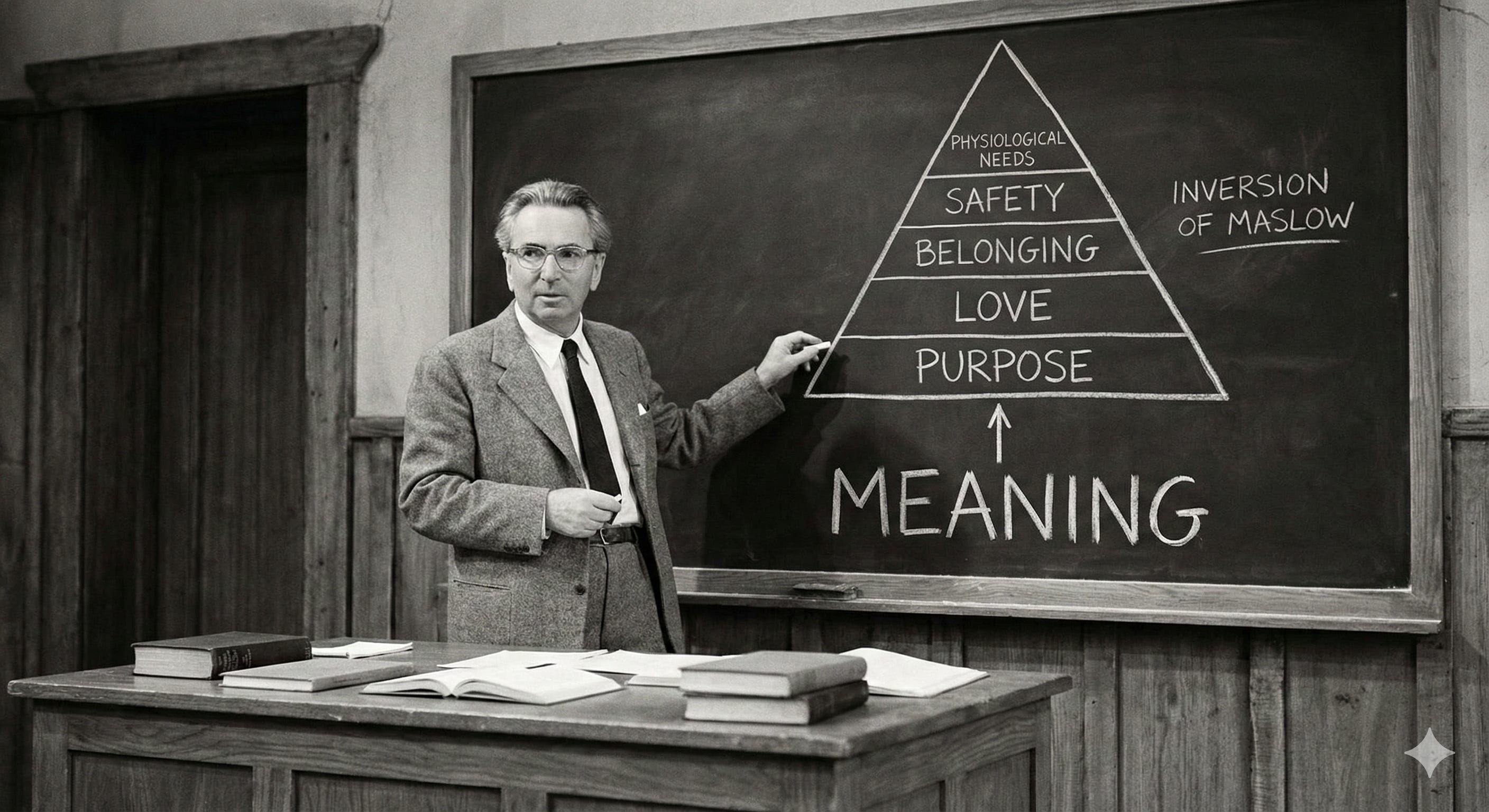
In Man’s Search for Meaning, Viktor E. Frankl recounts his years in the Nazi death camps. His account flips Maslow’s hierarchy of needs on its head. Humans, he argues, can not only survive but psychologically thrive without basic needs and amongst immense suffering as long as they have purpose. Frankl doesn’t just regurgitate Nietzsche, though (“he who has a why to live can bear with almost any how”). Frankl circularises this insight by observing that one of the sources of purpose in the camps was the very act of consciously facing suffering. To quote Gordon W. Allport in the preface to the fourth edition:
“It is here that we encounter the central theme of existentialism: to live is to suffer, to survive is to find meaning in the suffering. If there is a purpose in life at all, there must be a purpose in suffering and in dying.”
I’d take an even harder stance: it’s not merely that purpose allows one to withstand suffering. Suffering is purpose. Suffering is meaning.
Choosing suffering
In the Myth of Sisyphus, Albert Camus declares that Sisyphus—destined to push a boulder up a hill everyday only for it to roll back down at the end of the day—lives a life rich in meaning created by his conscious revolt against his suffering. He concludes:
“The struggle itself towards the heights is enough to fill a man’s heart. One must imagine Sisyphus happy.”
To say that struggling equals happiness may seem strange to the modern human—obsessed with maximising pleasure and comfort and minimising pain and discomfort as we are. Yet we don’t need to imagine anything to see Camus’ point ourselves. We can look to two modern day reincarnations of Sisyphus: David Goggins and Ross Edgley.
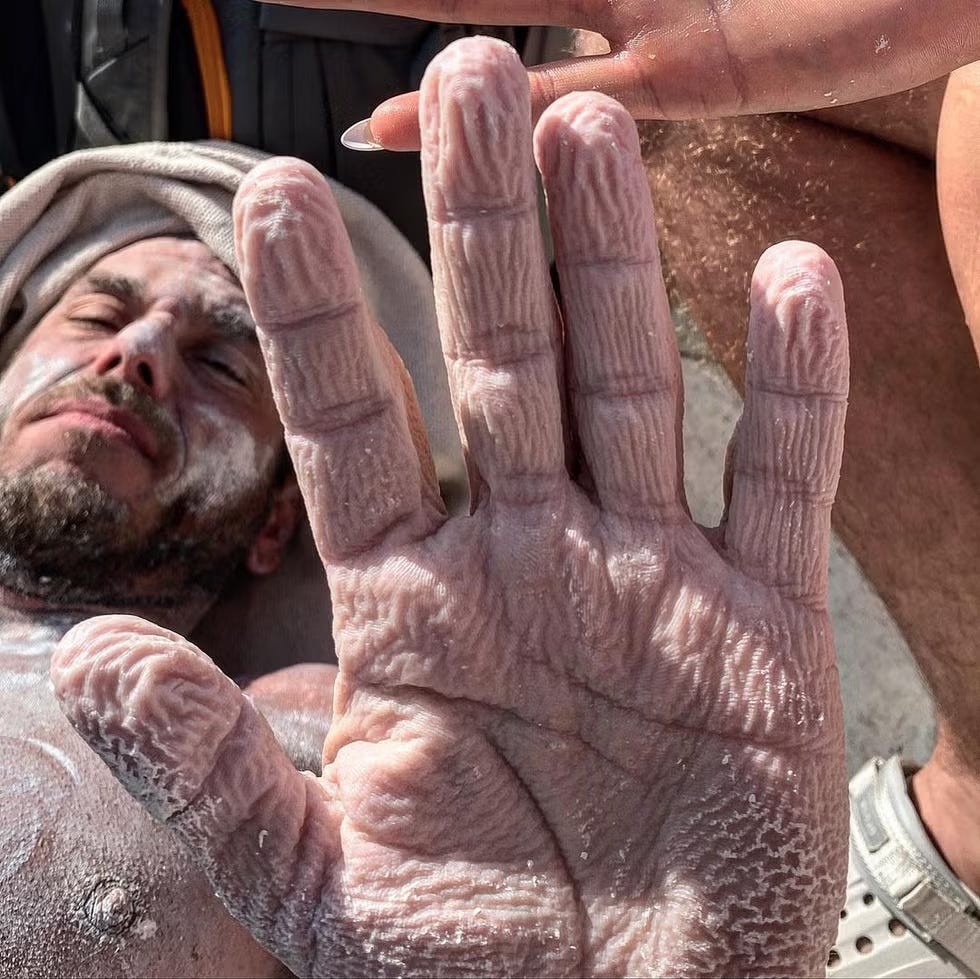
For those unfamiliar, Ross Edgley is an extreme endurance athlete, adventurer, sports scientist, and an author. I also consider him to be a philosopher of sorts. Some of his most impressive feats include dragging a car the distance of a marathon, completing an Olympic distance triathlon with a tree on his back, and swimming ~1,800 mi around Great Britain. He recently did Iceland too.
In Ross’s book The Art of Resilience, in which he recounts his swim around Great Britain, he explains his stoic philosophy and pursuit of eudaemonia. A couple of notable anecdotes include him finding chunks of his tongue in his porridge after the chronic salt exposure started to disintegrate it. Another time, he unknowingly swam with a jellyfish tentacle tangled up in his goggles—constantly stinging him in the face for an hour or so until the crew pointed out the source of the pain to him. Both of these events—completely pointless suffering—just made Ross laugh. Of course, every single one of his feats involves immense suffering—suffering that cannot possibly be paid off at the finish line or thereafter. Ross smiles through it all, and it is quite obvious that this man is happy because of his suffering.
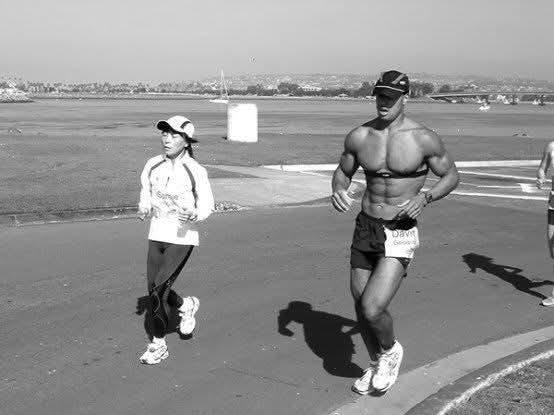
David Goggins, on the other hand, rarely smiles. Goggins is an American ultra-endurance athlete, ex-US Navy seal, motivational speaker, and author. I also consider him to be a philosopher of sorts. Goggins lived an incredible life. Growing up in an abusive home, by 24 he had become a fat loser with zero willpower working night shifts as a cockroach exterminator. He turned it around when he decided he “was sick of being haunted by being nobody”, and applied to be a Navy SEAL. In his book Can’t Hurt Me, he describes how he went through three Hell Weeks in a year (failing the first two due to pneumonia and fractured shins) before eventually making it.
He has since completed and won several ultramarathons. In 2005, he ran 101 miles in 19 hours having never run a marathon before. This qualified him to enter one of the toughest ultramarathons in the world, which he ran a few months later with stress fractures and acute kidney failure, placing fifth. Three months after that, he rented a bicycle to place second in a three-day ultra-distance triathlon in Hawaii. He also broke the world record for most pull-ups in 24 hours (4,030 in 17 hours). When he was 35, he found out that he was born with a hole in his heart that limits his cardiac function to 75%.
Now 50, he still runs 70+ miles most weeks for no prize, no audience, no reason except to conquer the voice that wants to quit. His source of purpose is overcoming mental resistance and enduring suffering. You won’t find Goggins smiling. You will find him regularly shouting at the camera telling viewers to “stay hard!”. To most outside observers, this is a miserable and painful existence, and many accuse him of psychopathy or sado-masochism. This is projection, though. Goggins may not smile, but he is happy—his veins course with eudaemonia. He chooses arbitrary, pointless suffering, and by doing so achieves purpose and meaning.
Sisyphean theodicy
They arrived there via two completely different routes, but both Edgley and Goggins have come to the same conclusion—that suffering is not inherently bad but actually something to be sought after. The skeptics who don’t understand Edgley or Goggins don’t understand the human animal. These modern avatars of Sisyphus aren’t psychopaths or masochists. They are human, all too human. To be human is to suffer.
What about non-human animal suffering?6 As I wrote about recently, non-human animals don’t really suffer in any way similar to the way we do. To do so requires complex emotional processing and phenomenal intelligence which other species don’t come close to exhibiting. This is despite our overwhelming tendency to anthropomorphise them—to over-exaggerate their human-like traits and to over-interpret their human-like behaviours. Nonetheless, it is of course true that other creatures—from dogs to dandelions—sense the environment around them and can detect, process, and respond to negative stimuli. To be alive is to suffer.
Many don’t agree with my views on animal suffering, and I don’t want to rehash that argument here, but we don’t have to agree here to appreciate that the suffering-meaning cohesion applies across species. If the intensity of suffering available to humans is proportional to the intensity of meaning derived from it, there is no reason to expect this relationship to breakdown for non-human animals. In other words, if you do happen to believe that animals suffer very intensely, then you must necessarily believe that animals derive intense meaning from that suffering too. Suffering and meaning emerge from the same complex psychological and neurological processes—they are pinned to each other across their spectra of intensities.
Wherever consciousness is complex enough for intense suffering, it is complex enough for intense meaning. The positive moral value of suffering therefore extends from David Goggins to shrimp (or whatever creature is currently in vogue for utilitarians).
This weekend I’ll be running the California International Marathon. It is true that the pain of a marathon, and of the marathon training block, delivers payoff at the finish line, but meaning is derived from the suffering itself, not the payoff. The last time I entered a marathon, I did not reach the finish line due to an injury. No medal, no sense of pride, no personal best. Yet it didn’t become a regretful or pointless experience—it was an incredibly meaningful one. The experience, despite being painful and pointless and not creating any longterm benefit (I lost all the fitness I had gained when recovering from the injury), was valuable to me.7
I wouldn’t want or expect an all-loving God to use His omnipotence to remove the pain and suffering associated with endurance running. Doing so would render it a less worthwhile thing to do. The same is true for involuntary sources of suffering—as attested to by Frankl and fictional Netflix rom-com characters, but also corroborated by any example of unwanted suffering I can think of from my own life.
To live is to suffer. A world without suffering would be a world without life itself. An all-loving, all-powerful God would be remiss to eliminate this moral good from the universe. A cold, dead universe without suffering is morally inferior to a universe rich with life, its suffering, and its meaning. I encourage you, dear reader, to meditate on the moral value that suffering—even pointless, involuntary suffering—adds to your own life.
To be fair, it was much cheaper when I went and I also had multiple scholarships which reduced the fees further. Still—a substantial sacrifice from my parents. Worth every penny based on the quality of this Substack though, right?!
It is said that this specific example made Darwin question his faith in God.
unless (cancer) cells have free will too … which they might.
I mean … “DPhil” … and “tutor”
Indeed, what about non-human organism suffering?
Notably, this was an instance of involuntary suffering. Not only was the pain of the injury involuntary, but so was the emotional pain of having wasted 32 weeks training for nothing. Yet this emotional pain was in itself meaningful.
I grew up Catholic (76)and have gone back and forth about God-quite jealous of those who believe and never question.
I'd be interested in you doing an article on determinism. Feel like you hinted at it in without being able to expand on it.
To me it seems clear that, whilst we have the feeling of choice and free will (in the sense that we feel we have options available for us and theoretically could make any choice), you will always make that same choice when presented with the exact same inputs?