

A streamer called “Clavicular” (real name: Braden Peters) has been gaining a lot of traction online recently for his hardline approach to “looksmaxxing”. For those who are unaware, this is a new realm of the manosphere whereby young men do what young Korean girls have been doing for decades—namely, everything in their power to improve their looks in an attempt to improve their lives.
For 20-year-old “Clav”, this means administering himself with a concoction of potions including testosterone (his natural production has been destroyed), accutane (a drug for acne), melanotan II (a peptide that enhances melanin production), retatrutide (an experimental next-gen GLP-1 mimetic), Anavar (a synthetic anabolic-androgenic steroid), and heaps of antioxidants to help his liver deal with these drugs, including ungodly quantities of the sleep drug melatonin which also has antioxidant properties at high doses. In addition to the drugs and supplements, he massages his face, mews, and performs bone-smashing—meaning he hits his facial bones with a hammer in zones where he wants to promote bone growth (like the cheek bones). He also claims to want to undergo limb-lengthening surgery soon to increase his height from 6’2” to 6’6”.
Interviewing him last month, the conservative pundit Michael Knowles turned the conversation to Clav’s politics. Clavicular revealed that, in a Vance versus Newsom 2028 presidential race, he backs Newsom “because JD Vance is subhuman and Gavin Newsom mogs”. He goes on to describe all the ways in which JD is ugly and fat, compared with Newsom, who is a “6’3” chad”. The clip is quite funny to be honest:
Clearly, Clavicular is unhealthily obsessed with looks. He’s also a bit of a dork, bad at talking to women, and malcoordinated. But this essay won’t spend time critiquing Clavicular. Plenty of others have done so—none more expertly than comedian gym bro Mike Tornabene. Instead, I want to take his political stance seriously.
Pretty privilege and the halo effect
You see, Clavicular is hyper-aware of something called pretty privilege. If you’re hot, people treat you better: the barista smiles at you, the boss minds less if you’re late to work, and people are more likely to do favours that you ask of them.
Pretty privilege slots into a broader psychological effect known as the halo effect. This describes how people judge one attribute of a thing based on pre-existing judgements of another attributes. For example, a 2020 study published in the Annals of Tourism Research found that the halo effect causes people to rate the location of different hotels in the same location differently based on how good other aspects of the hotels are (i.e., a bad hotel in a certain location gets worse “location ratings” than good hotel in the very same location).
Of course, it applies to peoples’ looks too, though exactly how this manifests is slightly different for men and for women. For example, a 2019 longitudinal, nationally representative American study found that being attractive protects women from being arrested and convicted, but not men. Other studies have found that attractiveness and femaleness also lead to more lenient judgements from jurors and lead to more lenient sentences.
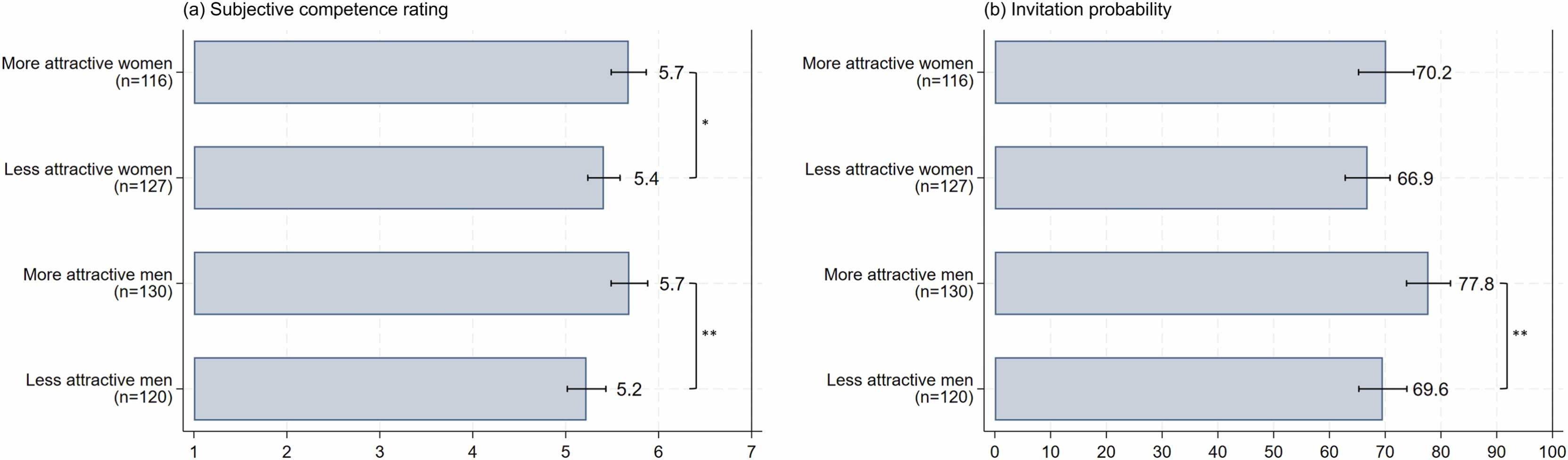
Outside of criminal justice, perceived workplace competency is heavily influenced by looks. A 2024 study using deepfakes to isolate physical attractiveness as the only variable being altered in job applications found that being more attractive led to significantly higher competency ratings and chances of being invited for an interview. Notably, the effect here was stronger in males, with females only experiencing significant pretty privilege for job applications in stereotypically female job roles.
The halo effect can spill into politics too. The wildly different responses we see to the Trump and Obama deportation strategies and mishaps, which are incredibly similar by any objective standard (if not worse under Obama), can be largely attributed to the halo effect (which sits upstream of biased media narratives).
In this case, Obama’s superior rhetoric and stateliness works like a halo—protecting other attributes of his leadership from being criticised as aggressively. Trump, instead, is quite uniquely unpresidential. While this sacrifices the halo effect, it adds an authenticity factor—something I have written about previously:

Obama is also much better looking than Trump. If we like the way someone looks, we might be predisposed to judge their other attributes more positively. Books are always judged first and foremost by their covers, and the same goes for humans. This is the calculus that Clavicular is considering regarding his prediction for the 2028 election.
Polymarket has Vance at 25% and Newsom at 19% at time of writing, but are looks alone powerful enough to switch things up in Newsom’s favour?
Political analysts focus on the wrong things
Clearly there are lots of factors that can go into a presidential election. Vance’s chances will obviously depend on the success of the Trump admin, and the nature of his participation in it over the next few years, while Newsom’s will depend on his ability to memory-hole his gubernatorial failures and continue his fire-with-fire anti-Trump strategy. Momentum will also matter. The passing of prop 50 is a big win for Newsom, and the midterms are predicted to tilt blue. Vance is a well-travelled, high IQ, erudite Yale grad and military vet with a proven track record of political campaigning and debating. Meanwhile Newsom is a seasoned politician and great orator with the ability to unite and lead the Biden and the Mumdani factions of the Democrat party. He’s also a mid-wit.1
In a democracy, we get one vote per person, regardless of one’s level of political engagement, education, or intelligence. I propose that this fact renders detailed dispassionate analysis of candidates and policy platforms somewhat irrelevant and overdone. Indeed, a 2020 Science paper argued that political campaigns don’t move the needle very much at all—with background economic factors, incumbency, and candidate characteristics playing more important roles.
Which candidate characteristics are important though? IQ doesn’t matter unless you can use it to get more people to vote for you. Erudition doesn’t matter unless reading Hayek makes you a better campaigner (it doesn’t). Of course, these things matter for the success of a government in power, but not for winning elections—as pointed out by Plato some time ago.2
Since a majority of voting people don’t have the ability nor interest in accurately assessing the best candidate, in reality, the president will be elected on vibes. And one of the most important influencers of vibes is physical appearance.
Being good-looking wins you elections
A landmark 2005 study sought to test the effect of politicians’ looks on election outcomes by using US congressional election results between the year 2000 and 2004. The researchers got participants, who were unfamiliar with the politicians being tested, to judge portraits of pairs of competing candidates based on a number of factors, including attractiveness, honesty, and competence. The participants made their judgements in 1.051 seconds on average, ensuring post-hoc rationalisation didn’t interrupt their instinctual judgements, and if participants recognised a candidate, the data were thrown out.
When competence judgements of portraits between Senate race winners and runners up were plotted against the actual difference in votes between the candidates, a significantly positive correlation emerges.
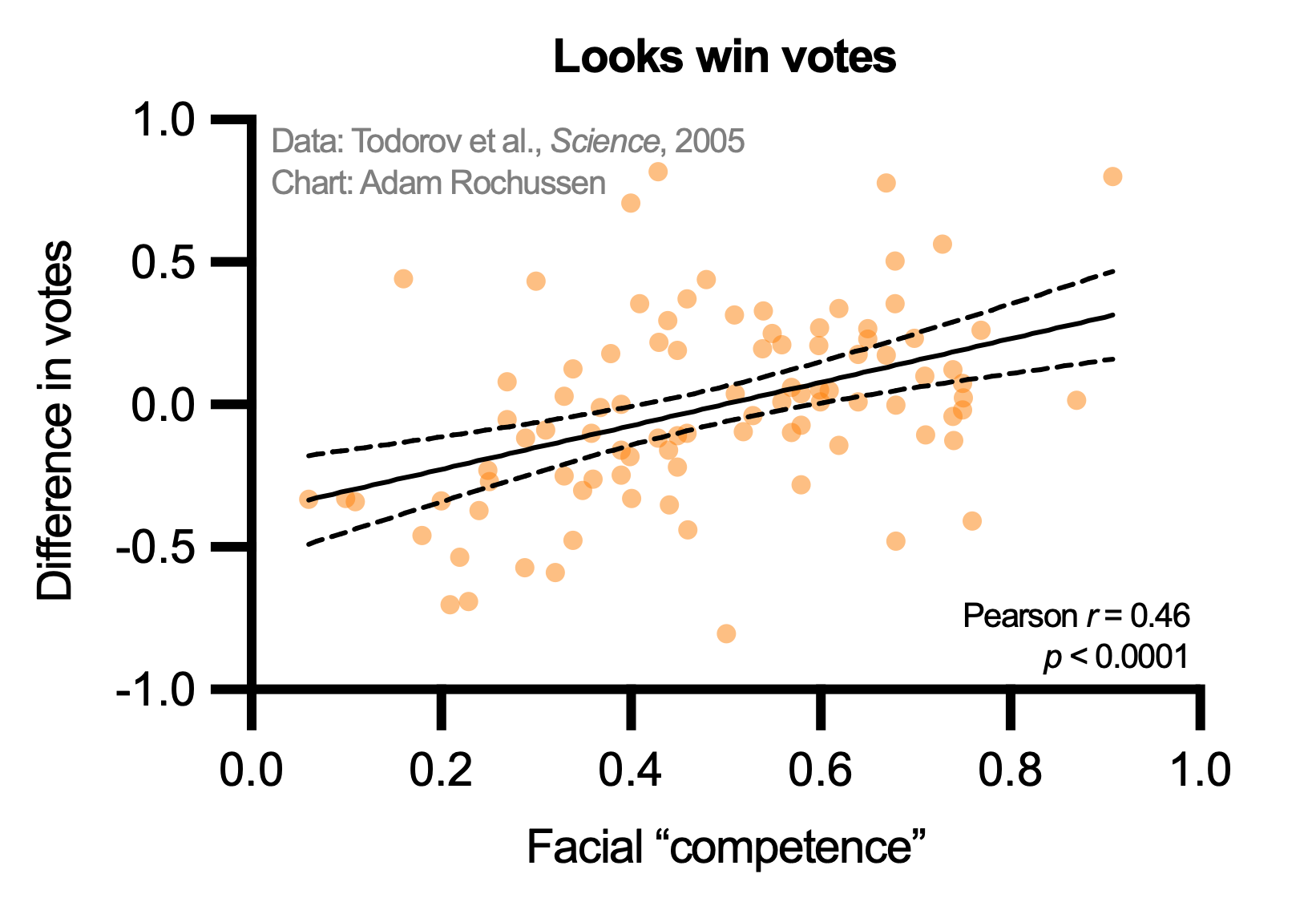
Incredibly, facial judgements of “competence” predicted the actual outcomes of Senate races in 71.6% of cases (p < 0.001) and House races in 66.8% of cases (p < 0.001). Notably, competence judgements seemed to outstrip all other tested factors, including “attractiveness” judgements.
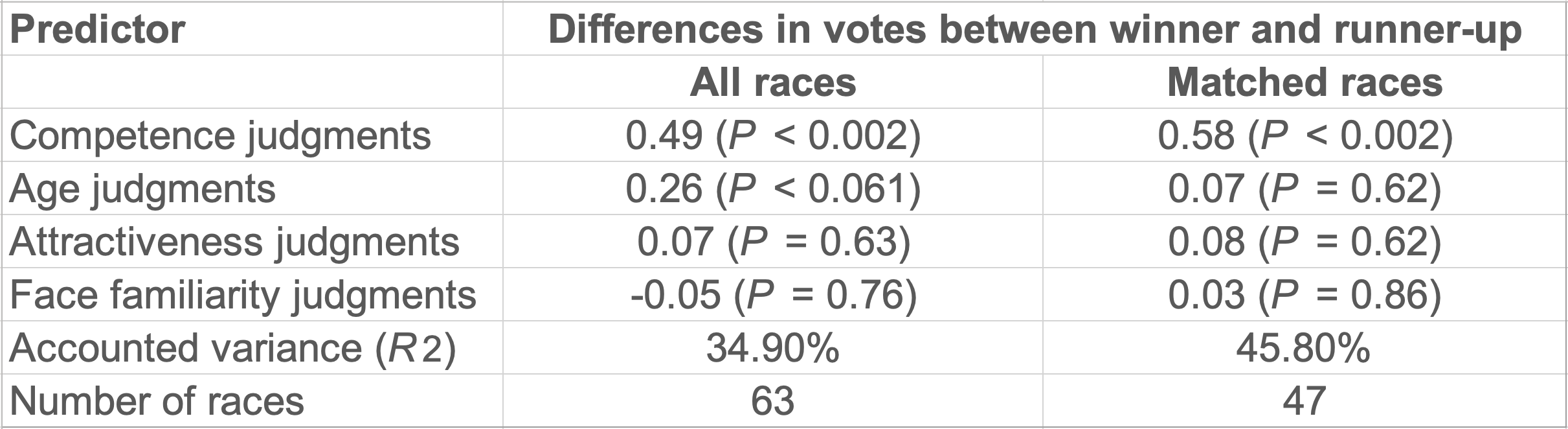
That judgements of “competence” of faces was much more important than “attractiveness” speaks to an important point about how male looks evolved: Masculine features (low voice, facial hair, prominant brows) seem to have evolved primarily to assist with intrasexual dominance among men, which determined access to mates ancestrally. Yet this selection pressure was/is at odds with facial features that appeal directly to females (intersexual attractiveness)—women actually prefer slightly higher vocal pitches and slightly less masculine features.
In other words, competition against other men drove selection for “competence” looks, while sexual selection for women drove “attractiveness” looks. When we talk about “good looks” relating to men, we inevitably mean a blend of these two facial attributes. Competency of men also overlaps strongly with attractiveness of men in general.
For women, the story is somewhat complicated by female intrasexual competition and significantly lower male attraction to female competency than vice versa (men care more about raw attractiveness of prospective female partners). I think if the Todorov et al. study could be repeated with only female candidates, the results might be markedly different. Luckily, I don’t think AOC or Kamala (remember her?) are particularly strong contenders for president in 2028, so we are fine focusing on male looks only here.
What about presidential elections?
Congressional elections are somewhat lower profile than presidential elections, with the latter receiving much more media coverage and in-depth analysis. So do looks still matter in this instance? I decided to put it to the test.
I looked at all presidential races since 1960—which was when the first presidential debates were televised and looks could really play a role. I took portraits of candidates from the Wikipedia page of each election and plugged them into Grok, asking it to give me a “looks score” from 1-10 based solely on judgements of competency from the portrait.3 I also took height as a factor—again from a Wikipedia page—and calculated whether height, competency-based looks, or the product of both predicted election outcomes better than chance. Crucially, the outcome I care about here is popular vote, not electoral vote.
Amazingly, the looks score predicted the presidential race winner in 81.8% of races that weren’t tied—significantly better than random chance via Chi-squared and one-tailed binomial tests. Height alone was not significantly predictive, but combining looks and height was a stronger predictor than just looks alone.
Incumbency is often thought to be a very important factor in predicting election outcomes, so I included an assessment of the predictive power of incumbency to compare it with looks. I used two definitions of incumbency—one defining an incumbent as a candidate who was elected as president in the previous race, and the other broadening the inclusion criteria to include vice presidents in office who then run for president (as JD Vance would be in 2028). Via these two definitions, incumbency predicted outcomes in 71.4% and 53.3% of races—with neither being statistically better than random chance.
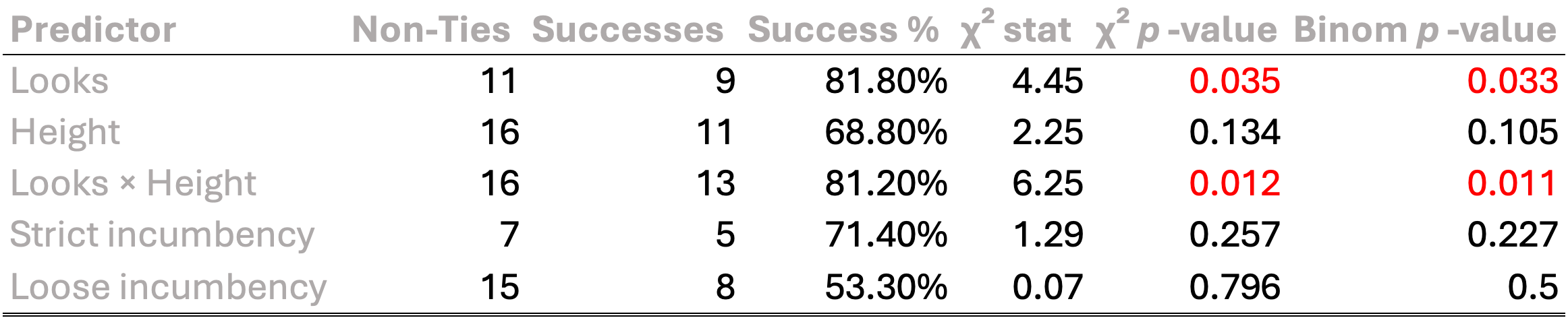
Beyond binary analyses, plotting vote-share difference against looks score differences revealed a (marginally) significantly positive correlation, with looks explaining around 25% of variance in vote-share differences.
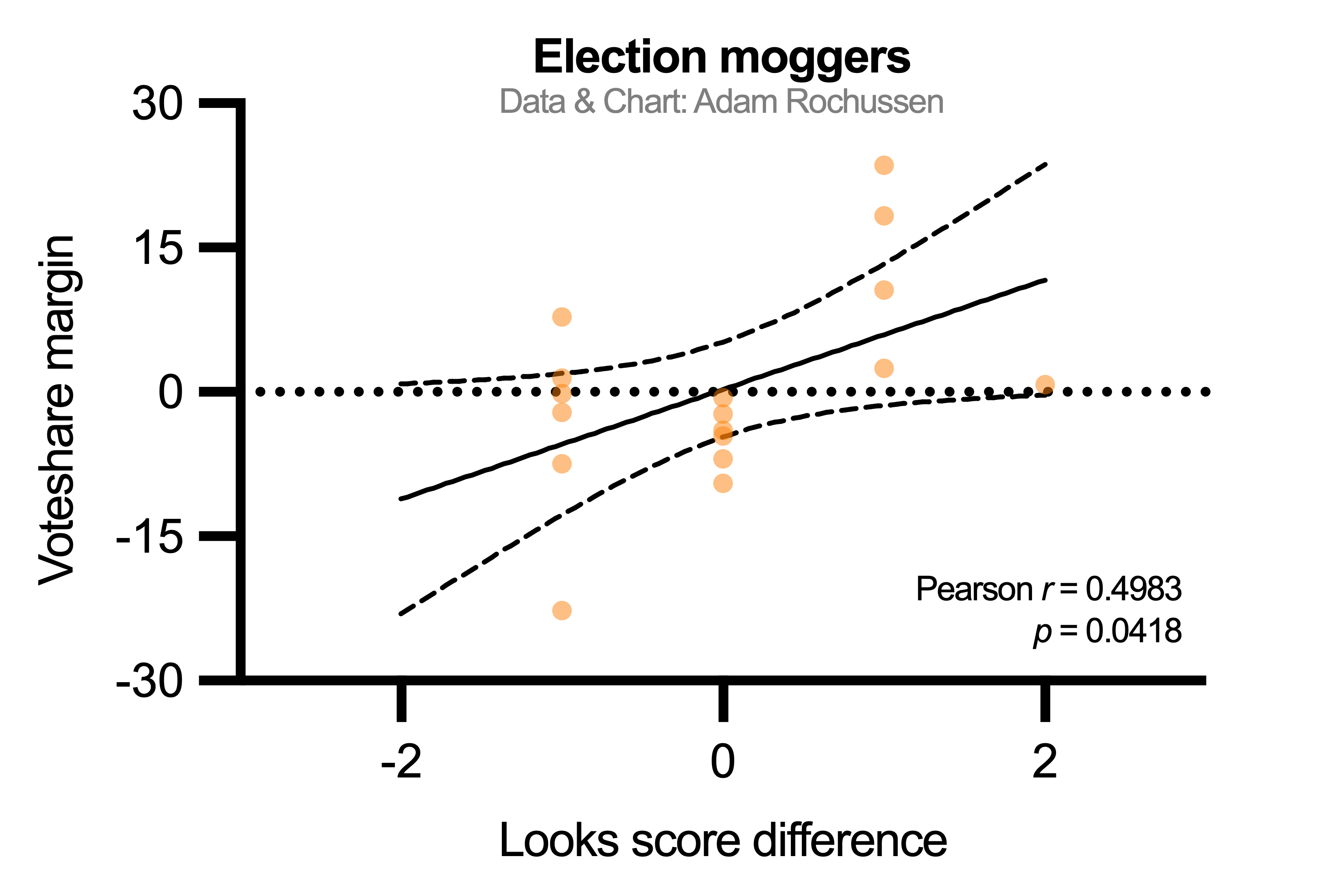
I want to ensure that readers are aware of the limitations of my Grok-based looks scoring. I can’t be sure Grok didn’t recognise the candidates and then be biased by the Halo effect, but I couldn’t find free, purpose-built AI tools that would rate facial “competency” over just attractiveness. Feel free to take my results with a pinch of salt in light of this. Human judgements would’ve been better but it’d be almost impossible to find people who don’t know who these candidates are (unlike the congressional races that Todorov et al. analysed). All the “significant” results here are also extremely marginal, and I probably should’ve applied a correction for multiple comparisons in the table above (which would made everything non-significant).
Caveats aside, it seems Clavicular may be the most perceptive political pundit of our time. And he’s voting Newsom if the election were today. But if looksmaxxing has taught us anything, it’s that our looks are malleable. And if Snapchat filters have taught us anything, it’s that perceptions of our looks are malleable.
Inverse catfishing
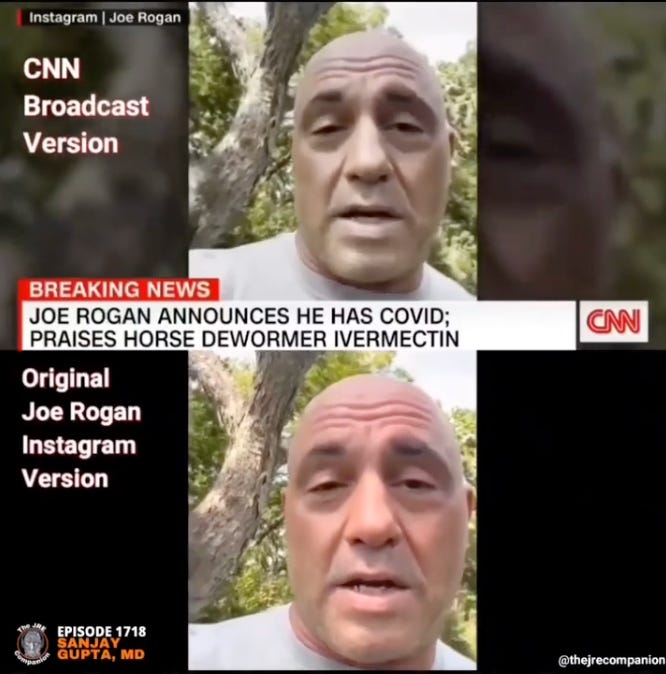
There are recent examples of trying to use the halo effect to discredit someone too. In 2021, Joe Rogan got COVID. His doctor and him concocted a “kitchen sink” solution for it, including the drug Ivermectin.4 It’s a very effective anti-parasitic drug that also has a strong antiviral track record in vitro and in mouse models, but which lacks strong evidence in human trials. CNN wanted to denounce this or perhaps their competitor Rogan in general, so they shared a heavily filtered version of his Instagram story in their reporting. Unfortunately for them, Rogan has a much larger audience than them and could simply expose their tactics.
A more recent example is that of Alex Pretti, the anti-ICE protestor who was killed during a scuffle with CBP agents. Hilariously, several media outlets used an AI-enhanced photo of him. The rationale is clear: ugly martyrs aren’t as effective as good-looking ones.5
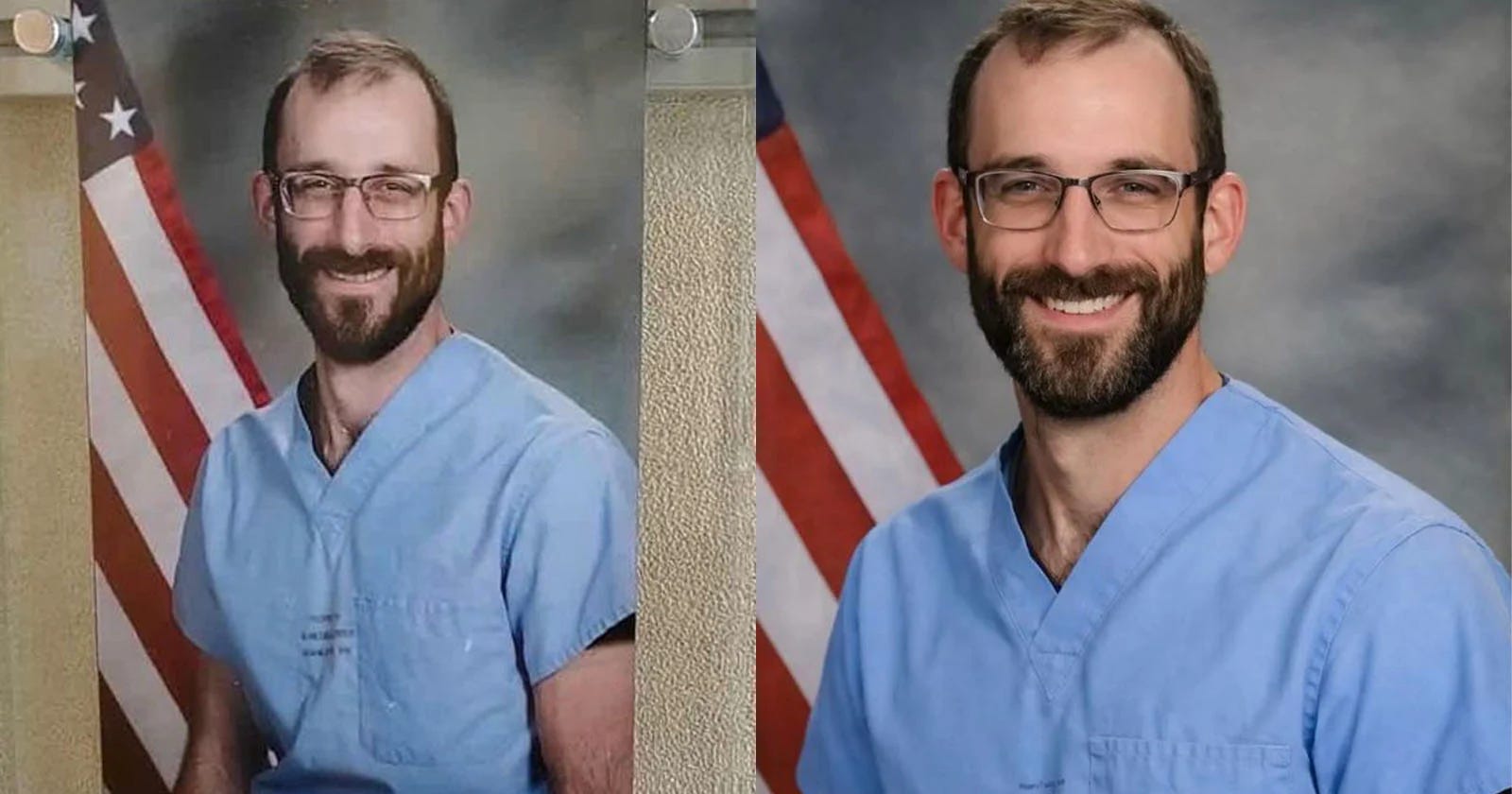
Interestingly, seeing the real version of both Rogan and Pretti after these failed attempts to warp the halo effect in a particular direction has exactly the opposite of the intended effect. Rogan looks, in reality, markedly healthy for someone with COVID in that video; while Pretti looks quite sickly and pasty compared to his AI-enhanced version.6
The effect is akin to when someone artificially enhances their online dating profile, known as “catfishing”. When they eventually show up to a real date, they get immediately exposed as a catfisher, and the gap between prior expectation and reality makes them seem even uglier to their date.
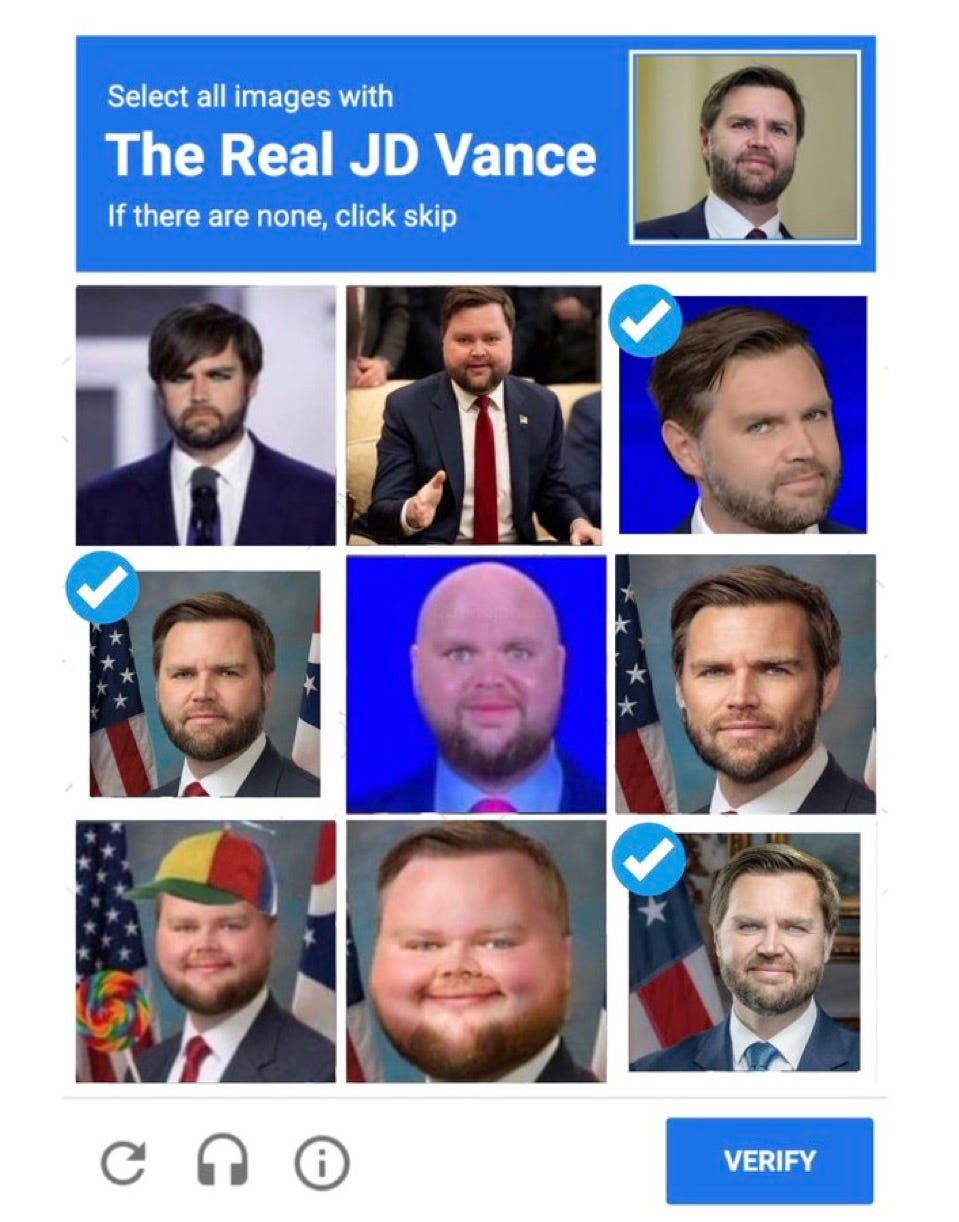
JD Vance seems to have been, cleverly, leveraging this inverse catfish effect recently. When he became the centre of insulting memes targeting his physical appearance, he laughed along and actually propagated the jokes himself. Not only does this demonstrate great humour and self-awareness, but also means that when people see his regular appearance, he looks comparatively better looking. Consider the meme below— he looks better in reality than most of the meme versions.
And then consider this chad-version of Vance compared to his real portrait—notice how bad he looks when put side-by-side with his AI-looksmaxxed self.
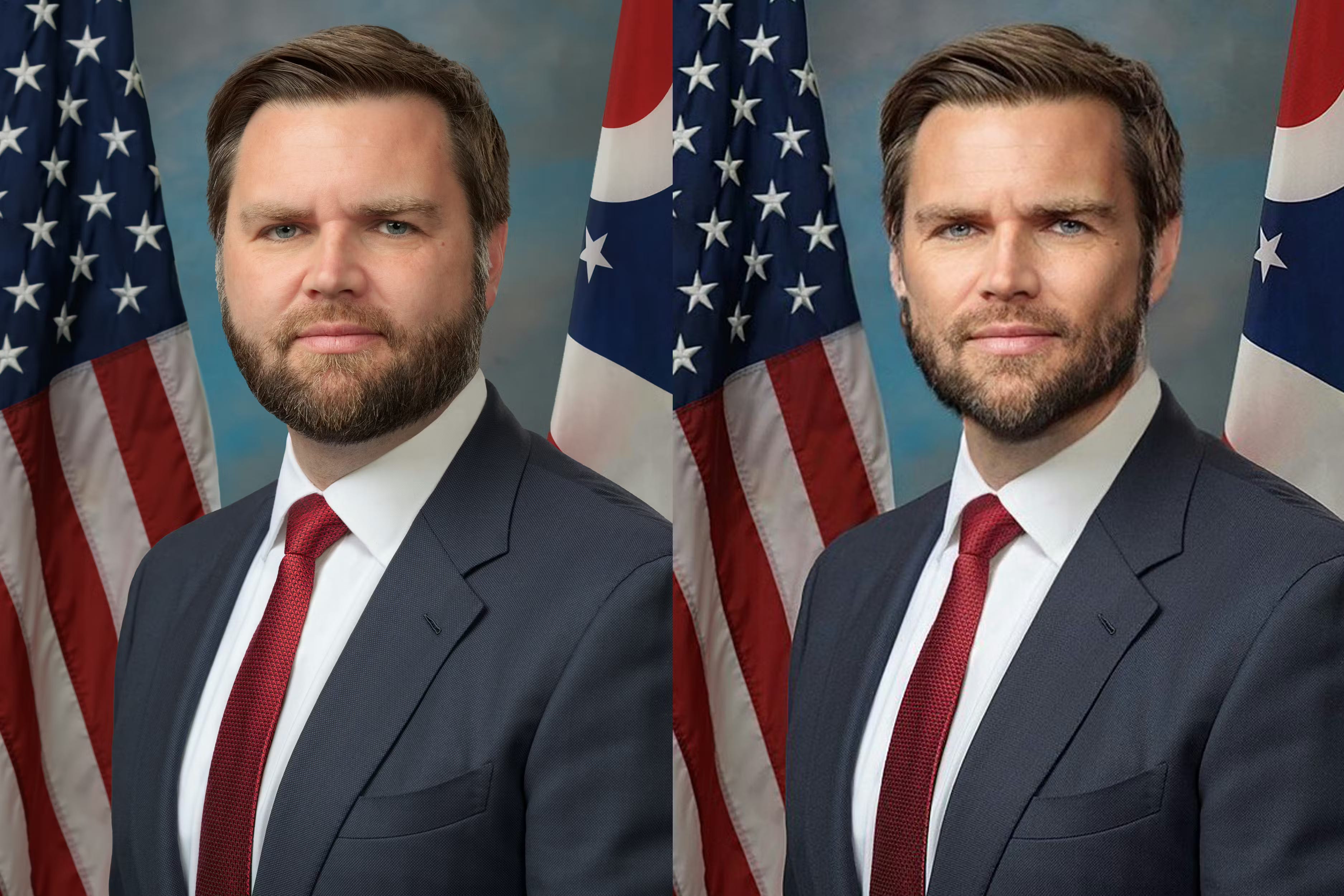
But memes aren’t that important for most of the voting public. His actual physical appearance on TV and at the eventual 2028 debates will be much more important. So how can he avoid being “mogged to death” by “6ft3 chad” Newsom?
Presidential looksmaxxing
To what extent can Vance actually improve his looks? Well the first thing to note is that altering the looks of a politician for political effect is nothing new. Back during WWII, the OSS hatched a plan to lace Hitler’s carrots with oestrogen to feminize him. The goal was to lower support for him as a leader by worsening his physical appearance. Yes, this is real. They really tried to make Hitler trans—before it was cool.
JD can do the opposite of this. At 41 years old, he can probably expect his natural testosterone production to decline over the coming years—especially given his cortisol-inducing job. A safe dose of testosterone replacement therapy wouldn’t be the worst idea for him to maintain muscle mass, boost cognitive energy, and promote leanness.
Indeed, becoming leaner is probably the best thing Vance can do, as this directly affects what one’s face looks like, and he seems to carry a lot of his fat in his face (me too, JD). If he struggles to get time to exercise or doesn’t have the willpower to control his eating habits, he should (seriously) consider going on a GLP-1 mimetic, especially with TrumpRx pricing.
I think Vance knows that he carries fat on his face, and that this is bad for his career as a politician: he uses his beard very well to hide the chubbiness of his face and neck, and he should continue to do this.
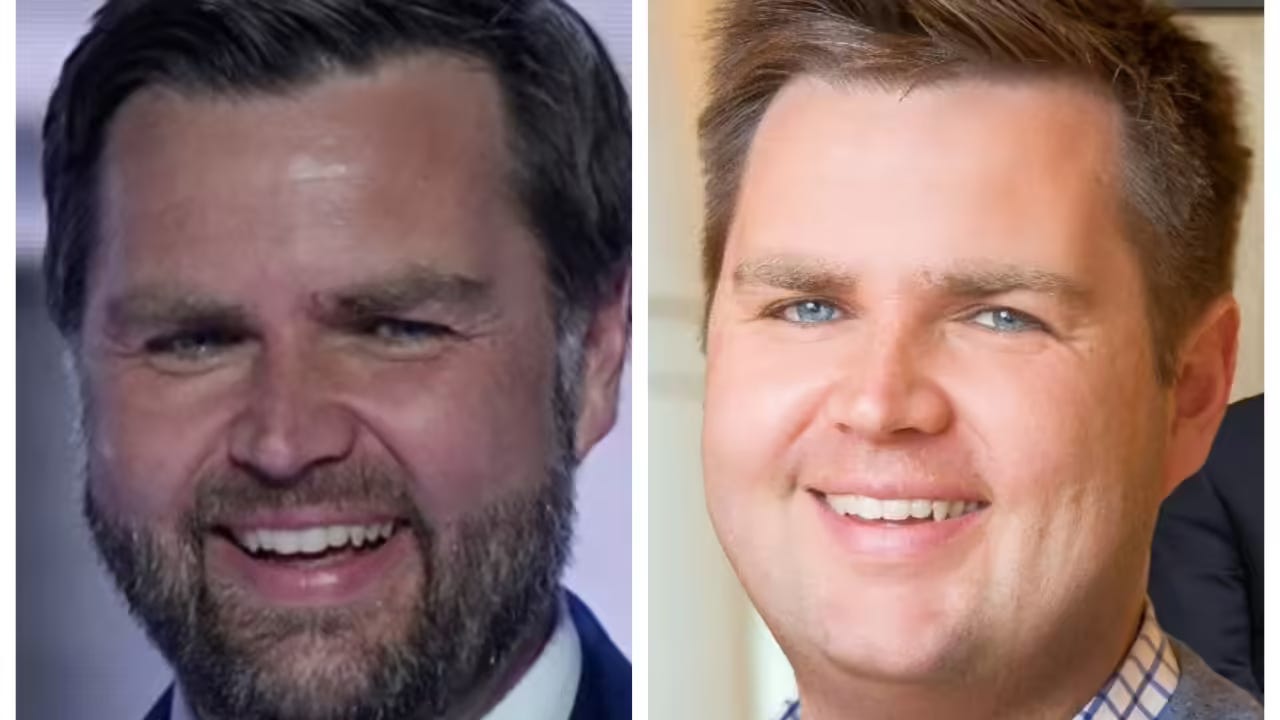
Vance also has age on his side. As 58-year-old Newsom’s forehead wrinkles set in, the mogging game is his to lose. The maintenance of Newsom’s hairline should be a top priority for Democrat PACs going forward.
Looks do matter enormously. Clavicular isn’t wrong. But they aren’t all that matter and certainly aren’t even the most important factor for things such as career prospects, wealth, fame, or even dating (outside of Tinder profiles, that is). That said, the halo effect of good looks in politics is clearly strong. As we see more of Newsom and Vance leading up to 2028, it will be interesting to see if and how their looks change. If I were our good friend Clav-“political soothsayer”-vicular, I’d probably stay away from Polymarket for now.
Newsom has revealed that his SAT score was 960. This equates to an IQ of 112. I’d estimate Vance’s IQ to be around 135.
In his Republic, he outlines how true leaders require τέχνη (expertise/knowledge/craft) that is distinct from the oratory skill of a sophist; but the sophist is better poised to persuade people and thereby be voted into power.
This is my complete prompt: “I’m going to upload portraits of people. I don’t want you to try and recognise who the images are of. I simply want you to analyse the faces on competency--based solely on the facial attributes. Give a score from 1-10 as if you were a human who had 1 second to glance at the face and then give a score of competency. I must stress, you must be blind to who the photos are actually of, so do not try to figure that out. I simply want a raw facial competency score. Can you do that for me?” and then uploaded images one by one. JPGs were saved with non-identifiable filenames in case. From my human judgement, the scores make sense (Obama = 8, Bush Jr = 7, Humphrey = 5). I’ll happily share the table with anyone who asks for it.
In addition to ivermectin, he took: anti-spike monoclonal antibodies (which directly neutralize SARS-CoV-2 virions), prednisone (an anti-inflammatory steroid), azithromycin (an antibiotic which doesn’t seem to do much for COVID but might prevent secondary bacterial infections), an NAD drip (which might boost cellular viral defence) and a vitamin drip (can’t hurt I suppose).
Of course, memes followed:
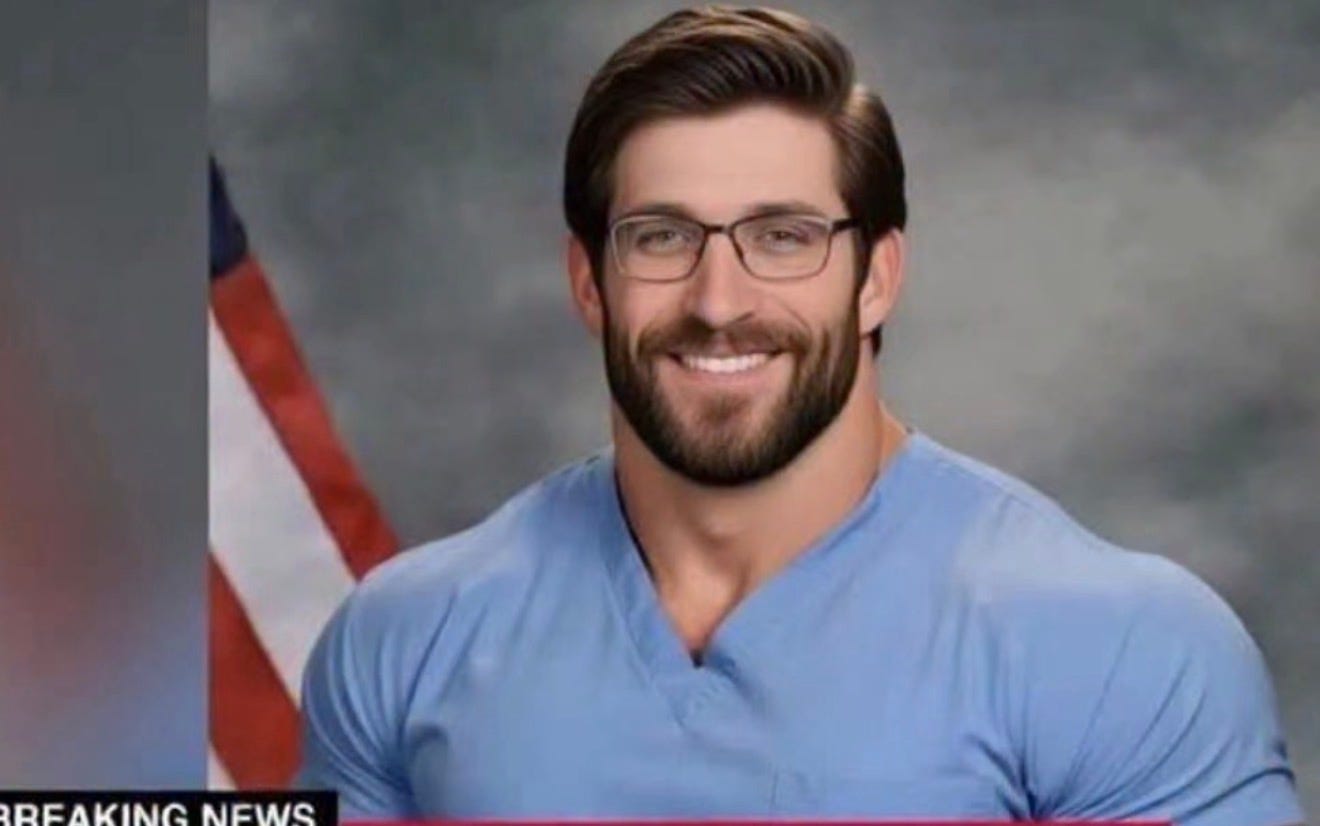
How did LBJ get elected? 😃
You do not know the meaning of the phrase “X’s to lose”