

Nathan Cofnas is the most famous postdoc in the world. For those who are unaware, he is a philosopher of biology with a particular interest in the evolution of cognitive traits. You might know of him due to his instrumental role in the unintentional dethroning of Jason Arday, though I can almost guarantee that your conception of him is a false one.1 Cofnas is not a racist in any meaningful sense of the word — his critics engineer his supposed racism via semantic revisionism. Cofnas is, however, seemingly ok with actual racism. This must be highlighted and refuted.
Race realism
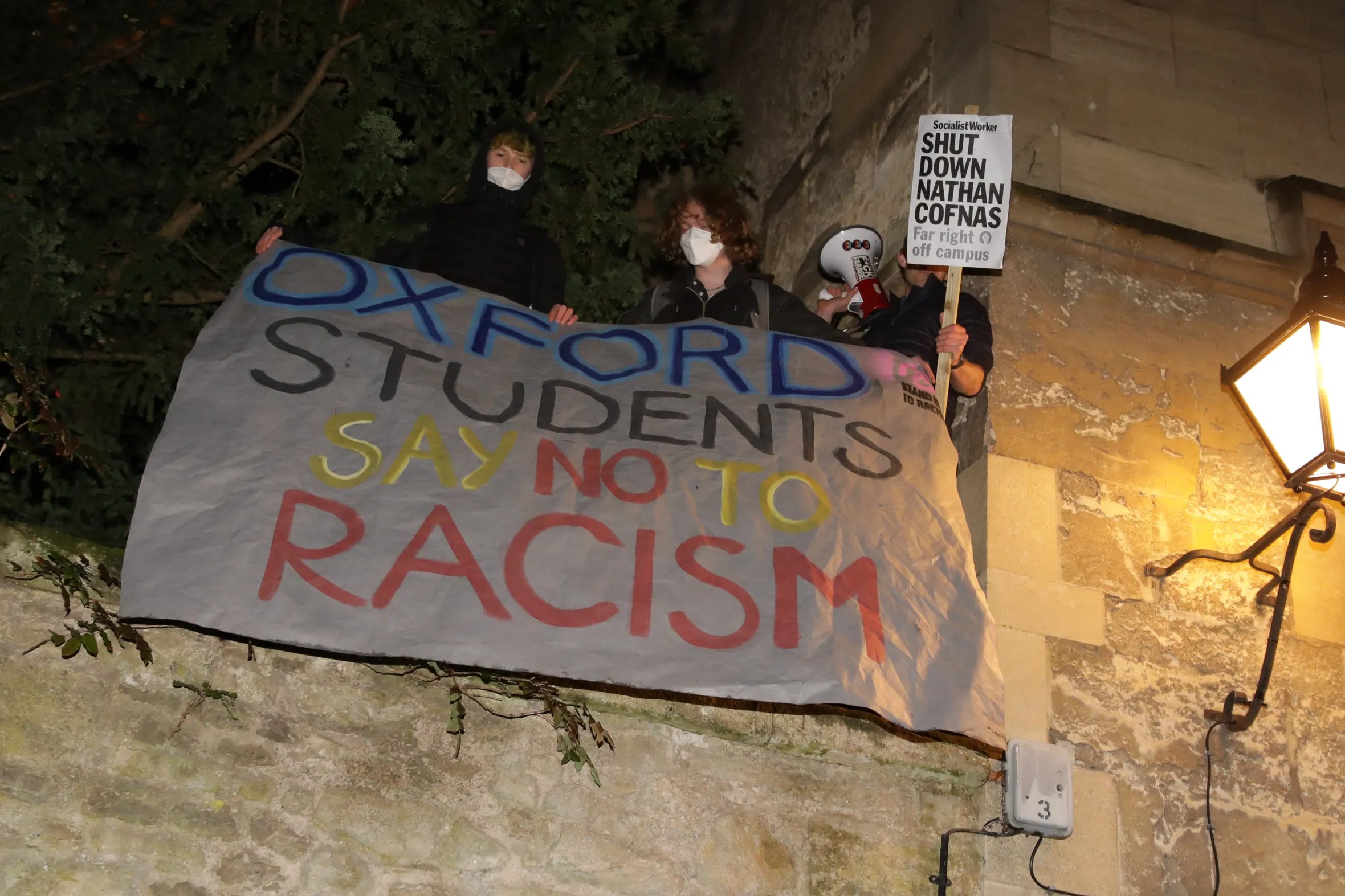
Last week, a swarm of Oxford students and unaffiliated activists, who primarily identify as good people, violently blockaded Oriel College, where Cofnas was due to speak. Their primary reason for doing so was because Cofnas, they say, is a racist, and they are supposedly opposed to racism. I think these protestors actually love racism, are morally wrong in their actions, and are incorrect in their rationale for accusing Cofnas of racism.
Most who accuse Cofnas of racism do so because he is a proponent of hereditarianism — the idea that human traits, including cognitive traits, are partly genetically heritable. What flows from this obviously true fact is the notion, which Cofnas is merely open to, that differences in the averages of cognitive traits between human racial groups, for which we have enormous amounts of reliable data, are partly due to genetic differences between racial groups, which we also know exist (obviously). Hereditarianism as applied to human biodiversity in this way is termed “race realism”.
This horrendously risqué position — of being open to a verboten empirical result — earns Cofnas the label of “racist”. Now, race realism has been the null hypothesis since the time of Aristotle at least, as I will explain in a future essay perhaps. However, for many who aren’t familiar with any of the research on this topic, the very mention of the idea causes palms to sweat, heart rate to rise, and one’s throat to constrict as the mind goes into overdrive trying to calculate the socially strategic reaction to make. This response is instinctive and highly reproducible, and I would argue that the reason for it is because of the “trivially true” status of hereditarianism.2 A desire to avoid this sweaty-palmed situation (being force into cognitive dissonance is intensely uncomfortable) is what motivates people who are primarily concerned with being perceived as a good person to call Cofnas a racist. Shut down the debate, and you can quickly shut down that uncomfortable feeling of having to pretend to believe something that is obviously false.
This desire to shut down the debate has, in recent years, led to a complete reinvention of the meaning of the word “racism”. The classical definition of racism is as follows:
a belief that race is the primary determinant of human traits and capacities and that racial differences produce an inherent superiority of a particular race
racial prejudice or discrimination
The first sense here is about a belief in an empirical claim (one that is false) combined with a normative claim that empirical differences engender some value hierarchy of racial groups. Deciding whether some phenotype is superior to another depends entirely on context, but cannot be grounds for being called a racist if the claim is actually empirical, not normative. For example, black people are objectively better at resisting ultraviolet radiation from the sun, and this is inherent to the racial group. A more precise definition of racism here would insist on a sense of moral or legal superiority. The second sense of the word (“racial prejudice or discrimination”) reflects more of a standard, commonsensical view of what it means to be a racist.
But some time in late 2020, Merriam-Webster changed their definition:
a belief that race is a fundamental determinant of human traits and capacities and that racial differences produce an inherent superiority of a particular race
and: behavior or attitudes that reflect and foster this belief : racial discrimination or prejudice
the systemic oppression of a racial group to the social, economic, and political advantage of another
and: a political or social system founded on racism and designed to execute its principles
Asides from the silly add-on about systemic oppression (this is an example of racism, not a definition of it — the final bit of “definition” #2 even includes the word “racism” in it), there are some other key changes. The sneakiest is going from, “… the primary determinant …”, to ,”… a fundamental determinant …”. This may seem minor, but it makes a world of difference! You see, race just is a fundamental determinant of human traits. Or, at least, the gene variants that produce racially diverse phenotypes are fundamental determinants of human traits. Skin colour is literally one of those traits. That’s just an empirical fact. Insisting that this is racist is totally anathema to reality, truth, and science.
All of this revisionism is a key strategy for opponents of Cofnas. By seizing semantic control, they can repurpose historically loaded labels towards increasingly undeserving targets. I reject this entirely. I have never read or heard Cofnas demonstrate any kind of racial prejudice, so he cannot be called a racist.
That said, if I learned anything from my participation in the short-lived Cambridge University Rugby club black-authors-only book club, it’s that it is not enough to be merely not racist. One must aspire to be anti-racist!3 Here, Cofnas falls short.
Real racism
In an interview with Winston Marshall back in August, Cofnas revealed that he isn’t particularly opposed to racism in the form of affirmative action, and that he considers ethnic representation to be an incontestably important societal goal:
“I think ... we might have to engage in some social engineering to prevent a complete decimation of certain group representation ... if people are simply not going to accept [disparities], then ... some kind of quota system may be necessary.”
Marshall pushed back, as he should have. Cofnas acknowledged that nobody cares that there aren’t many jews in the NBA, but he still insisted that maintaining a certain amount of black (for example) representation in academia (for example) is just going to be necessary, and that racist policies that hire or admit based on race rather than merit are the way to go:
“I would advocate under certain circumstances ... a quota system ... If it’s really important to have some level of representation ... then just say we’re going to have this X percent set aside for this group.”
Racial quotas are, in fact, racist. Quotas and affirmative action insist on a legal superiority of certain races over others — explicitly on the basis of race — and exacts prejudice against the disfavoured race(s) in whatever process the quotas are being applied to. It’s also a form of systemic oppression, so that additional “definition” of racism applies here too.

This kind of practice is simply incompatible with liberal values. We should be prioritising individual liberties and equality under the law rather than treating individuals on the basis of ethnic clades and trying to engineer group outcomes.
Now, I don’t think Cofnas is actually a fan of this kind of racism, unlike his critics, but he seems to think that this form of racism is inevitable and not worth fighting against.
Winning the hereditarian revolution
In 2023, Cofnas wrote an influential article called “A guide for the hereditarian revolution”. He wants hereditarianism to go mainstream. I think this would be good because I believe that hereditarianism is broadly true and the “equality thesis” is false — the idea that all humans are completely equal in innate ability and only environmental factors (including discrimination) can produce disparate outcomes between categories of people.
Cofnas agrees that the equality thesis has led to actual racial discrimination in the form of affirmative action and the preferential treatment of certain racial groups over others on the basis of their race.4
One motivating factor for a hereditarian revolution, therefore, is to extirpate this racism from our society and implement a colourblind meritocracy that upholds liberal values over the values of ethnocentric mafiosi. This is something that I could get behind! Sadly, this doesn’t seem to motivate Cofnas very much. He seems to care mainly about the epistemological victory and the widespread adoption of truth over falsehood. This is noble, but it leaves the negative societal consequences that have emerged following the adoption of the false equality thesis completely untouched.
Cofnas’ vision is one of losing the hereditarian revolution. The academic point about heritability of (cognitive) traits and racial differences might be accepted, but it’ll only be used to more deeply entrench race-communism into our society, per Cofnas’ vision. To win the hereditarian revolution, falsehoods about the genetic determinants of cognitive traits must obviously be abandoned, but the more important battle is to ensure the relegation of the notion of “racial representation” to the history books.
The good news is that this argument is already half-won. As Cofnas points out, there are many instances of groups not being represented in culturally lauded positions and members of those underrepresented groups just not caring. The last time a jew competed in the 100m final at the Olympics was in 1924. I suspect that the reason Cofnas doesn’t mind there being very little jewish representation in sports is because he personally doesn’t care for sports. What Cofnas does care about is academia and intellectual prestige. Thing is, this is a very jewish thing to value. It makes sense for people to like things that they are good at, and for ethnic groups to revere things that they, collectively, excel at. If you polled black Americans, you’d find they care much more about sportsmen than they do about Harvard faculty members. When Cofnas predicts civil unrest from a disproportionately white, jewish, and east asian professoriate, he exhibits a failure of a kind of ethnic theory of mind — he assumes blacks will care about the same things that jews care about. I don’t think this is naturally the case.5
Going forwards, winning conditions for the hereditarian revolution must be insisted upon. If groups of race-obsessed people want their group to be representation throughout society, then by all means they can go ahead and form an ethnostate. But if we’re going to live in multiethnic, liberal societies, then a colourblind meritocracy must be fervently promoted. Otherwise, the hereditarian revolution is simply not worth vying for. I hope Nathan considers becoming more anti-racist.
Many Cofnas opponents will presume that Cofnas was delighted in the downfall of Arday. This is false. His dethroning of Arday was “unintentional” because Cofnas has stated that he never wanted Arday to lose his job at all. Cofnas was happy for Arday to have kept his unearned professorship despite the detrimental effect this would have had on thousands of students forced to sit through faux-intellectual drivel and on aspiring young academics left despondent in the face of a brazenly anti-meritocratic academic career ladder. Arday-as-professor was a preferable outcome for Cofnas because Arday could then play a useful role in degrading the validity and prestige of institutes like Cambridge from the inside by exemplifying the worst of race-communism and academia’s disregard for liberal ideals. Perhaps due to personal history, Cofnas mainly cares about attacking Cambridge, not Arday. I find this view to be strange in a way that’s related to the strangeness of his vision for the hereditarian revolution, as I will explain.
Every man and their dog knows that personalities and intelligence are inherited. It is only through incorporation into polite society, via the conduit of academia, that we learn to unlearn this truth.
This book club was hilarious in hindsight. Post-Floyd, mid-lockdown Zoom calls where we’d all pretend to find the dumbest arguments extremely profound. The book club didn’t last long after one week’s meeting when the only black guy on the call and I both argued against racial quotas while the director of the club (who was an english literature fellow) argued for them.
By the way, even though this is unconstitutional in America and supposedly illegal in the UK, it still happens on a massive scale: many US colleges continue to engage in affirmative action and the British government seems to think part of its job is to find legal grey areas and loopholes that enable the practice.
Notwithstanding attempts by racially exogenous activist elites to persuade various minorities otherwise.
Cofnas is a racist. Racism is true.