

Last month I graduated from the University of Cambridge with my PhD. I flew back from the US, where I’ve started my postdoc, for the ceremony. It was a great weekend. A sunny April Saturday in Cambridge is pretty unbeatable by my assessment. I was graduating with my partner, who had earned her MPhil, and I got to spend valuable time with my parents and brothers, as well as see many friends again, all of which made it a very special and enjoyable occasion. Weirdly missing from the whole event was any sense of accomplishment and achievement. I felt distinctly nonchalant.
Getting the most elite degree from one of the most elite universities in the world should drive some sense of accomplishment, especially for someone raised to be an academic weapon from a young age (although I certainly wasn’t pushed as hard as some). It didn’t. No spark of pride at all really. Reflecting, I think I now know why: getting my PhD from Cambridge was one of the easiest things I have ever done, especially relative to how it is perceived.
This may sound ridiculous, or ridiculously arrogant, but let me clarify my point: I’m not trying to persuade you of my own intellect, I’m arguing that getting a PhD actually doesn’t require particularly high intellect nor does it require particularly hard work—objectively. Yet the societal perception of a PhD is that of a Herculean or even Sisyphean task (almost the opposite is true, as I will explain). There is an incentive for those with PhDs to overemphasise the difficulty of their achievement in order to amplify their perceived expertise and to propagate credentialism, from which they benefit. In reality, doing a PhD is an easy career move (if you can call it that), doesn’t particularly require conscientiousness, and certainly doesn’t make you smarter than the average person.
The easiest thing I’ve ever done
A caveat to what I am about tell you about my PhD, as a useful anecdote, is that PhD requirements (for both graduating and being admitted in the first place) differ by country, university, department, and even principle investigator (PI=the head of a lab who “supervises” you). This heterogeneity, though, is itself damaging to the prestige of a PhD, since you cannot guarantee that one PhD holder was held to the same standard as another.
So, what does one have to do to get a PhD? The hardest part is being admitted to a PhD programme. For a PhD in the life sciences from University of Cambridge, I had to do the following:
Get a 2i or higher at undergraduate level (for those unfamiliar with the British system, this means 60% or higher, with the percentages being normalised such that 60% of the class achieve this standard by definition)
Acquire funding and admittance for a PhD by either:
cold-emailing the head of a lab expressing interesting in a PhD and hoping they have money to fund you
applying to a PhD programme which comes with funding. The funding covers fees, a stipend, and maybe even some research costs. Very few PIs will refuse to take you on after you’ve been accepted to a programme, since the financial burden of a PhD student is the main drawback and admission to the programme is seen as enough of a hurdle that busy PIs don’t find it necessary to vet you further.
That’s it in terms of absolute requirements. Having research experience, a masters, and interviewing well all help of course. For me, the research experience and masters were baked into my undergrad programme (Natural Sciences with a “Part III” integrated masters in biochemistry). My pre-PhD degrees being from Cambridge also probably helped, since undergrad admission to Cambridge is genuinely tough and the Natural Sciences tripos is probably much more rigorous than most other STEM courses at other unis. My performance at undergrad wasn’t amazing though. In my final year (the only one that counts at Cambridge) I averaged 64% and ranked 20/27 in my department (this was my best year by the way—I spent second year partying and averaged 52.5%). In fact, if anything, I’d argue that my undergrad record indicated a distinct lack of hard work. Despite this, I was accepted to both PhDs that I applied to (one was directly to a PI, the other to a programme funded by the Wellcome Trust, which I ended up going with because it paid me more).
My experience here was seamless, despite being subpar (at least amongst Cambridge MSci grads). I gather that the US is much more competitive, with severe grade and CV inflation meaning years of research experience is an implicit pre-requisite pre-PhD. To that I would say that the US is probably more competitive across every realm (law firms, consultancy jobs, pharma/industry, tech jobs etc), so my arguments herein are valid relativistically. I also think that British secondary education and undergraduate education is superior to that in the US, meaning more must be done post-graduating to achieve the same level of expertise before beginning a PhD.
Having been admitted to the PhD programme, what did I have to do to actually get the degree?
I had to attain adequate termly reports from my supervisor
I had to complete a first year report with a viva voce examination
I had to present my work once in four years at an internal departmental seminar
I had to eventually write my thesis, which doesn’t have a minimum word requirement, and then be examined on it in another viva voce.
Perhaps the hardest parts of this are the thesis and viva (certainly this is what most complain about). In my case, I focused on journal articles instead (scientists might actually read these), meaning I put very little effort or emphasis into the thesis. I wrote it in two weeks, had one round of feedback from my supervisor, and then submitted it last autumn. I had the viva some months later, which was a ~3 hour discussion with an internal examiner (a faculty member who I knew well) and an external examiner (faculty from another university who my supervisor knew well). My thesis was almost embarrassingly small, so I was asked to do “minor corrections” to expand my introduction chapter and add a summary chapter, which I did in a week and resubmitted. That’s it. PhD achieved.
Tramlines
It is almost impossible to fail a PhD. The only time this can really happen is at the final viva exam. Yet, the incentive here is to pass the student. Corrections mean more work for the examiners, and failing a student (almost unheard of) is a huge reputational hit for the supervisor, which is why the supervisor is best off picking lenient examiners.
This isn’t just my hunch. An analysis of over 26,000 PhD candidates across 14 UK universities found that only 3.3% of students failed their viva exam, and only 3% of that 3.3% (less than 0.1% of the total) don’t get any degree, with 97% of the failures still being awarded an MPhil as what is effectively a consolation prize. By contrast, many more (16.2% of the intake) don’t get a PhD simply because they quit. Notably, these data are from between 2006 and 2017. I would confidently wager that the stats are even more egregious nowadays, with lower rates of failure at the viva and higher rates of drop out due to “mental health” (in line with general trends in higher education).
Contrary to the perception of the Sisyphean task promulgated by those who benefit from such a perception, doing a PhD is an anti-Sisyphean task—like rolling a boulder down a hill and trying not to get in your own way. You’d have to do something very weird to stop the boulder getting to the finish line.

If I wanted to, I could have done incredibly little work over four years and still got my PhD. Indeed, many do precisely this. I’m friends with many highly intelligent people who ended up not liking academia (there is a lot to dislike) and completely losing interest in science. Yet the work requirement is so low, the student lifestyle so easy, the job security so valuable, the UK income and council tax exemption so advantageous, the guaranteed CV boost at the end so tempting, that sticking it out is the best thing to do. I absolutely agree with the actions of these friends.
These incentives are actually really important to understanding the sort of person that gets a PhD. At best, a PhD candidate is motivated by a sheer love of science, truth, and knowledge. I’m sure there is a sliver of this in every PhD candidate. If we’re being honest, though, the less virtuous motivators I outlined above are probably more powerful. There is also the giddy delight at the thought of being called “Dr”—the seductive allure of credentialism, the power of which few will admit.
Doing a PhD is also a low agency option. In my case, I didn’t have to move cities, didn’t have to make new friends necessarily, didn’t have to shift my routine to fit that of a real job, and didn’t have to face the turbulence of the job market. For someone conditioned to revere academic success above all else, a PhD can represent the default option which doesn’t require much decision or introspection as to what you actually want from life. It’s much safer to stay on the tramlines even if you aren’t really controlling the direction of the tram. I speak here from experience. If I’m honest—which I am—one of the main reasons I did a PhD was because I thought a city job was for suckers, I wasn’t ready for a nine-to-five, and I wanted to play for the uni rugby team. It was an immature decision that I have since managed to mould into a good one retroactively.
You might be tempted to think that the enormous dropout rate (16.2%) of PhDs implies that they are difficult. Don’t get me wrong—making valuable contributions to one’s field can be difficult. Getting a PhD does not require such contributions though. I would argue that the high dropout rate is instead evidence for the selection for low-agency graduates among PhD applicants. For a PhD project to be successful (measured by actual scientific discovery, not degree completion), failures must be overcome. Science can be unpredictable and involve a degree of chance. Biology, in particular, is complex. Projects can be derailed by an unreliable method, an incorrect assumption or hypothesis, or even being scooped by a competitor. Solving problems and overcoming failures requires both creativity and agency. Lacking these attributes leads to quitting. Negative mental health, which I’m sure many dropouts cite as their reason, is a symptom of low agency.
The alternative
It is a sad fact of skewed incentives that the cream of the undergrad crop tend not to pursue PhDs. In my experience, the smartest undergrads go for the more competitive fields. Most of my undergrad friends who earned first class Cambridge degrees flocked straight to London. Excluding the medics, most work in the classic finance/law/consultancy arena, but also for tech startups and engineering companies. These pathways are much more competitive, much more financially rewarding, and much more difficult. They select for intelligent hard workers with high agency and a sturdier mettle.
To contextualise the 97% PhD viva pass rate, let’s compare it to a postgraduate qualification from the financial sector: the Chartered Financial Analyst (CFA) charter. Similar to a PhD, the CFA charter is acquired after 4-5 years post graduation from university. Applicants come from a similar academic stratum, being predominantly Russel Group graduates with a 2i or higher. The CFA Institute, which runs this global programme, recommends 300 hours of independent study as a minimum for each level, which there are three of. Of course, this is to be done on weekends and evenings whilst working a full-time city job, hence it taking many years—a minimum of 4000 hours of work experience is required to even enroll in the exams. Some firms who sponsor their graduate cohorts may offer some time off close to the exam itself, but many do not at all. What’s more, whereas failing a PhD normally results in you getting an MPhil instead, failing the CFA exam just leaves you thousands in debt. The pass rate? Around 45% for each level, meaning the overall pass rate for all three levels is less than 10%. That’s hard.
The only way to resolve such a vast discrepancy in pass rates is to claim that everyone doing a PhD is just outrageously smart and hard working (which the incentives don’t predict), or to conclude that PhDs are, in fact, easy. What’s more, the global standardisation of the CFA means that, unlike a PhD or even an MBA, the quality of charter holders can be guaranteed.
The lazy genius?
Since PhDs are quite easy, there is a chance they could select for lazy people (2019 Adam is a case in point). But what about actual intelligence? Maybe PhDs fit into the “brilliant but lazy” category.
This may well be true in some cases, but I prefer to draw conclusions based on data rather than anecdote. Studies on the IQ of PhD students or holders are few and far between, typically with small sample sizes. To set the benchmark, we can look at data from 1967 which looked at 148 faculty members from University of Cambridge across various departments. Accounting for the Flynn effect, the average IQ across disciplines was around 122 (±13.7). For context, the distribution of IQ, by definition, has a mean of 100 and a standard deviation of 15. This puts the 1967 faculty, on average, in the 93rd percentile of the general population. Similarly, a 2016 study of 38 PhD students and postdocs from University of Oxford found an average IQ of 125 (±6).
Don’t get me wrong, this is smart, but it is nothing to write home about, and certainly far below the perception. If we take a 125 IQ to be representative of all UK PhD holders (which it definitely isn’t), this places PhDs in the top 5% of IQs. Yet, according to an OECD report, only 2% of the UK population have PhDs. This means the perceived eliteness of a PhD is over twice as high as their actual intellectual eliteness.
Of course, 125 is likely much higher than the real average IQ of PhD holders. For one, the 2016 study is from Oxford, an elite university, likely selecting for smarter people. Secondly, the calibre of PhD graduates has likely dropped since 2016, as admissions have swelled and standards slipped. There isn’t longitudinal data at the PhD level, but a recent meta-analysis looking at the intelligence of university graduates versus the non-university educated found essentially no difference at all, with the mean IQ of university graduates being 102, which the authors describe as “merely average”. Thus, it wouldn’t surprise me if the real average IQ of PhD holders is something like 110.
Make PhDs hard again
So what? IQ is just one measure and it’s not even that important, you may protest. On IQ as a measure for intelligence, you would be wrong—IQ is the single best objective metric that correlates with intelligence. Complaints about the validity of IQ tend to involve politically motivated reasoning. The actual validity, reliability, and predictive power of IQ is unquestionable, despite disgruntlement from biological Marxists. On the importance of intelligence for a PhD, I can offer some wriggle room. Perhaps intelligence isn’t and shouldn’t be important to acquire a PhD. This is certainly the view of those who prioritise inclusivity over excellence. That’s fine, but then the societal reverence for PhDs must decline in concert. My primary objection is to the huge mismatch I see between perceived expertise and actual expertise; between credentialism and intellectualism.
That said, I would rather society did not accept the dumbing down of the PhD as this negates the very purpose of the PhD. We are currently facing an expertise crisis. The average person has been forced to “trust the experts” again and again, all the while the “experts” have been proven consistently wrong on issues ranging from COVID to global warming. Some propose a solution of ignoring the experts and allowing amateur voices to fill the void. I think a better longterm solution is to produce smarter and less ideologically captured experts in the first place. Experts who can debate amateur voices from first principles, rather than by leveraging their credentials. This requires the elevation of more competent experts who pursue critical thinking over ideology. Whilst this is probably best achieved by starting at the level of secondary, or even primary, education, it can be fixed at the level of the PhD by making PhDs actually worth something. PhDs must become more elite.
Some shudder at the suggestion that academia should become more elite. However, this stems from a conflation of intellectual elitism with social elitism. I’m not calling for a rebirth of the Victorian era aristocrat-scientist, who can pour unearned generational wealth into random experiments sewing rats together. I’m calling for academic excellence where it is needed. In fact, intellectual and social elitism are opposed to each other. Siphoning the best talent from only the richest or most socially pedestalized stratum of society is going to produce an inferior cohort of PhDs, versus enabling access to PhDs across financial strata and social class but enforcing stricter intellectual requirements at the point of application and completion.
Making PhDs hard again also has beneficial effects on the structure of science funding. Last year, I attended a panel discussion on “Improving the Structures of Science” at the MRC Laboratory of Molecular Biology in Cambridge. Something all panel speakers converged on was the fact that there seems to be a bottleneck of funding at the stage of scientific independence, that is, after one’s postdoc when trying to acquire funding to start a lab. A longitudinal cohort study of publishing records from over 350,000 scientists from 38 countries found that this is also one of the points at which most people leave academic science, either finding industry jobs or leaving science altogether.
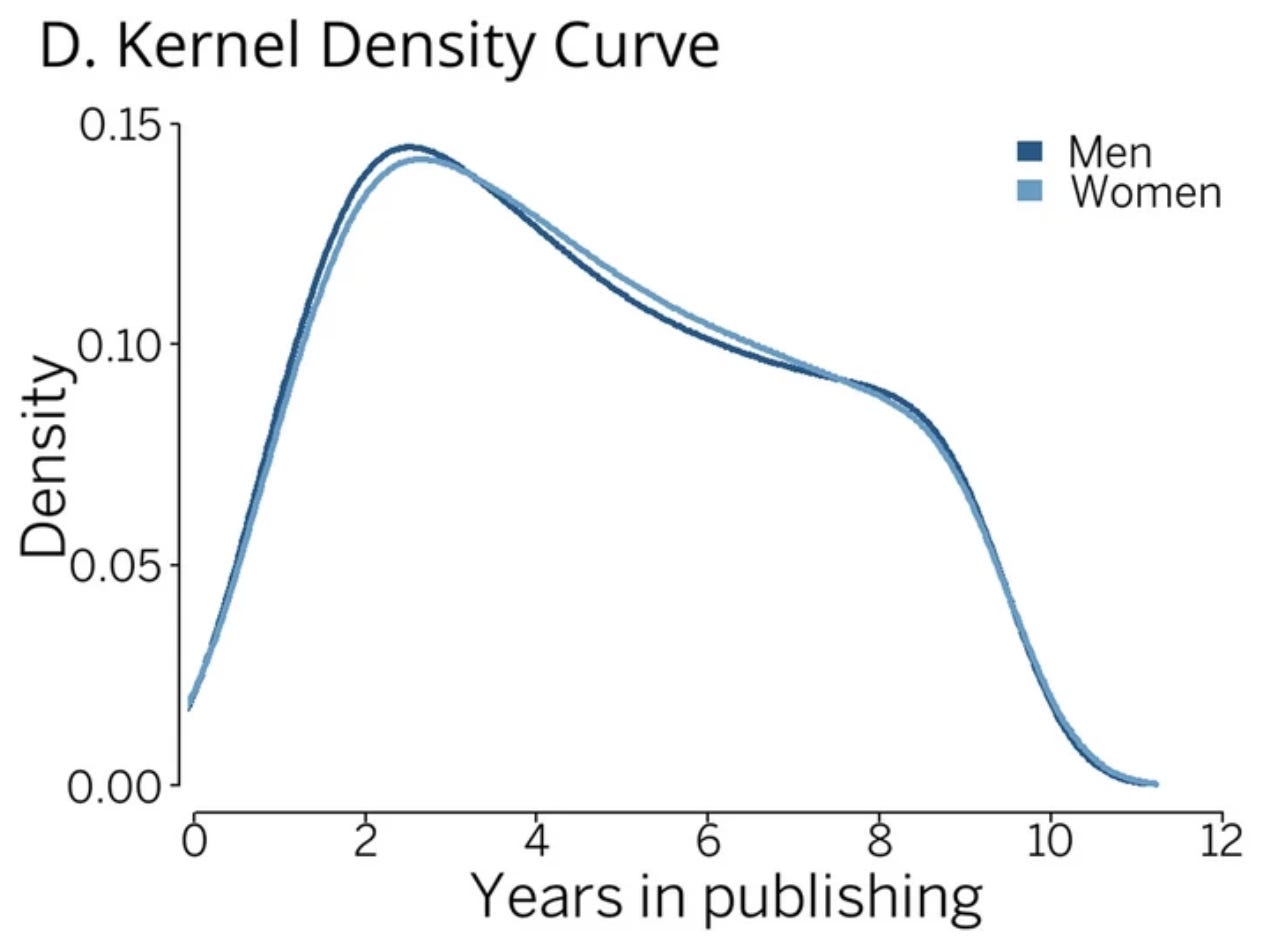
One of the panel members, himself an assistant professor, argued that the application process for early career grants is far too complicated and there isn’t enough funding to go around. This is true. The reason for the exodus is that it is very difficult to get funding after one’s postdoc. But there are two variables affecting this dynamic: the number of scientists applying for funding and the total funding available. Given that academic science is a privilege funded by the tax payer and philanthropy, I don’t think insisting on more funding is a viable solution. To the panel, I offered an alternative hypothesis: there are too many PhDs for the funding that is around. The issue is that there is far too much chaff and not enough wheat competing for limited funding. PhDs are too easy and too common. Some predictable pearl-clutching ensued, but one panel member, a key figure involved in Downing Street’s creation of the UK’s Advanced Research and Invention Agency (ARIA), came up to me afterwards to quietly admit that he completely agrees with what I had said.
Tougher entry into PhD programmes and then a tougher requirement for graduation would remove such ferocious competition and sharp exodus later in scientists’ careers by making the competitiveness of science more ubiquitous across career stages. It is a fact of life that funding for science cannot be infinite. Scientists must compete for finite resources to a certain degree. Making PhDs harder would make the rate of science attrition much more even over time, removing bottlenecks for funding. This is better for everyone. It would reduce wasted funding on PhD students who are unlikely to contribute value to their fields, and it would improve the lives of scientists who would now be less likely to have to change career path at the point in life when most want to start families and seek stability. A good place to start would be a standardised test as part of the PhD application (and no, these aren’t racist).
In defence of the PhD student
That PhD requirements are not challenging does not mean that any particular PhD project cannot be phenomenally difficult. My distinct lack of pride at my graduation or after my viva exam was perhaps compensated for by massive relief and swelling pride when I submitted my work in the form of journal articles to respectable academic journals (although this was and is muted excitement until they actually get published, God willing!).
Whilst PhDs are easy, science itself is actually really really hard. I recall torturous weeks clocking over 80 hours within the walls of my institute; experiments that never saw success despite dozens of attempts, each optimising from the previous; over 20 drafts of my first paper as I both honed my writing ability and jostled with my PI for command of the interpretation of my data; rejection after rejection for postdoc fellowships; constant fear that my discoveries were artefacts or would be scooped etc. And all of this was for some rather unimportant papers in the grand scheme of things. It is very difficult to push the boundaries of human knowledge in meaningful ways, and yet this should be the purpose of a PhD.
Many PhD students do contribute meaningfully to human knowledge, and the degree they receive at the end of it should reflect this achievement, rather than be a footnote—an annoying piece of admin—to the end of 4+ years of arduous research. It should never be the case that a PhD student binds their thesis prior to their viva exam because they are so confident in the triviality of the viva that they know they won’t have to get it rebound with corrections, as was the case for viral smell lady Ally Louks (she’s since quit research by the way, no doubt due to an inability to get funding).
I’m not entirely sure the best way to evaluate PhD students for completion of their degrees. Perhaps theses could be sent for open peer-review online—a democratisation of the viva exam. Perhaps PhD degrees should be withheld until a certain number of citations of one’s PhD work is attained. Perhaps institutions can be given a limited number of PhDs to award per year that is less in number than number of PhD students per cohort, and students can re-compete for their degree the following year if unsuccessful. Certainly preventing choice of favourable examiners with twisted conflicts of interest would be a good start. However we proceed, we must recognise that society can justly pooh-pooh credentialed experts if those credentials are in fact easy to get. Experts must be elite intellectuals. PhDs must be hard.
"This may sound ridiculous, or ridiculously arrogant, but let me clarify my point: I’m not trying to persuade you of my own intellect, I’m arguing that getting a PhD actually doesn’t require particularly high intellect nor does it require particularly hard work—objectively. Yet the societal perception of a PhD is that of a Herculean or even Sisyphean task (almost the opposite is true, as I will explain)."
Well, I'll give you points for honesty, it DOES sound ridiculous AND arrogant! I am not totally sure of your motives writing this, but I certainly hope it is either tongue-in-cheek, or deliberate rage-bait to go viral and grow your new Substack, because the most charitable thing I can say is your experience is very much *NOT* the norm of STEM PhDs in the United States, and from my professional circle, most of the world.
I am not sure how generalizable your quoted 16% drop-out rate is, because many studies suggest the attrition number in engineering, medicine, and the life sciences is closer to 40-50%. Perhaps half of all doctoral students, who already completed a bachelors +/- masters (a small minority of the population already) are just dummies? IMO, no, Occam's razor would suggest the most likely explanation is PhDs are difficult.
"Having been admitted to the PhD programme, what did I have to do to actually get the degree?
I had to attain adequate termly reports from my supervisor
I had to complete a first year report with a viva voce examination
I had to present my work once in four years at an internal departmental seminar
I had to eventually write my thesis, which doesn’t have a minimum word requirement, and then be examined on it in another viva voce."
If every PhD program was like that, I would agree it would be pretty easy. But that is not really the case! For my own PhD in molecular biology at a not-very-prestigious school in the southeastern US, I had to:
Complete 2 full years of additional courses in molecular biology, oncology and statistics (even though I already had another doctorate), some of which was quite rigorous in terms of not only the content, but also the tests and papers required (this was also in the pre-ChatGPT era)
Present my work *annually* at the school, and strongly encouraged at national conferences
Pass preliminary oral AND written exams by committee before beginning dissertation work (I agree that most people pass their prelims, but that is not the rate limiting step of PhDs anywhere, the tough part is the research)
Conduct novel research that would lead to at least two peer-reviewed publications (and ideally more)
I had to write and submit multiple extramural grants. The proposal did not have to be successfully funded, but submission was a requirement
Write up research results in a dissertation (mine was around 200 pages) and defend in front of committee
What makes a PhD difficult, and indeed more challenging than my STEM bachelor's or other doctorate in vetmed, is that nothing is guaranteed. You can end up in a nightmare project that implodes, and your PhD can be over. Some people can eke out a PhD with negative results; most can't. You can have a PI who never stops asking for more experiments, more papers, and other hoops, delaying you endlessly. You can run out of funding. Members of your committee can stonewall you for political or personal reasons (not the most common, but it happens). In contrast, pretty much every other degree out there (including med school!) follows a linear course, and if you check all the boxes and pass the tests, congrats, you get the diploma. Not the case for PhD.
If you want to make the case for more uniformity in graduate training, I'm all for it. But please, don't go shitting on thousands of people's careers just because you had a somewhat easier path. Thanks!
Great post! Agree generally but I think it's worth pointing out too aspects that don't carry over to the US (maybe also to other places but I wouldn't know).
1. The (relative) financial advantage of doing the PhD. Most people doing a PhD in the US (at least in STEM) could make >2x more working instead (>5x more if they went to a good undergrad) and there aren't really tax advantages. Plus, the resume boost is not very large AFAIK unless you're gunning for really specific jobs and those tend to be selective enough that they won't take you if you just scrape by during your PhD.
2. Not having to move cities for the PhD is very rare in the US. Some people stay in the same school but the vast majority go somewhere else and most schools are far away from each other.