

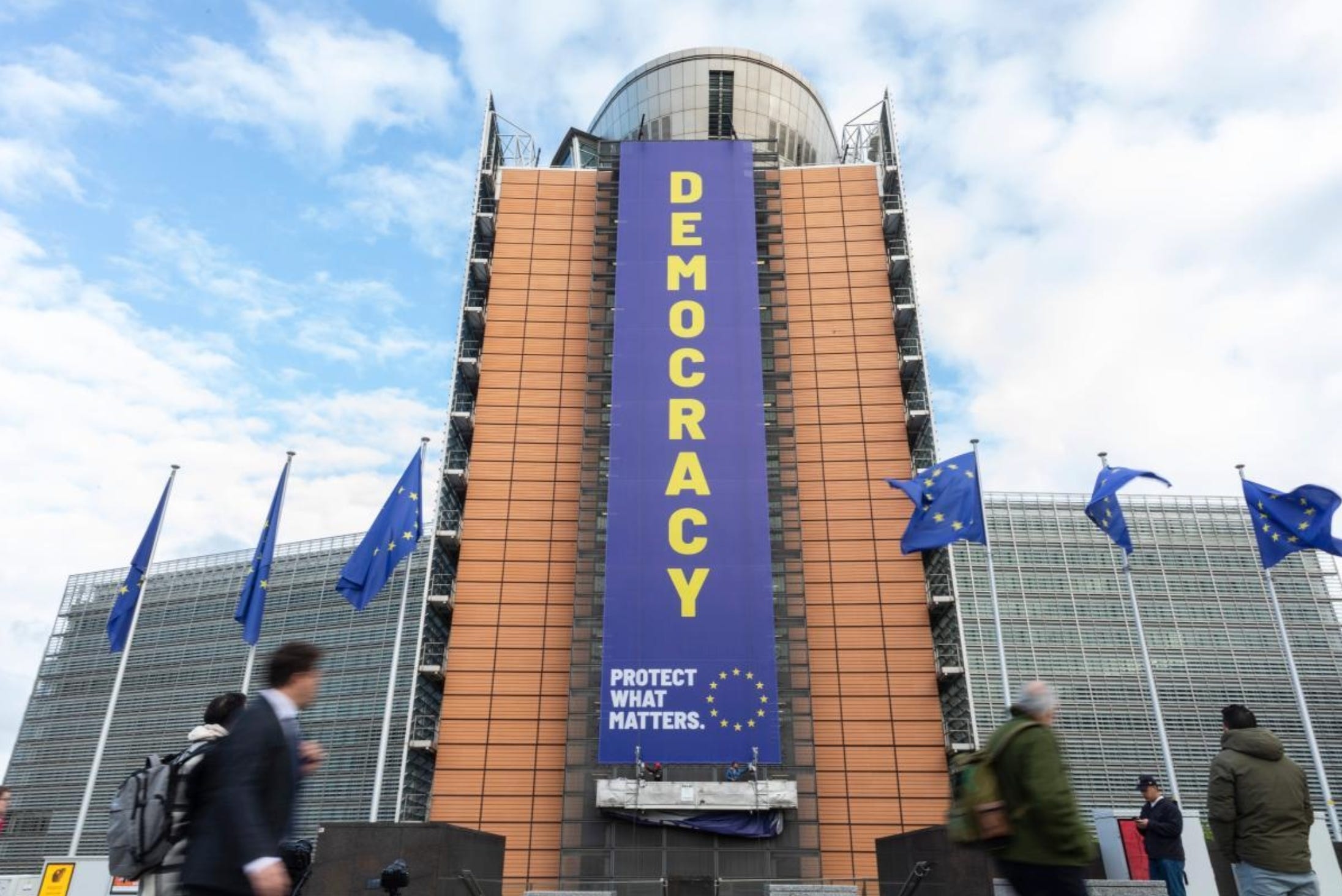
If you go to Brussels, the capital of Belgium and the European Union, you’ll stumble across a building with a huge, newly erected banner displaying the word “DEMOCRACY” in vertical lettering. Underneath is the imperative to “protect what matters”. This is Ursula von der Leyen’s subtle attempt to imply that the EU represents democracy and that this embodiment of democracy is what matters.
This appeal to democracy as an axiomatic good that is worth protecting is pervasive. Across the world, we have hundreds of political parties with the word “democratic” or derivatives thereof in their name. Germany alone has a “Christlich Demokratische Union”, a “Sozialdemokratische Partei Deutschlands”, and a “Freie Demokratische Partei”. The Korean peninsula has also bought into the democratic axiom, with the “Democratic People’s Republic of Korea” in the north and the “Democratic Party of Korea” ruling in the south.
In the US, we have the “Democratic Party” whose nominal north star is to defend democracy above all else. It’s not just the Democrats who play this game, though. Here in California, Republican gubernatorial candidate Chad Bianco has been trying to investigate election fraud supposedly to defend democracy. In response, Democratic judges and politicians have been blocking him from doing so—also supposedly to defend democracy. We’ve also seen dramatic gerrymandering shifts that we are told are essential to protect democracy—or at least one party’s version of democracy.
Democracy has become, in its modern manifestation, the ultimate thought-terminating cliché. Rarely do we see an elaboration of why democracy is good. It is simply taken as ground truth that democracy just is good. Why is “for democracy!” such a common and seemingly convincing argument? What even is democracy? Where did it come from? Is it deserving, in and of itself, of protection? These questions are worth exploring.
Athens, Socrates and the myth of mob rule

Δημοκρατία (rule by the people) was a revolutionary Athenian idea that emerged ~2500 years ago. Back then, things worked a little differently. Citizens saw political engagement as an essential duty of civic life. Politics was really a branch of philosophy. To be apolitical, as many profess to be nowadays, no doubt due to polarisation fatigue, was considered to be immoral. Instead of voting for representatives, the ancient Athenians used a lottery system, which randomly and mandatorily put a rotating selection of citizens in political office for a period.
This had several advantages. For one, the divide between politicians and citizens was non-existent. There was no such thing as a professional politician. For two, politicians weren’t constantly grovelling for votes by, say, giving more and more free government money to various bribable pockets of the populace.1 They were motivated to rule well, rather than to win elections. For three, the ancient Athenian system avoided elite capture, because power was constantly being randomly recirculated away from any one cabal. The main counter-argument against Athenian democracy is the claim that such a direct system results in mob rule, and that this is bad. Interesting! Sounds scary. But is it true?
Claims of mob rule usually centre around rare and misunderstood cases. The execution of Socrates is a prime example. We are told that Socrates was sentenced to death by a majority and that this is mob rule being bad because we know Socrates is a famous philosopher and probably a good guy or something. Not quite. Yes, history has been very kind to Socrates, mainly because history is written by the losers—in this case Socrates’ student Plato. In reality, Socrates was an anti-democratic (ergo, anti-Athenian) radical who intellectually contributed to and complied with the Thirty Tyrants regime—a Sparta-backed violent dictatorship that ruled Athens for eight months in 404 BC. That regime, led by several of Socrates’ ex-students, massacred thousands of Athenians without trial, confiscated private property to fund the Spartan army, and stripped citizenship from everyone who wasn’t loyal to the regime. Socrates’ association with the Thirty was objectively bad, and treasonous from the Athenian perspective.
Luckily for Socrates, after Athenian democracy was restored, an amnesty was passed to give immunity to anyone guilty of crimes during the tyranny. This meant that Socrates could not be charged with anything that he might have been legitimately guilty of leading up to and during the rule of the Thirty. The Athenians officially forgave him, but they did not forget what he had done to their city-state. As a result, the charges eventually raised against him were quite nebulous: impiety and corrupting the young. Had he not had amnesty, much more concrete charges would probably have been raised against him.
But him being sentenced to death for this seems a bit extreme, no? Isn’t that mob rule gone mad? Again—not quite. You see, Socrates wanted to be executed. The decision over sentencing in ancient Athens was, as you might expect, subject to democratic debate. Typically, the prosecution suggested one punishment and the defence another, and then 500 randomly selected jurors decided what was appropriate. In Socrates’ case, there was no middle-ground punishment to be agreed upon because, while the prosecution called for death penalty, Socrates asked to be given the treatment of a victorious Olympic athlete (free meals at the Prytaneum). Obviously this mockery resulted in the jury showing him little mercy.
Further corroborating Socrates’ desire for his own execution is the fact that, after his friends had bribed the guards while he was on death row, he refused the opportunity to simply escape. He chose, instead, to stay and be executed. On his death bed, Socrates turned to his disciple Crito and said, “I owe a cock to Asclepius; will you remember to pay the debt?”, implying that he is grateful for having been given the hemlock poison that killed him. Ultimately, Socrates committed suicide by jury. As is true for any martyr, he knew that the power of victimhood would help to purify and solidify his legacy.
On balance, Socrates’ execution was justified. This was not an example of mob rule gone mad, but of real democracy protecting itself against radical traitors.
This is but one example, but technocratic critics will often cry “mob rule” as a general problem caused by giving political power to citizens. Yet, if the mob comprises highly intelligent and virtuous citizens with skin in the game and shared cultural values, then such mob rule is preferable to professional political rule where politicians buy votes and the elites play status games with political views substituted as fashion. Mob rule is only bad for the 49% when the 51% hold very different views and priorities to them, as seems to be increasingly the case in modern Western democracies but was not the case in ancient Athens. In a place like ancient Athens, “mob rule” was democracy, and it was good.
We don’t have real democracy
Athenian democracy was a resounding success. It lasted almost 200 years and was only eventually brought to an end because the Athenians lost an opportunistic war against the Macedonians in the wake of the death of Alexander the Great in 322 BC. Crucially, despite constant warring, it never broke down for any internal reasons and its participants were advocates for democracy until the end. The Athenians certainly believed in protecting democracy, and many of them died doing so.
I would actually take Ursula von der Leyen’s advice and protect Athenian democracy too. But today’s democracy is so far removed from the Athenian system that the only thing tying the two systems together is the name. Before you accuse me of being a radical, I am far from alone here: half of young Brits say they would never fight to defend their country and 77% of young Americans are physically ineligible for military service due to mental or physical health, recreational drug use, and/or being too fat. Clearly, most people don’t really believe in protecting modern “democracy” either.
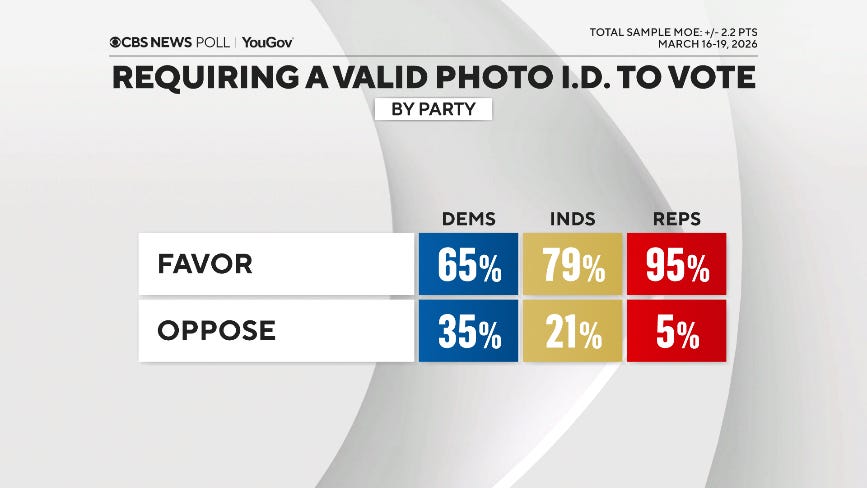
Politicians, too, don’t really believe it. As I’ve already described, opposing parties often use the same apparent motivation (“protecting democracy”) to support their diametrically opposed policies. The issue of voter ID in the US is a classic example of this. There is overwhelming support for making it a requirement to show photo ID in order to vote among Democratic (65%), independent (79%), and Republican (95%) voters. Republican politicians are desperately trying to pass a bill (the SAVE Act) that would make this a legal requirement across all states, citing the need to protect our democracy by safeguarding elections. Democratic politicians, on the other hand, are vehemently against this proposed bill—also citing the need to protect democracy as their reason, because apparently legitimate voters might not have a photo ID and therefore could be disenfranchised by this policy.
Politicians in modern democracies completely contravening the will of the people is rather common actually. Take the Brexit referendum of 2016 in the UK. A majority of the people, motivated primarily by a desire to curb rising immigration and to reduce the control that Brussels exerts over UK law, voted to leave the EU. The technocrats who run the “democracy”2, though, simply couldn’t bring themselves to give the δημος any actual κρατος. The Conservative party dragged their heels, completely lost sight of what the referendum was actually about, took almost four years to actually leave the EU, remained a part of the European Convention on Human Rights, and then ramped up non-European immigration substantially in the subsequent years (the infamous “Boriswave”).
Back in 2016, Brits believed in democracy more strongly. The referendum saw an impressive 72.2% turnout. As a freshly enfranchised 18-year-old, I was among the slim minority who voted “remain” at the time. Despite me disagreeing with the majority, the unwillingness of our politicians and civil service to enact the will of the majority in this case has only degraded my faith and that of many others in British democracy. In 2016, 17,410,742 people voted for Brexit from a pool of 46,500,001 registered voters. Contrast this with the 2024 UK general election, where the turnout was a measly 59.7%, and the decline in civic engagement and faith becomes obvious. In 2024, Keir Starmer’s Labour Party won only 9,708,716 votes from a pool of 48,224,212 registered voters. And yet, with this 20% of the total possible votes, Labour have enjoyed much more executive power than Donald Trump has over in the states!3
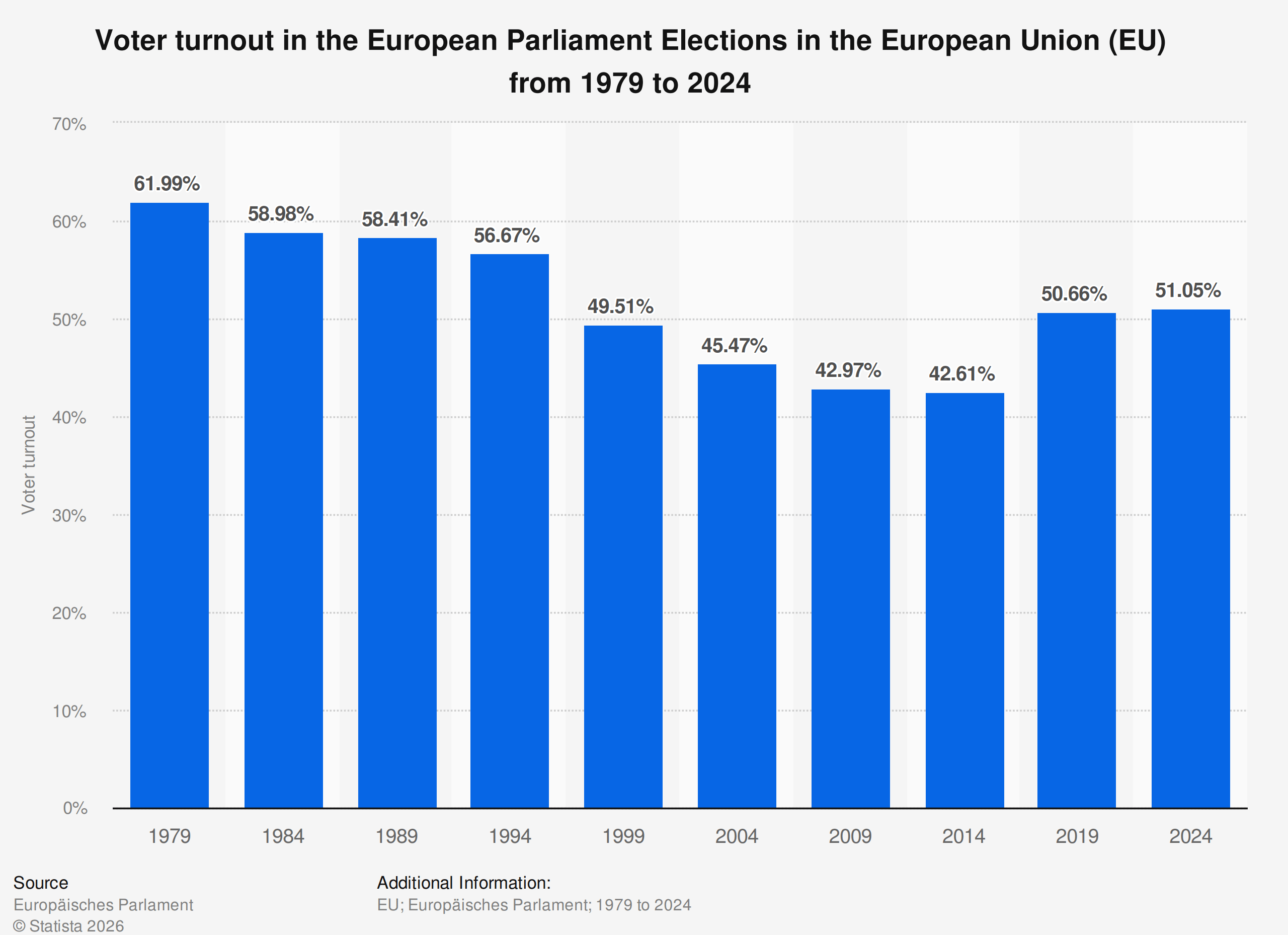
The same pattern emerges across many modern democracies. Even the mighty EU, democracy incarnate, has seen voter turnout in its elections steadily declining since 1979 (except for the upwards bump after Brexit).
Perhaps people aren’t bothering to vote because they are slowly beginning to realise that voting isn’t actually the point of democracy. Progressive movements like women’s suffrage and the civil rights movement in the US have always centred on the universal right to vote as being the ultimate end goal. This isn’t how democracy was first embodied by the Athenians at all, though. Lest we forget, there were no votes for politicians in ancient Athens. Rule by the people actually meant that the people did the ruling: Thousands of citizens would gather on the Pynx hill, discuss motions, and pass them via a simple show of hands. The “voting” here came with the debate. If you weren’t present for the discussions and speeches, you didn’t get to vote.
We are so far removed from the Athenian ideal today that we have completely lost sight of this notion of active civic engagement (beyond marking a ballot every few years). Instead of actual democracy, we now have unpopular institutions that wear democracy as a skin suit and fill their halls with professional politicians who nobody voted for. Citizens instead partake in political voyeurism—we feel like we are a part of the debate because we watch clickbait arguments on YouTube and laugh at clips of the least charitable renditions of our ideological opponents’ views, or we read cynical, smug op-eds in our favourite “we-are-the-good-guys” news outlet. We feel part of a political tribe, but those actually running the tribe care not for us beyond their desire to secure our votes. I think people are beginning to peer through this mirage of democracy. I think there are only so many more contraventions of the will of the people by ideologically foreign technocrats that will be tolerated.
Helvetian hellenism
You can probably tell by now that I seem to be pretty fond of Athenian democracy. But we can’t have that in the modern world! That’s fantasy! Well, maybe.
Switzerland gets pretty close, actually. Yes, the Swiss have a representative parliament like many other modern democracies, but they also retain many Athenian mechanisms, including mandatory and optional referenda. Federalism assists with the scaling issue, and some of the Swiss cantons even retain Pynx-style open-air assemblies with votes via show of hands (which they call Landsgemeinden). It will be interesting to see the outcome of the upcoming Swiss referendum to cap immigration if the population exceeds 10 million (which some pundits have strategically branded the “Swiss Brexit”—even though Switzerland isn’t in the EU). Switzerland recently voted against an inheritance tax on the ultra-wealthy, so direct democracy devolving into a populism that serves the short-term shallow desires of the majority can hardly be claimed in this case.
While Switzerland seems to enjoy a more Athenian influence on its version of democracy, I’m not sure that it is generalisable across the west. I have already referred to the “mob” of Athenians being “highly intelligent and virtuous citizens with skin in the game and shared cultural values”. Indeed, it has been conjectured that ancient Athenians had IQs around a standard deviation higher than modern day Greeks (although polygenic scoring of ancient Greeks does not support this more broadly outside of Athens). I suspect that this is key for a more direct democracy to work well: The Swiss enjoy a very high GDP per capita (~13% higher than that of the US and ~55% higher than that of the UK, adjusted for purchasing power); a very strong national identity, despite a relatively diverse ethnolinguistic makeup (mainly a mix of European ethnicities and languages, to be fair); and strong civic education combined with a decent national IQ. In these regards, Switzerland shares many of the democracy-enabling characteristics of ancient Athens.
One thing missing from the Swiss model is the random lottery of political leaders that Athens employed. Clearly, the main worry regarding a modern implementation of this is maintaining high competency (as if we don’t have this problem in our current systems …). We don’t have a good example for sortition being implemented in the modern era, but a strong, pragmatic case for sortition has been made by others elsewhere.
Ends, not means
When people get cagey about giving too much power to the people, they reveal that it is not democracy that is worth defending, but their preferred values. Technocrats only fear populism when populist ideas are bad (this has almost become tautologous these days). The elephant in the room here is that democracy is only useful as long as the δημος have good values and ideas. Clearly, then, it is the values and ideas that are actually worth protecting and defending, not the political process of democracy. Historically, the process of democracy has been a good way of empowering good values, but as modern democracy has spread and mutated, this is decreasingly the case.
This is true insofar as the label “democracy” is erroneously used to describe very undemocratic regimes (you can think of Russia or North Korea—a cynical Athenian hardliner like myself might also think of the UK and the US!). But it is also true when genuine democracy does not arrive at the values that we generally think are good.
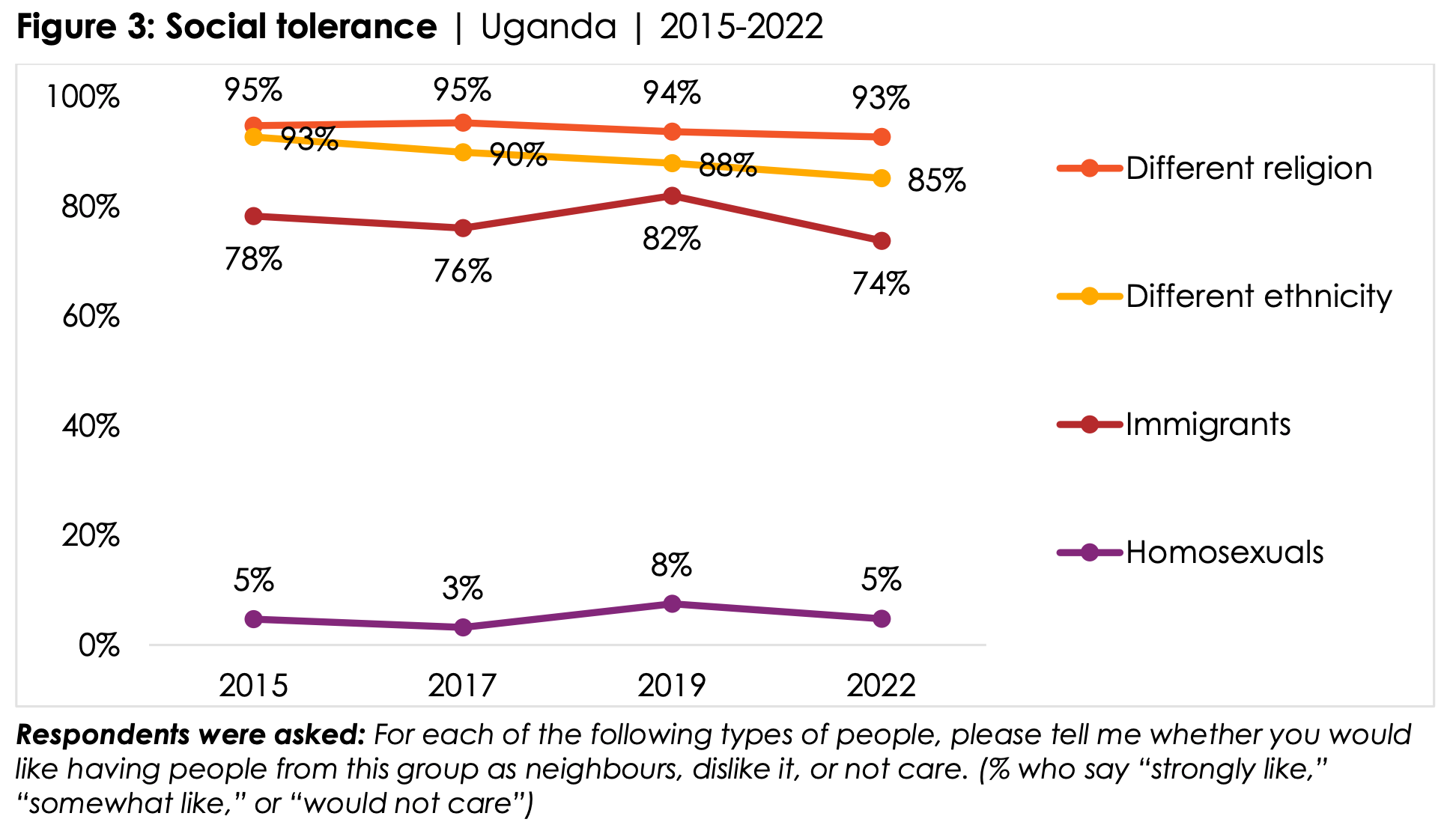
Take Uganda, an ostensibly democratic country. In 2023, its parliament passed the Anti-Homosexuality Act with 389 votes for and only 2 against. Critics can complain about executive influence on the parliament and general authoritarianism and corruption, but this particular law cannot be ascribed to these perversions of democracy. It was and is extremely popular among regular Ugandans: 97% of Ugandans agree that homosexuality should be illegal, according to polling by Afrobarometer. Further, this isn’t generic bigotry—Ugandans seems quite tolerant of other religions, ethnicities, and nationalities. They just really don’t like homosexuality in particular. It also doesn’t seem to be changing over time despite the globalisation of socio-political discussions via the internet and social media and extreme pressure from western NGOs.
The obvious but difficult truth to confront here is that the process of democracy, when given to a population with somewhat illiberal values, does not arrive at liberalness. Indeed, western professional politicians and elites only favour democracy when the people they rule over have the same views as them. This fundamentally undemocratic perspective was beautifully exposed when Winston Marshall challenged Nancy Pelosi at the Oxford Union in 2024. Pelosi could have won that debate if she didn’t lie about her obvious disdain for democracy and instead redefined the motion by pivoting to defending liberal values. Democratically elected politicians should advocate for ideals and values, à la liberal constitutionalism, not merely for the democratic process by which they have acquired power personally.
The case of Uganda (there are many others, too) highlights that “liberal” and “democracy” do not always go hand in hand. In our western liberal democracies, we should realise that the tool of democracy is only valuable insofar as it defends liberal values. We know that this is true because conflicts between liberty and democracy are how we have justified our modern departure from real democracy. The Founding Fathers of the United States, for example, heavily favoured liberty over democracy when they constructed their republic, yet rarely do we see an appreciate for this yin and yang in our current political discourse. Athens did well with its pure form of democracy because its citizenry were abnormally virtuous, educated, and civically minded. Either we aspire to create polities with a similarly constituted populace, or we undemocratically favour liberal values over democratic values when they come into conflict. Overwhelmingly, the west has favoured the latter, so we should stop pretending otherwise.
Increasingly, it is considered to be an axiomatic truth that democracy is the ultimate end goal of societal progress. I posit that democracy is merely a means to an ends. The ends that actually are worth protecting are things that are not just a process, as democracy is, but an inherently valuable ideal. These desiderata include life, individual liberty, virtue, truth, justice, excellence, opportunity, hope, prosperity, beauty, human flourishing.
Next time a politician engages is hollow sloganism and uses “defending democracy” as a cudgel with which to hack into your brainstem and engineer a vote for them, consider how shallow and hypocritical their argument really is. We must defend values and ideals, not a process that may or may not achieve those values and ideals.
I find it funny how lots of pro-democracy advocates demand we remove money and special interests out of politics. Yes, there is a tremendous amount of bribery involved in modern democracy, but it is bribery of the voting populace by economically illiterate and vote-hungry politicians. Consider the comparative magnitudes of social spending by government versus lobbying of government.
Yes I know the UK is nominally a constitutional monarchy. It very much brands itself and acts as a representative democracy though, which is essentially seen as “the best form of democracy” nowadays.
The executive and legislative branches are merged in the UK, so it is very easy for the ruling party to simply pass new laws.
Thought provoking post, with elections next year 2027 I was wondering why I don't have the urgency to register as a voter despite seeing what happened during 'Gen Z' protests . I think I saw some errors I don't understand such as >though, simply couldn’t bring themselves to give the δημος any actual κρατος.