

Speaking to a large crowd of University of Alabama graduands at his recent commencement speech, Donald Trump recounts a story about a transgender male beating a women’s weightlifting record. He asks the crowd if he should act out the scene:
Should I imitate it? You know my wife gets very upset when I do this. She says, “Darling it’s not presidential”. I say, “Yeah but people like it!”. Should I do it or not?
The crowd cheers “Do it!” and he obliges. In another life, Trump is a wildly successful standup comic.
Since then he posted an AI-generated image of himself as the pope on his personal social media account, which the White House then reposted.

Yes, Trump doesn’t care about being presidential, he cares about being liked. But he is not the only one. Senator John Fetterman dresses like a total slob. It’s not Senatorial, but it draws attention and some people like it. The airline Ryanair posts childish TikToks with bleeped out f-bombs. It’s not professional, but people like it. The Trump White House publicises some of its most bipartisanly laudable accomplishments with a total lack of seriousness. It’s improper, but the other side get rage-baited and people like it. Australian political parties are posting some very strange stuff indeed on social media. It’s not normal, but some people probably like it. Elon Musk plucked the goal of cutting two trillion dollars from the federal budget out of thin air. It’s not realistic and wasn’t the plan, but the crowd loved it.
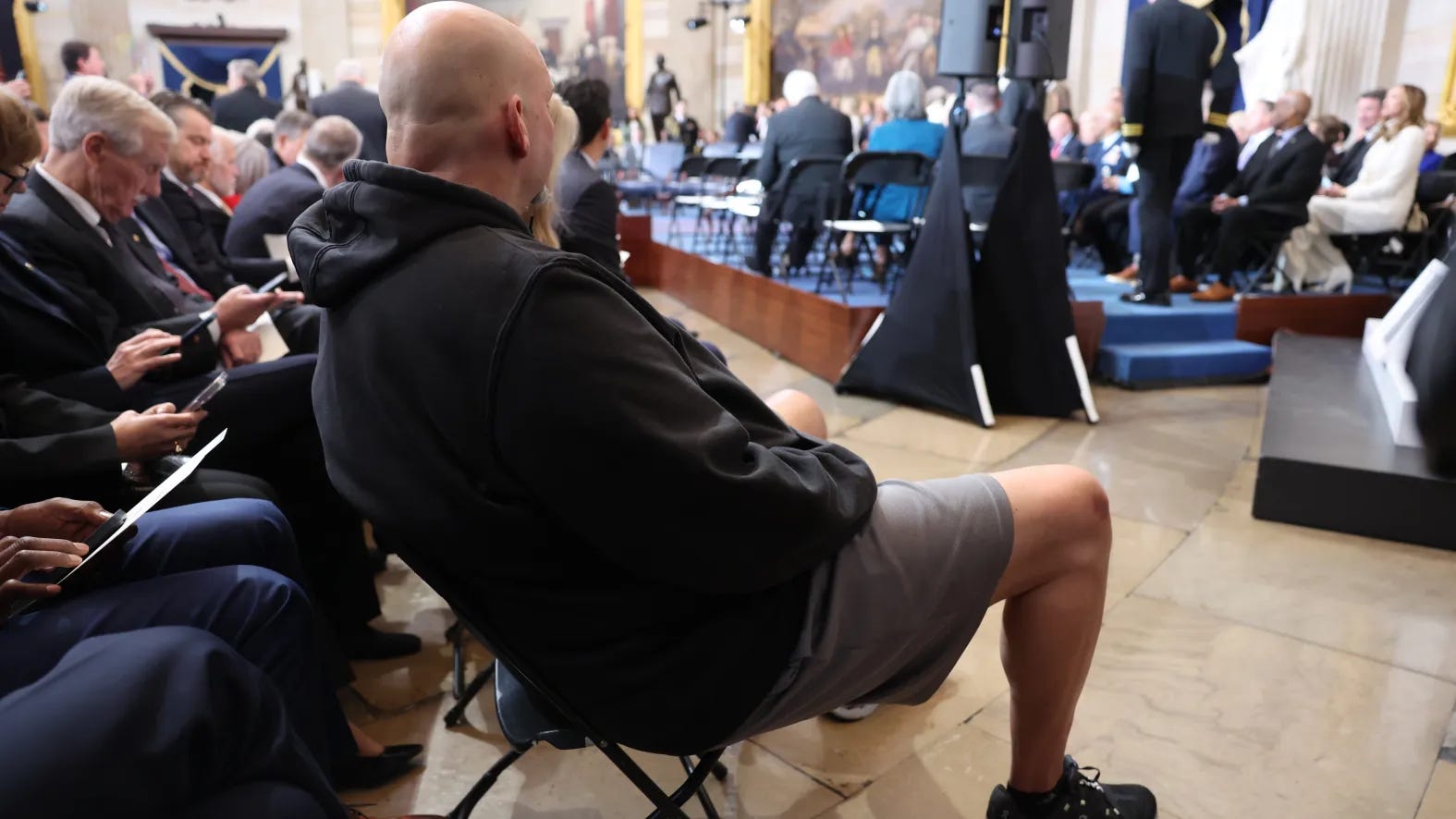
These are a few particularly blatant examples of unseriousness from public figures, institutions, and companies, but the death of professionalism pervades society. Why can nobody be serious anymore?
Professionalism, to me, means taking yourself and your job seriously, caring about the quality of your outputs, and caring about the impression you give on behalf of your institution/company. Everywhere I look I see evidence of this attitude being eroded not just from the top down, but also the bottom up:
Three-day in-person work weeks are par for the course since COVID, but even that is too much for the UK civil service, who are planning strikes in response.
Emails are increasingly “Hey … Cheers…” versus “Dear … Yours sincerely…”.
Professional dress codes are being slackened across the board. Anecdotally, walking through the City of London makes this abundantly obvious.
Academic standards and attitudes at elite institutions are crumbling.
Companies are increasingly giving in to the fact that sometimes their employees just don’t feel like showing up at all, and they shouldn’t challenge it because mental health something something.
Productivity is declining in certain sectors for mysterious reasons (i.e., people simply aren’t doing their jobs properly).
I detest dogma, pointless rules, posturing, and pretentiousness probably far more than the average person, yet the past decade or so has seen the baby chucked out with the bathwater. I think this is regression, rather than progression. I believe that professionalism, seriousness, and decorum are important facets of society, the revival of which would benefit everybody. There are surely a great number of aetiological factors at play here. I will outline a few before offering my prognosis and paths forward.
Toxic authenticity
If you wish to compete with other humans in any game that is global and online (any type of content creation—in the broad sense1), conventional wisdom suggests that it is unwise to pit yourself against 8 billion other humans in the same game. The solution is to play a different game—namely being the best and most authentic version of yourself, rather than trying to be a better version of someone else. Being authentic creates a healthier mental framework to act within. It can also be far less stressful than the alternative, since it is more honest and dishonesty takes a toll on the soul and the mind.
The benefits of authenticity aren’t limited only to the internal though. There are several external benefits of authenticity, perhaps explaining why it is all the rage online nowadays. People want to know who it is that they are supposed to be giving their trust and attention to. The more relatable someone seems, the more trustworthy and the more deserved of your attention they are. Thus, authenticity sells better.
The problem is, discerning true authenticity is a difficult task, particularly when given very little information to work with (e.g., a person’s Instagram profile). Given the advantages authenticity offers, and the difficulty of discerning true authenticity, this creates a perverse incentive to engage in faux-authenticity. In the hyper-comparative world of social media and clickbait news media this creates a meta-game that many (particularly those high in trait Machiavellianism) play. Namely, “How can I signal as much authenticity as possible?”.
To state the obvious, attempting to cheat the “authenticity game” in this way is the opposite of authentic. It is manipulative and dishonest. Sadly, it is often successful. Strategies inevitably involve throwing decorum or social standards to the wind, signalling “I simply don’t fit within social norms because I’m such a real person”. Sticking out by rejecting professionalism and its requisite uniformity is the ultimate attention-grab.
In terms of physical appearance, this is exactly what John Fetterman is doing. Cynical take—but this is also what people who insist on wearing their so-called cultural dress at occasions that demand uniformity defined by the host, not the guest, are doing (faux-traditional African dress at English University graduation ceremonies, and faux-traditional tartan kilts at black tie events are two excellent examples of this). The whole notion of “needing to express oneself” is more often than not simply hijacking authenticity to garner attention. You don’t “need” to express anything, you just want the benefits of standing out from the crowd and of signalling “authenticity”.
Crucially, this need to display authenticity isn’t limited to our personal lives, but also to professional settings within corporations or institutions, often transmitted via their social media presence or news media. The textbook example of professional authenticity is Donald Trump, whose unabashed authenticity won him two non-consecutive presidential elections. With the playbook set out by Trump, the same perverse incentives implore others to drop the professionalism and be “real” instead (I recall the “Kamala is brat” phase and shiver with cringe). This is especially true now that everyone—from political parties to airlines—must compete for views online as the first line of engagement with their constituents or customers. In fact, the incentive to seem authentic is arguably even greater at the institutional level than at the individual level.
It is no secret that trust in and respect for previously pedestalized institutions, companies, or positions have waned, exacerbated by a swathe of their shortcomings in recent years and a complete inability to cover things up now we live in the age of free flowing information.
The hardest hit by this fervent distrust have been politicians, large corporations, and the news media. Some first-order effects of this distrust include surprising election results, where incumbency now appears to confer a disadvantage for the first time ever, and a shift in information diet away from classical media and towards podcasters who offer less authority but much more authenticity (maybe Substackers represent the Golden Mean here … 😉)
The examples of Trump’s success and the glaring defeat of classical media to podcasters and new media has told professionals to do one thing: increase their appeals to authenticity. Employ a gen Z social media team and you’re off to the races (refer back to my Ryanair and White House examples at the start of this essay).
In this way, a need to compete via faux-authenticity has led to individuals and institutions killing any professional veneer they might have had in place. Never mind that a professional veneer may have actually served an important purpose. Getting a zoomer to retort “they’re so real for that” seems to be the ultimate goal.
Zoomer brats, millennial cucks
There is a clear generational power dynamic online. Gen Z/α is much more gung ho. Gen Z/α can be brutally honest. Gen Z/α dictates what is cool. Perhaps watching up-close footage from war zones / hardcore pornography / gruesome accidents / police bodycam footage / *insert your favourite psychologically damaging type of internet content* on your phone aged 12 has an effect on the human psyche that makes the zoomer sense of humour much darker and more cynical than that of millennials/gen X. Millennials are also slow to pick up trends (probably because they spend less time online/on their phones) and so risk being out of touch and cringey. This doesn’t stop millennials trying though. I see example after example of millennials desperately appealing to zoomers for approval—adopting zoomer vernacular or imitating zoomer-initiated trends online, for example. Mimicking zoomer behaviour online also seems to be a way in which millennials/Gen X can try to avoid ageing—something they are seemingly terrified of.
The nihilistic and cynical bent adopted by zoomers is reflected in their real-world behaviours. Zoomers just don’t seem to care that much. I am reminded of a discussion with my older brother, who works in the City of London, recounting his experience with a fresh wave of zoomer interns at his office (he himself just sneaks into the bottom end of the millennial generation). None of them wear smart clothes. None of them show up on time. None of them eat before work (that would require waking up early), and therefore go out after the first meeting for breakfast together. But crucially, none of them get reprimanded in any meaningful way. And even if they did, they don’t care, so what would be the point of the reprimand? The funny thing is, Gen Z don’t have to care. In material terms, despite the obsessive focus on the housing market, they are actually better off than every preceding generation (“unprecedentedly rich”, as put by the Economist), and the thing that normally drives a sense of striving or progression in life—dopamine—is easily acquired from the screen in their pocket instead. Worst of all, lax parents, lax teachers, and lax employers have all conditioned gen Z to be demanding and inflexible by letting them get their way all of the time.
Zoomer brattiness and millennial kowtowing decimates professionalism. Nobody feels like they have to do anything anymore. As more zoomers and gen alpha begin to infiltrate the workforce there is a chance this apathy could get much worse, although I have reason to suspect that gen Z will course-correct, as I will get onto later.
Professionalism is right wing. Yuck!
Since this death of professionalism seems to be seen as an example of societal progress, flush with woke epithets centred around self-expression, it is lauded by those on team “progressive”. Meanwhile, those on team “conservative” find themselves reactively anti-self expression, criticising the president of a warring nation for not wearing a suit, for example2.
In general, if a certain behaviour is promulgated by a figure perceived as right-wing, then that behaviour is labelled right-wing and the left recoils from it, and vice versa. In this way, suits are now right-wing coded in part thanks to Jordan Peterson. You could validly argue that wearing a suit is a genuinely conservative thing to do, since it conserves traditional formal attire. But other non-traditional behaviours, like exercising and eating a diet sufficient in protein, have also seen this political lens erroneously applied. There are feedback loops here making the political polarisation of normal things worse—right-wing people more readily gravitate towards these erroneously right-wing coded behaviours and thus exacerbate the stereotype. Equally, people who engage in these behaviours for non-political reasons are labelled as right-wing regardless of their actual political leaning and are then used as examples with which to falsely propagate the stereotype nonetheless. Andrew Huberman as part of the “manosphere” is a case in point. It seems encouraging anyone, but especially men, to pursue excellence in any realm gets smeared as right-wing these days.
The same kind of right-wing coding is at play regarding professionalism, which is the institutional or career-centric manifestation of the pursuit of excellence. Pride in your nine-to-five is seen as an outdated mindset, not relevant in our era of Instagram travel influencers, YouTubers, and crypto traders. Rejecting cynicism and buying into one’s professional duty is therefore seen as yearning for a previous time, which smells awfully conservative. The lens of political polarisation seems to be the nail in the coffin for the death of professionalism.
The future looks (b)right
While I’d love to grab your attention by stressing the negatives of the societal problem I’ve laid out here, I am an anti-doomer and generally find societal homeostasis to be far more powerful than most realise. We may not be at the bottom of the pit of the death of professionalism yet, but I do think we will see it reborn. Regarding the political schism over professionalism, there are two equally plausible paths forward for its resurrection: either the left embraces professionalism, or the professional-embracing right wins out over the left.
For the former, this means the left must acknowledge the value of professionalism and society can move forward agreeing that professional standards, appropriate seriousness, and proper decorum are not to be given up in the name of “progress” or “self-expression” or “authenticity”.
There are whiffs of this already. On the aesthetic front, there is this quite popular left-wing chap who writes and posts about menswear online, often focusing on formal clothing. He mainly leverages his passion for formal attire to dunk on conservatives wearing ill-fitting suits, but regardless of this vindictive motive, it is refreshing to see a die-hard progressive championing decorum and proper attire. The genius of his framing is in highlighting the craftsmanship of the tailors of good suits, contrasting it with fast fashion and the corporate greed of Big Clothing. In this way he moulds professional attire into left-wing ideals.
A much more potent motivator for the left to return to embracing professionalism is their reacting to a lack of professionalism from the right. The more Trump departs from presidentiality, the greater the opportunity for a Democrat candidate to fill this vacuum by appealing to total seriousness and decorum while rejecting cattiness. So far, the left in America have failed to resist the pull towards cattiness, and find themselves hardly better than Trump in terms of professionalism (the benefits of appeals to authenticity are too great for both sides—Trump’s examples just get much more coverage). Nonetheless, I am holding out for the position of the metered and professional centrist to be filled eventually, perhaps taking the lead from the much more professional politicians across the pond (Macron and Badenoch come to mind).
The alternative is that Trump’s presidency marks a global return to conservatism (not that Trump himself is particularly conservative, but his election is a hallmark of a wider trend), and that professionalism piggybacks on this rise of the right in the coming years. The American left seems to be in disarray, and the right is doing well in Europe as the centre-left parties in power still struggle to grapple with the issues people actually care about (chiefly, immigration). We might see a greater cultural resurgence of pride—both national and personal—the latter of which might enable and encourage people to hold themselves to greater professional standards.
Trying to be cool is not cool
Regarding the generational dynamic of the death of professionalism, what millennials and older generations don’t seem to realise is that it isn’t the specific trends that GenZ/α engage in that are inherently cool, it is the fact that these trends are mysterious to older generations and therefore confer exclusivity to young people that makes them cool.
The same goes for Gen Z vernacular. As soon as a previously “cool” phrase comes out of a millennials mouth, it is instantly not cool anymore. What is especially uncool about this is the cringe of trying so hard to be cool by older generations. Younger generations can distinguish faux from real authenticity pretty well when it’s coming from older generations. Since no authentic millennial goes round saying, “no cap fr this burrito is bussin. It’s giving demure. The chef understood the assignment. What a sigma”, it’s obvious that this is pure try-hard and completely fake.
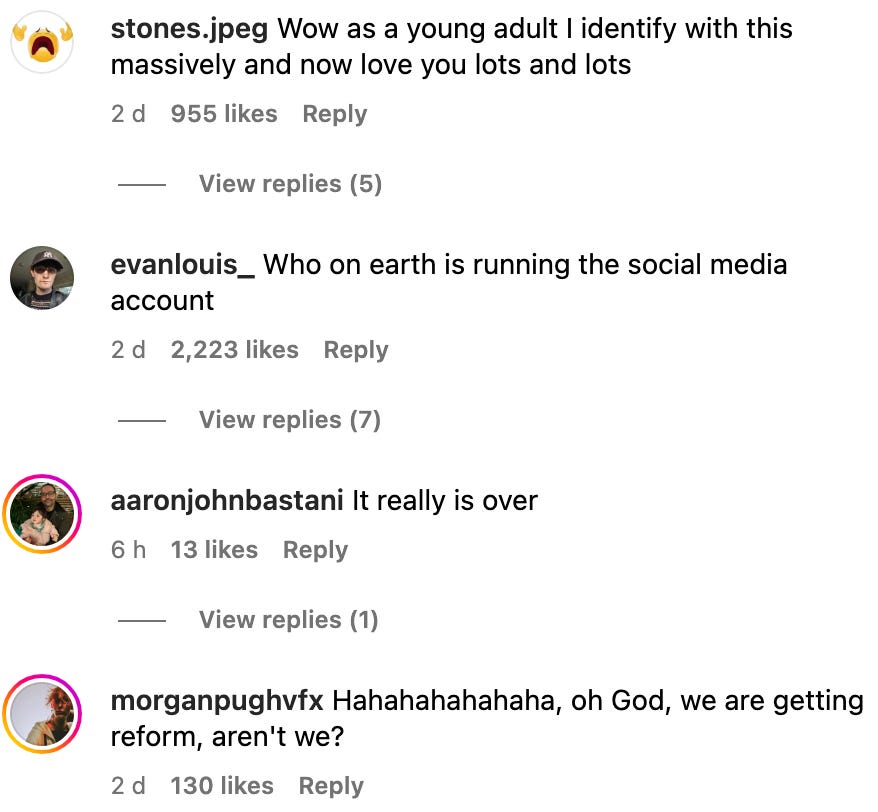
As I was writing this essay, UK’s Labour Party posted on their Instagram page a Keir Starmer edit supposedly demonstrating his “aura”. It might have been funny before the general election, but now he is our prime minister and has a serious job to do. British citizens want a functioning government, not propaganda reels. This type of disregard for professionalism is just not cool anymore. The comments on the video prove my point.
Akin to the political vacuum of professionalism in the wake of Trump, a generational vacuum for professionalism emerges in the wake of uncool and unserious millennials. If millennials are “quietly quitting”, not caring about their jobs, and abandoning wearing a suit, this creates the perfect incentive for young people to embrace professionalism as their own. Again—I detect whiffs of this already with the meme of the “academic weapon” and people like Davis Clarke, an accountant who posts content about his dedication to his job, gaining popularity online.
I hope that we are coming to the end of the era of outrage culture, the coddling of younger generations, and faux appeals to authenticity. I want to live in a society that unironically embraces striving, humanity, and aspiration. This doesn’t mean everyone must don a suit. I certainly won’t be wearing a suit to the lab anytime soon, although I appreciate that my PI does, and there is something that I love about the aesthetic of the 20th century scientist in well-tailored suit with a fag hanging off his bottom lip. Formality isn’t exactly what I’m after, although it is part of it when appropriate. I want real authenticity, pride in quality, and not doing things because, as Trump put it, “people like it”. This is a society that is roused by a Creed halftime show unironically, rather than one in which millennial white women mimic a Kendrick Lamar halftime show to try and seem cool. A society in which people, institutions, politicians and corporations don’t need to compromise their professionalism by making shitty jokes, peddling overused memes and trends, and constantly breaking the fourth wall to rage-bait and subvert expectations for attention. I want us to mature from our current era of societal-level audience capture.
Professionalism means parking features of your private life outside of the work place (e.g., covering tattoos if they would detract from professional efficacy). It means forcing yourself to go to work when you don’t feel like it. It means acting with appropriate decorum even if you would speak or behave differently in the confines of your own home or when spending time with friends. It means aspiring to excellence at what you do and not degrading yourself to garner attention.
I consider a positive attitude towards professionalism to be the epitome of societal progress. This is my plea for a return to this mode over the next decade or so. I am optimistic that we can and will.
By content creator and content consumer, I mean literally any type of production and consumption that occurs in the public realm and is propagated via technology. This could be classic social media influencers, authors, journalists, actors, politicians, etc. If you produce work in the public sphere, you are a content creator.
I’m torn on this one. Of course, Zelensky is actually conserving a tradition, which should be right up the alley of conservatives. At the same time, his choice of attire is unavoidably an appeal to authenticity. Whether it is faux or real authenticity remains to be determined, but the perverse incentives are undeniably in place. A cynic would equally criticise Churchill for doing the same during WWII.
From what I understand of work and political sides, professionalism is a right-wing value where the collective believe in a hierarchy at work and respect it, while left-wing believes in communautarism where there is no hierarchy and everybody thinks alike. The first one requires you to put aside your identity temporarily to adopt the identity that work requires you to show during work days, while the second one needs you to replace your core identity to belong in the group.