

The free will illusion
An increasingly common point of view, promulgated by many modern atheist philosophers, is that free will is an illusion. The idea has evolved steadily since Darwin, but gained mainstream traction through the 2010s until now, emerging from the New Atheist movement. Explanations for free will have puzzled humans for millennia. Since Biblical theists invoke God as the source of free will, it has become the assumed atheist position to throw the baby (free will) out with the bathwater (God). Not every atheist agrees. Daniel Dennett, parting from his fellow New Atheist horsemen, tries to argue that free will and determinism are in fact compatible (via semantic acrobatics, critics point out). The overwhelming majority of atheist philosophers, however, converge on the conclusion that free will is an illusion. Harris wrote a book about it, Dawkins is forced to admit it, O’Connor argues cogently for it, and even agency-obsessed Williamson agrees that free will is an illusion.
The argument is formed of two parts:
Why is free will impossible? Well, the universe is deterministic at the micro level, even if things sometimes seem random at the macro level. That is to say, everything has a cause and effect. This leaves no room for a decision-making agent.
Given this, why do we think that we do have free will? Our experience of free will is a product of evolution. It so-happened that the emergence of the feeling of free will provided a fitness advantage to our ancestors, thus it persisted through to us.
In this essay I describe why I believe this to be delusional thinking, and an example of motivated reasoning, rather than an empirically-derived theory. I point out that the universe is, in fact, not purely deterministic. I follow by arguing for what I believe to be the most likely theory of consciousness, so-called “Orch OR”, which draws on aspects of neuroscience, cell biology, molecular biology, and quantum physics. I offer my thoughts on the nature of free will according to this model, and discuss theological implications.
Where is the evidence?
“Extraordinary claims require extraordinary evidence.” ~ Marcello Truzzi
The field of evolutionary psychology gets a bad rap for being chock full of fun explanations that sort of make sense teleologically, but have not been or cannot be tested in the real world. Empirical evidence is what is required to take an idea from hypothesis to theory. When considering the free will illusion, what evidence do we have that (i) free will doesn’t exist and (ii) an illusion of free will exists? Well … none. In fact, every bit of empirical evidence points to the fact that we do have free will. This is an important but often-overlooked point: the experience of all humans suggests that we do have free will. Free will is the null hypothesis. It has been the philosophical status quo for good reason. To refute this, in denial of Occam’s razor, would require extraordinary evidence.
The great irony of the illusion hypothesis is to say
“oh no, that’s just because evolution wants you to think you have free will, because it probably provides a fitness advantage. Yes, everything we experience points to the fact that we have free will, but that’s just the great power of natural selection creating an illusion!”
I would consider this putting the cart before the horse. To me, this arrives at a conclusion and then reasons how this conclusion can be achieved. The motivation for such reasoning, which I can empathise with, may stem from the desire to completely remove any need for a God, since God is typically suggested as the source of free will.
As an atheist myself, who spent his teenage years basking in New Atheist rhetoric, this motivated reasoning was eerily familiar to me. A common response put forward by theists when asked for evidence of the existence of God, facing the actual lack of tangible evidence, is to entrench deeper into the conclusion and twist the reasoning by saying
“oh no, that’s just because God doesn’t want you to know for sure that he exists, because that doesn’t require faith, which is a sacred virtue. It’s because of His infinite Godly wisdom that he creates the illusion of not existing”.
The theist’s “absent God illusion” and the atheist’s “free will illusion” are, in this sense, remarkably comparable. Both are delusional thinking - inventing new hypotheses to make up for the lack of evidence for pre-requisite hypotheses, and never bothering to touch base with reality.
It’s important to state that evidence for the illusion of free will is not too much to ask for. Let’s consider a genuine illusion that evolved in animals due to its selection advantage: pain. Pain, as any neuroscientist, stoic, Buddhist, or David Goggins will tell you, is merely an illusion. That is to say, it is a construct of the mind, emerging via natural selection as a powerful deterrent against somatic harm. We understand very well how the illusion of pain is created by the body, and there are a number of interventions that can dissolve the illusion, including genetic and pharmacological.
There are no examples of brain lesions, genetic mutations, or pharmacological interventions that can abrogate the supposed illusion of free will. Nor has there been any discovery of a brain region or neural pathway dedicated to upholding this illusion. I am willing to cede that the concept of free will is much more complex than the concept of pain, but this doesn’t give you a pass on the requirement for evidence. Based on the lack of evidence, proponents of the free will illusion must temper their confidence in this hypothesis.
The universe is not deterministic
The notion that free will is an illusion falls flat on not two, but three counts, with the third being the most fundamental:
Empirical experience suggests that we do have free will.
There is no empirical evidence that free will is an illusion.
Empirical evidence shows that the universe is not deterministic.
The presupposition that the entire hypothesis is built on is that biology, chemistry, and physics are deterministic. This is an outdated and incorrect view of the universe.
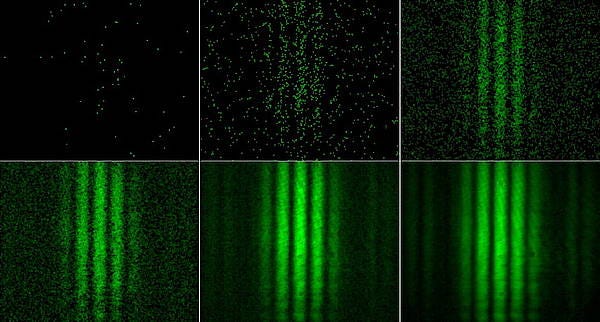
In 1801, Thomas Young demonstrated that light can act as both a wave and a particle, since particles fired at a double slit produce an interference pattern, a characteristic property of waves, on a detector behind the slits. The idea is that the photons pass through both slits and interfere with each other, due to differences in path length, to create intensity maxima and minima. Over a century later, Geoffrey Taylor showed that single photons, released one at a time, still produce the interference pattern. If only one photon at a time is being fired through the slits, how can it be interfering with other photons to produce an interference pattern? This was a mind-boggling result. Even more bizarrely though, when attempting to see which slit the single photons pass through to produce the interference pattern, by placing a detector before the slits, the interference pattern was lost. Further attempts to catch the photon “deciding” which slit to go through revealed more quantum weirdness, such as Wheeler’s delayed choice experiments and quantum eraser experiments, which show that photons essentially retcon how they passed through slits based on whether their path information is being extracted or not. Extremely creepy stuff that you can spend days reading about and still be left scratching your head. Creepy or not, this is the nature of the universe.
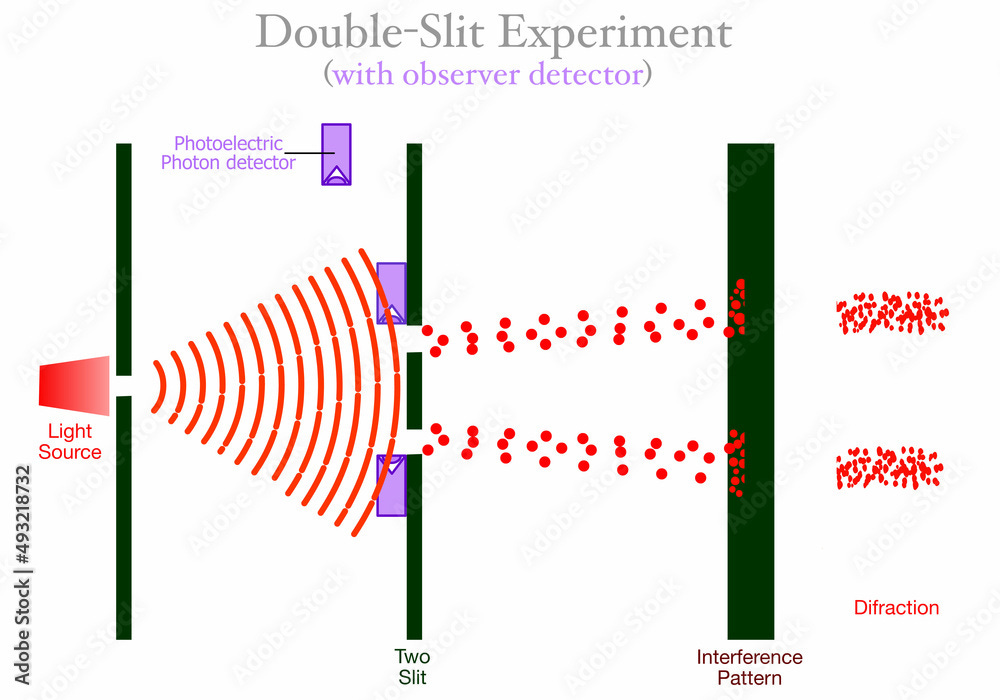
There are a number of interpretations as to what is actually going on here. The mainstream Copenhagen interpretation of quantum mechanics, which I’m partial to, posits that a particle exists in quantum superposition of two states. The particle goes through both slits and interferes with itself. Quantum superposition collapses upon observation, so-called “subjective reduction”, at which point the universe “decides” where the particle ends up. So you have a pseudo-real state collapsing into the reality that we observe, and this reality is not determined, but assigned, or decided, by the universe.
It’s all very confusing, but the tldr of it all is that particles do not behave deterministically, but rather probabilistically. This isn’t only true for massless photons, but has been demonstrated for electrons, atoms, and even large molecules. This means there is nothing that can determine where a single particle will appear on a detector behind the double slit. There is no cause-and-effect going on here.
What does this mean for free will? Well it firstly means that the assumption that the universe is deterministic is false, and so it cannot be used as the foundation upon which to argue for hypothetical illusions of free will. But how does quantum “randomness” lead to free will?1 What does the behaviour of particles in slits mean for how a brain works? Before I lay out my preferred hypothesis, I’ll say that answering these questions should now be the aim of scientists and philosophers in the relevant fields. There are two fundamental data points:
We experience free will
The universe is not purely deterministic
These facts are now the empirical base from which we can build philosophical arguments, thought-experiments, hypotheses, and theories of consciousness and free will.
From quantum particles to brain function: Orch OR theory
The best hypothesis that I am aware of that bridges the gap between quantum physics and neuroscience is the orchestrated objective reduction theory of consciousness, or “Orch OR”. It was first published by anaesthetist Stuart Hameroff and Nobel prize-winning physicist Roger Penrose in 1996. If you have institutional access, I’d encourage you to read the original paper, linked here, otherwise more recent comprehensive reviews are here and here (I do my best to explain the basics here though). Like all bold theories over the history of science, it has received much criticism. None seems to land fully, however, with Hameroff still insisting that Orch OR is “the most complete, and most easily falsifiable theory of consciousness”.
Before I summarise the theory, I need to expand a bit on the quantum superposition idea introduced above. The difficulty expanding quantum superposition from a photon to a large molecule is in part due to the requirement for quantum coherence. This means that all of the objects within the quantum system must have a defined phase-relationship with each other in order for the system to achieve superposition. Maintenance of this coherence typically requires extremely delicate experimental conditions, such as low temperatures and a vacuum, since interaction with the quantum system, such as when “observing” the state, causes collapse of the wave function (i.e., subjective reduction). At this point, the universe picks an eigenstate (one of the possibilities within the superposition) for the system to exist as in reality. In 1994, Penrose introduced the notion that if significantly large quantum systems do maintain coherence, they will collapse as a consequence of size, with larger quantum systems collapsing faster. He called this “objective reduction” since it occurs independently of an observer, or subject, and is dependent only on the object whose superposition is being reduced. Per the standard Copenhagen interpretation, Schrödinger’s cat is thought to be simultaneously dead and alive until the observer checks the box, at which point the quantum superposition collapses and reality is “decided” via subjective reduction. Objective reduction basically says that if the cat is large enough, its quantum states automatically reduce into one or the other outcome. Okay, now onto the theory…

Every cell of our body has a cytoskeleton, which is composed of proteinaceous filaments that give the cell physical structure, shape, and also help to spatially organise the cell’s components. One type of filament is the microtubule. Microtubules primarily serve as the highways of the cell, upon which the motor proteins dynein and kinesins can walk, carrying cargoes to where they are needed. There is a famous animation, that you may have seen, of a kinesin sassily dragging a large vesicle along a microtubule2. What is interesting about microtubules is their beautiful symmetry and order. Microtubules are made of two protein monomers called α-tubulin and β-tubulin, which dimerise and then interact end-on-end to form proto-filaments. These in turn, assemble side-by-side to form a hollow tube formed of 13 proto-filaments with pseudo-helical symmetry (sounds complicated, just look at the image below).
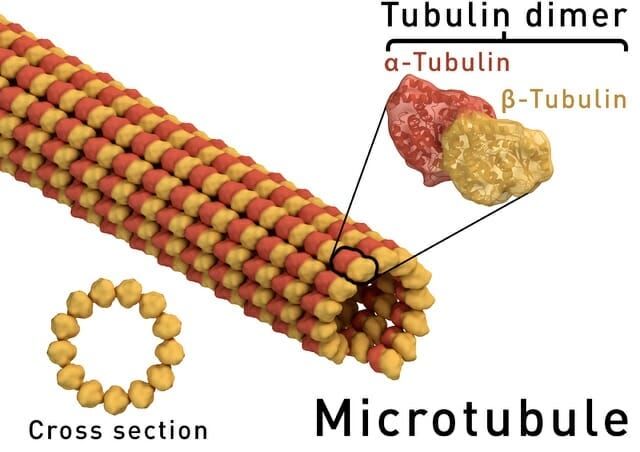
Previously, it was thought that biological systems are too warm, wet, and noisy to sustain any quantum coherence. The incredibly ordered and stable structure of microtubules are posited by Penrose and Hameroff as being a possible exception, offering an extremely ordered and protected nano-environment within cells.
Looking closer at the protein structure, α- and β-tubulin contain a number of aromatic amino acids within their polypeptide sequences. Budding chemists amongst you may recall “aromatic” means that it has carbon rings, akin to benzene, that contain a delocalised ring of π-orbitals. Benzene can be schematically represented with alternating double bonds, or just a ring inside the outer hexagon, to reflect the fact that the electrons aren’t in one place or another, but actually in quantum superposition.
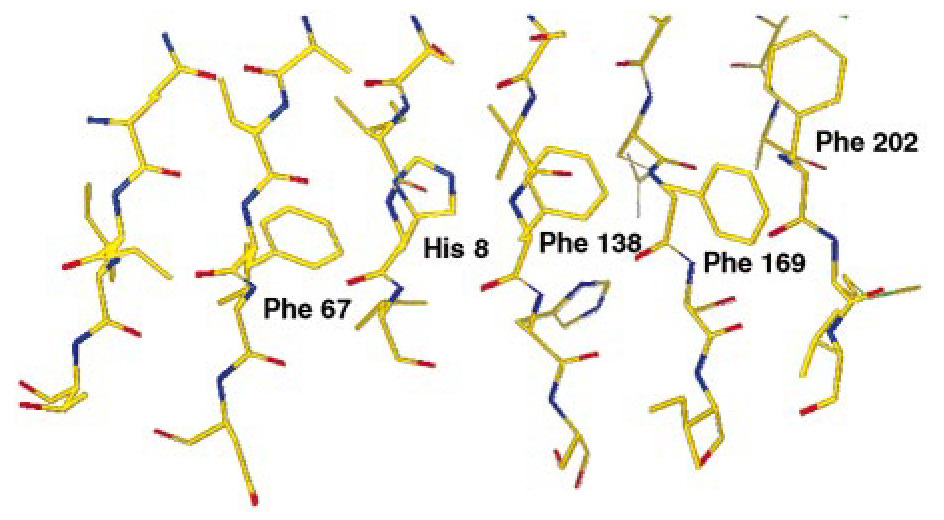
Aromatic amino acids include tryptophan, tyrosine, histidine, and phenylalanine. Normally quite rare in most proteins, tubulin contains 86 aromatic rings. What’s more, solving the structure of the αβ-tubulin dimer at 3.5 Å resolution revealed stacking of these aromatic rings (see above), creating a large system of delocalised electrons. The quantum state of the aromatic side chain is also reflected in conformational change of the amino acid spatial structure itself. Basically any reduced eigenstate would cause a slight mass shift in the molecule, and so the whole molecule exists in a conformational superposition too, until the wave function collapses.
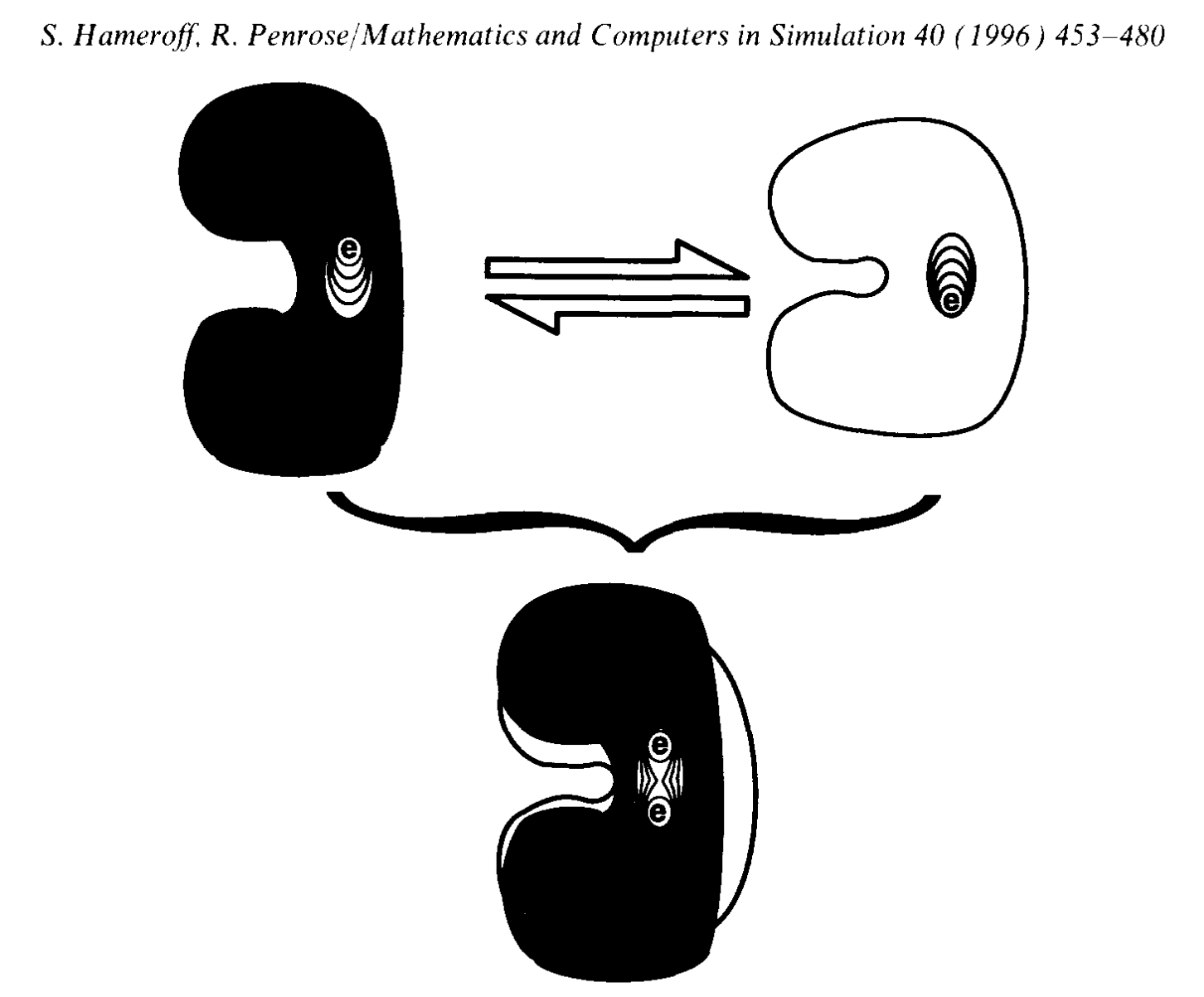
Not only are the protein subunits of microtubules highly suited for protein-level quantum superposition, but the highly ordered structure of microtubules creates a large array of quantum coherence, where all of these subunits can be in a defined phase-relationship with each other. What’s more, this coherence is protected from subjective reduction for significant periods of time (> 500 ms) by a shell of ordered water both outside and inside the microtubule.
Fascinating. But how is this relevant for consciousness in the brain? Well, the brain is made up, in large part, of neurons. Neurons are specialised cells that have a soma, containing the nucleus and other key cellular machinery, and then an extended axon which extends large distances towards a synapse, where it can transmit information between cells. The axons contain large arrays of microtubules which can transport things like neurotransmitters from the nucleus / endoplasmic reticulum, where they are made, to the synapse, where they perform their functions. Orch OR argues that this high density of extremely ordered microtubules adds even more scale to the quantum coherence. Such a large scale means that objective reduction, which you’ll recall happens faster with increasing size of coherent quantum systems, can occur at biologically relevant timescales, meaning ~ 500 ms. So the scale of microtubule arrays in the axons of cells in the brain causes objective reduction to occur quickly enough to be within the limits of protection from interaction (subjective reduction) afforded by the nano-environment, and within the timescale of biologically relevant processes like electrical impulses in neurons.
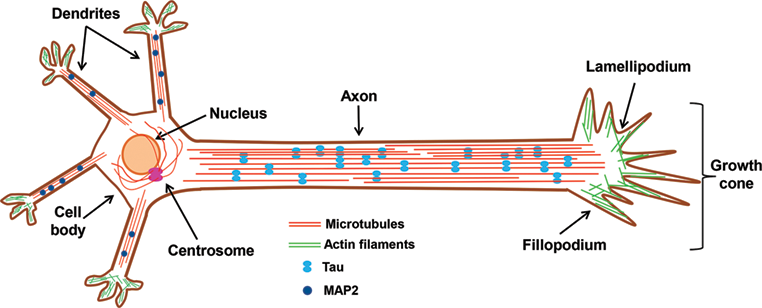
How these conformational changes within microtubules might relate to neurological processes is expanded upon in the 1996 paper. For example, conformational states of tubulins in a microtubule will affect the binding of microtubule-associated proteins, such as dynein and kinesins mentioned earlier, which provides a plausible mechanism for the transduction of quantum decision-making into biochemical signals that affect neurological function.
There is much more to Orch OR, including how large-scale quantum coherence relates to meaningful computation in the brain, and how proteins that interact with microtubules can fine-tune (orchestrate) the objective reduction (the “Orch” part of Orch OR). Again, to fully understand I would recommend reading the 1996 paper, but hopefully I have laid out the basics here to demonstrate how quantum superposition can exist in the brain, and how it can affect thought.
To me, this is an incredibly complicated, but beautiful and actually very understandable theory given enough background reading in the requisite disparate scientific fields. It’s highly interdisciplinary nature means that few people are equipped to critique it in its entirety. My rudimentary understanding of quantum mechanics means I cannot faithfully validate this aspect of the theory, but certainly the cell biology and protein structural biology aspects seem plausible. It is an elegant and plausible theory, but plausibility is a prerequisite, and not at all sufficient for a theory to stand.
Evidence for Orch OR
One key piece of emerging evidence for Orch OR is the effect of general anaesthetics. Anaesthetic drugs abrogate conscious experience without affecting unconscious or subconscious brain activity, and are thus a perfect experimental tool to test theories of consciousness. The precise mechanism of action of anaesthetics is elusive, but is an area of active research. It has long been assumed that anaesthetics would inhibit synaptic neurotransmission or nerve impulse propagation via ion channel inhibition. In fact, it seems that anaesthetics may be acting directly on microtubules in the brain and reducing their stability. Interestingly, modelling of microtubules and anaesthetic gases has shown that anaesthetics bind directly to the aromatic hydrophobic pockets in microtubules and impair quantum coherence of the π-orbitals. Indeed, more potent anaesthetics prevent dipole oscillations more strongly, and non-anaesthetic drugs that still can bind tubulin do not affect these oscillations. This quantum oscillation impairment of anaesthetics has been recently directly linked to microtubule stability.
Asides from anaesthetics, direct evidence for quantum superposition states in microtubule arrays was published just this year.
As our ability to measure quantum effects in biological settings improves, our ability to stress-test Orch OR will increase. It is a fascinating area of research that I will be following closely.
Philosophical implications of quantum-derived free will
Clearly, I am excited about Orch OR. I think it’s fair to say that Hameroff and Penrose were hugely ahead of their time in 1996, and its fascinating to assess some of the recent evidence in support of the theory. Of course, many of the specifics of the theory may be proven untrue. Either way, the notion that free will can be derived from quantum effects in our brains is, in my opinion, a highly likely one. As stated in the first half of this essay, quantum effects in the brain satisfies our three crucial fundaments: (i) free will seems to exist (ii) no evidence supports the existence of an illusion of free will (iii) the universe is not purely deterministic thanks to quantum phenomena. An interesting area to explore philosophically, is what this actually means for the nature of free will.
Firstly, let’s talk about the evolution of consciousness. If Orch OR stands, we can basically see brains as huge amplifiers for quantum superposition. Consciousness could be enabled via Orch OR either proportionally to microtubule array size and number, or all-at-once above a certain threshold of microtubule array size and number. In other words, consciousness could be analogue or digital. In either case, consciousness could easily have emerged from evolution via natural selection, either serendipitously (digital model) or under direct selection pressure (analogue model).3
Under a digital paradigm of consciousness, it is possible that only humans are conscious and possess free will. Other animals and life forms would fall below the the threshold for quantum decision-making to affect their physiology, and so their actions are purely deterministic, predictable, and computable. Of course, the threshold could be somewhere else, say, including great apes or large cetaceans.
Alternatively, under an analogue paradigm of consciousness, Orch OR permits low levels of quantum decision-making in small brains and other microtubule-rich structures, and this simply amplifies with scale. Under this model, consciousness is a spectrum. Ethical vegans will have to wrestle with where the arbitrary cutoff for un-killable consciousness lies, especially considering that plants and fungi also possess arrayed microtubules.
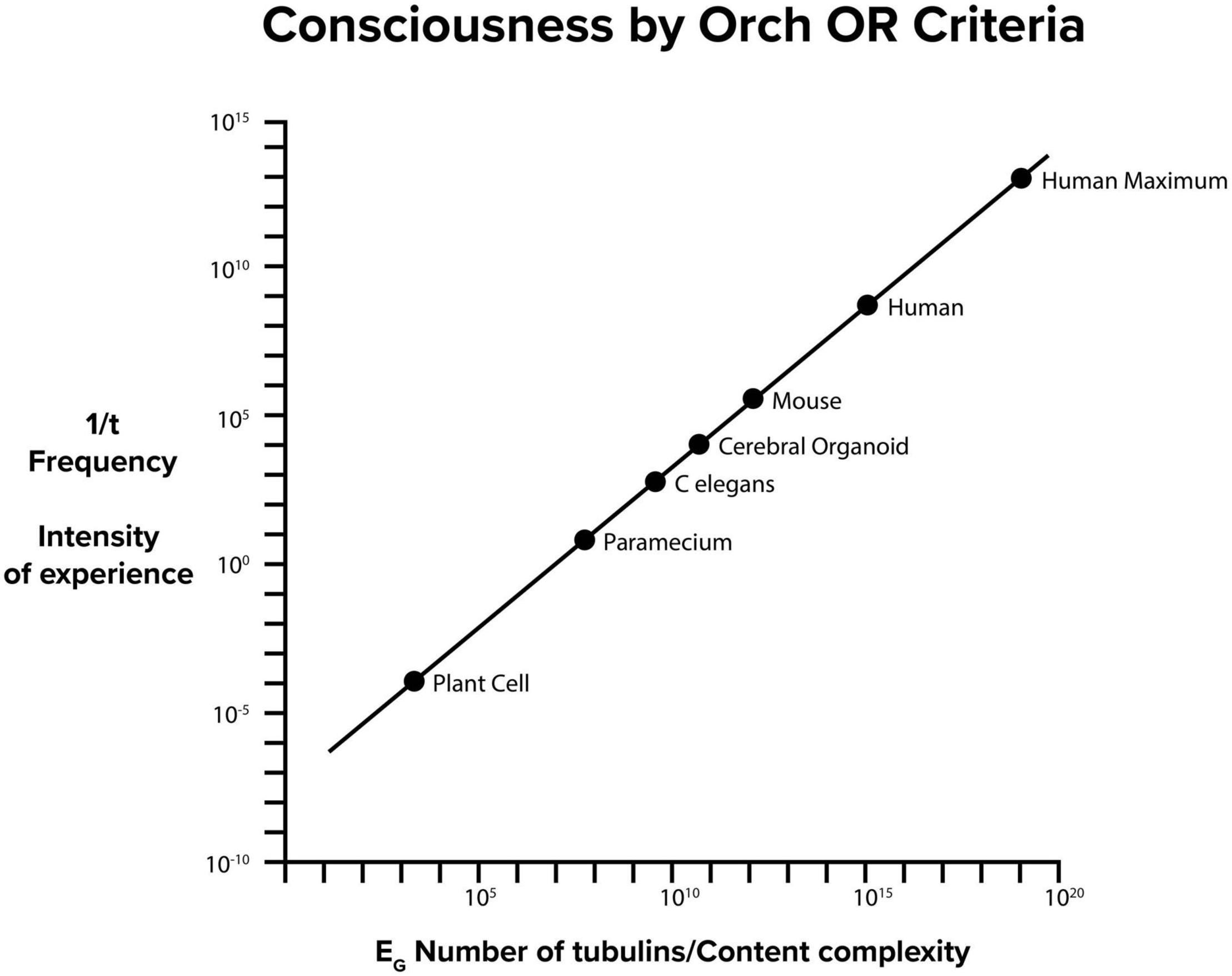
Under either evolutionary paradigm, it is interesting to consider the hierarchy of consciousness on Earth. Instinctively, I am inclined to put humans at the top of this hierarchy, but I may be wrong. It is worth noting that level of consciousness and propensity for free will does not necessarily correlate with non-conscious brain function (although it probably does). Thus, one could imagine a whale that is highly conscious but much more stupid than a human. Of course, brain size isn’t the only factor for consciousness, as is true for intelligence. Scale of quantum coherence within a brain would be dependent on, amongst other things, number of neurons, size of neurons, density of microtubules within axons, arrangement of microtubules within axons, genetic differences in tubulin structure, proteomic differences in microtubule-interacting proteins, and interconnectivity of neurons.
You still haven’t bridged the gap from quantum brain processes to free will, Adam. You keep saying “quantum decision-making”, but what actually is that? Who is the “agent”? What actually is free will?
Okay. Let’s keep the definition of free will unchanged. I don’t want to engage in any form of compatibilism. Free will means the power to choose an action regardless of a prior state of the universe or event - the ability to make completely free choices. To break this down, let’s go back to the single photon double-slit experiment. We’ve established that nothing determines where the photon appears on the detector screen behind the slits. Yet when measured, the photon does appear in reality in a defined location. Crucially, this is not a “random” process (whatever that means). The photon will not appear randomly, but within the probability distribution defined by its wave function. How the wave function collapses is not known exactly, but I would consider it to be a form of decision-making. The problem is with defining the agent of that decision-making process.
To help frame this problem, let’s talk about gravity. Linguistically, we tend to assign agency to gravity. The Earth orbits the Sun because of the Sun’s gravity. The Sun attracts the Earth. When you learn a bit more about gravity you realise that the Earth also exerts its gravity on the Sun - cool! Still, its an object exerting a force on another object and vice versa. The word “exerting” implies a subject, or an agent. In actuality, neither the Sun nor the Earth are agents here. Gravity is not a force, but an emergent property of the geometry of spacetime. It’s more simple for school kids to understand it in terms of a force though.
In the same vein, let me put it to you that reduction of a quantum superposition into a definitive eigenstate is “decided” not necessarily by an agent in the classical sense, but as an emergent property of the universe. It is absolutely being decided, but this decision-making process permeates the entire universe and doesn’t belong to the photon going through a slit (or two slits simultaneously!). Thus, when quantum decision-making is amplified by the human brain, per Orch OR or otherwise, to have direct effects on neurological processes, this decision is made as a consequence of the quantum properties of the universe. A decision or choice is absolutely being made, and this choice is free, being completely undetermined and non-computable, but there is no agent in the classical sense.
I’m sorry if this is unsatisfying for you to read, but it is, in my view, the most precise interpretation of what’s going on here. So to say “I” have free will, is actually to say “I” (meaning my corporeal being that houses my brain) am tapping into this decision-making property of the universe. The free choice physically occurs in my brain, and thus I claim ownership of the choice. So I am wholly satisfied in simplifying the explanation, akin to “gravity is like a force”, by saying that I have made a decision via my own free will. This is true, just not that precise, but saves having to regurgitate this now-immense essay anytime I want to claim agency over my decisions.
To reiterate, millions of completely non-determined, uncomputable, but non-random decisions are taking place in my brain as a consequence of spacetime geometry that we don’t fully understand. The summation of these quantum choices, which are entirely free, results in neurological processes that define my thoughts and actions. This is free will.
Theological implications of quantum-derived free will
Critically, this paradigm does not invoke a soul, or spirit. Nor does it invoke a God. There is nothing woo-woo going on here except for the completely woo-woo reality of quantum physics. It is an absolutely rational and evidence-based model for free will. Yet I want to extend an olive branch to the spiritually-inclined amongst us.
Let me first state that all religious and spiritual epistemology are simply human attempts to explain the incredibly complex nature of the universe, often without the tools to do so. Most world religions decorate the core spiritual concepts at the heart of theological inquiry with extra stuff that probably isn’t true. I don’t believe that Yahweh empowered Moses to actually part the Red Sea. I don’t believe that Jesus actually rose from the dead. I don’t believe that Muhammad actually flew from Mecca to Jerusalem on a winged horse. But I do have sympathy for these stories, and think that, as with most myths and legends, there probably was some original, true, non-supernatural story that evolved over time as a consequence of the error-prone transmission of information, combined with a sprinkling of either accidental or deliberate, possibly politically motivated, human imagination.
What is interesting to me though, is the addiction of the human mind to assigning the inexplicable to a literal humanoid agent. Unanswered questions, such as the alleged beginning of the universe, or the aetiology of free will, are palmed off to a God or gods. The weird and whacky nature of the universe, in which spacetime geometry dictates movement of mass, and in which a poorly described permissive quantum decision-making process allows brains to enact free will, does not have a face or a name, but I empathise with the desire to give it one. My olive branch is to offer a linguistic switcheroo, to define “God” simply as “the inherent characteristics of the universe”. Even the staunchest of atheists, such as Jordan Peterson, wouldn’t deny the existence of the inherent characteristics of the universe.
Conclusion
Of course, as with all scientific theories, my position on free will is malleable. If tremendous strides are made in the realm of quantum physics, and the instructions for the decision behind that elusive eigenstate materialisation are discovered, revealing a purely deterministic universe, the theory changes. As of now though, this essay represents the most evidence-based answer to the question of free will that I can offer.
Updating all presuppositions with latest advances in the relevant scientific fields reveals that the notion of an illusion of free will has no basis in reality, and there is no reason that neurological processes need to be deterministic. These facts remove the need to deny free will, which is a markedly tricky manoeuvre in the face of the quite obvious experience of free will with which we are all familiar. Determinists all have really low clubhead speed. Total non-athletes.. Atheistic free will exists.
Not actually random at all. Addressed later.
This animation depicts hand-over-hand walking, but actually recent direct imaging of kinesin-1, via an ultra-high resolution light microscopy technique called MINFLUX, showed a preference for chassé-inchworm processivity. Not yet peer-reviewed, but the pre-print is here.
A tangential thought here is that serendipitous evolution, whilst has been shown to occur, is much rarer than directly selected evolution. Thus, if consciousness is indeed digital and was essentially accidentally selected for just because the pre-requisites for consciousness happen to also be pre-requisites for non-consciousness cell biological functions, then this has huge implications for the Fermi paradox. Serendipitous evolution of consciousness, one would imagine, would be infinitesimally rare, thus explaining why we seem to be the only conscious entities in the universe that we know of (many other reasons of course).
Very great article. I just came upon your substack and it's a total gem - thank you!
"...offer a linguistic switcheroo, "To define “God” simply as “the inherent characteristics of the universe”.
This sidesteps the most compelling question - why are these characteristics there, and are they inherent? This is where Aquinas' "ipsum esse subsistens" seems to rub up against where you've stopped.
I've asked Bl. Nicolas Steno, father of crystallography and modern geology, to pray for you!
Interesting, thoughtful and well written essay.
Have you considered how our free will is often coloured by emotions which are a response to chemicals and homones levels in our bodies? Moreover, as sentient beings humans are also endowed with the ability to do abstract thinking. One might say that free will is a product of at least a biological urge to promote or sustain oneself and philosophical contemplations about why the world exists and how to act accordingly.
But since lower forms of life which are not sentient also exhibit free will, perhaps free will does not so much depend on the ability to do abstract thinking.
It is likely I haven't fully understood the arguments here, but I thought the axons in nerve cells merely acts as electrical transmitters as to relay stimuli from one end of the body to another. That they contain Pi-stacking to accomplish this is no more peculiar than graphene sheets that are also electrical conductors.
Regarding the ORCH OR theory maybe there is an uncountable number of parallel universes, each of which is a manifestation of a particular Orch OR state?
"A decision or choice is absolutely being made, and this choice is free, being completely undetermined and non-computable, but there is no agent in the classical sense."
Isn't that clawing straws? The passive noun in this sentence here might as well be substituted with an active noun, such as the universe or God, if you like.
:-)
" Most world religions decorate the core spiritual concepts at the heart of theological inquiry with extra stuff that probably isn’t true. I don’t believe that Yahweh empowered Moses to actually part the Red Sea. "
Some religious scriptures can better be understood allegorically, say the first chapter of Genesis which merely describes a human being from infancy (unselfconscious) to gaining self-awareness.
Robert Oeffner