

Have you ever met a vegan? You’ll certainly know about it if you have. These are people who refuse to consume animal products, including eating meat, fish, dairy, and eggs. Depending on the strictness of the vegan in question, they may also abstain from honey and avocados—the farming of which requires insect labour—and typically also avoid leather products or cosmetics with things like beeswax in them.
Regardless of where they draw lines in the sand, the important thing to note is that vegans are just better people. Morally superior, I mean. Vegans won’t say this—in fact they make a point of not saying/thinking this because doing so belies said moral superiority—but vegan smugness is difficult to fully conceal, and most can whiff their sententiousness from a mile away.
I quite like smugness and arrogance if it is justified—I find it honest. So the question of importance seems to be whether vegans actually are morally superior to non-vegans. Is their highfalutin worldview deserving of praise and proselytisation, or are the moral fundaments of veganism perhaps less selfless than at first glance?
Here I will break down the psychology and morality of veganism, focusing particularly on “ethical veganism” which is concerned with animal welfare (instead of health or the environment, say). I have three arguments to make:
Ethical veganism rests on the presupposition that animals are “conscious” or “sentient” (whatever that means) and that they feel pain. This is false.
Ethical veganism requires a utilitarian ethical philosophy, which doesn’t map well onto actual morality as it evolved in humans.
When observing ethical veganism meta-ethically or through an Adlerian psychological lens, veganism emerges as a purely selfish exercise.
Pt I: No, animals don’t “feel pain”
EDIT: this claim seems to be unproductively provocative for some readers. The point is to highlight that pain can mean anything from “evasive signal transduction” to “complex emotional distress”. The word was intended to be applied to humans, but we typically use it to describe the lesser pain of animals. Vegans must contend with the fact that plants or bacteria also can sense things and exhibit “pain” if we continue to stretch the definition. In it’s truest form, only humans “feel pain”, and when we see an animal suffering, we imagine that it is experiencing human-like pain, when it is not.
What is pain?
Merriam-Webster gives us two definitions for pain:
“a localized or generalized unpleasant bodily sensation or complex of sensations that causes mild to severe physical discomfort and emotional distress and typically results from bodily disorder (such as injury or disease)”
and
“a basic bodily sensation that is induced by a noxious stimulus, is received by naked nerve endings, is associated with actual or potential tissue damage, is characterized by physical discomfort (such as pricking, throbbing, or aching), and typically leads to evasive action”
These may seem like two ways of describing the same thing, but these definitions couldn’t be more different.
The first definition is a subjective one—focusing on sensation and emotion. This is what most of us associate with pain in our everyday lives. We recall stubbing our toe and think of the negative emotional milieu that accompanied the event. Meanwhile, the second definition is more scientific and objective. It correctly identifies the aetiology of pain as a noxious stimulus and the mechanism of pain involving nociceptors and neural networks. It adds that pain is typically followed by evasive action.
While the second definition is a useful description of how pain works, it isn’t describing what pain actually is. That would be the first definition—an emotionally distressing negative sensation.
This is a key distinction because, while we can say for certain that animals have nociceptors and neural pathways that are somewhat akin to our pain-associated neural pathways, and we can see animals taking evasive action in response to noxious stimuli, we cannot claim at all that animals experience emotional distress or a negative bodily sensation akin to humans. The neural pathways for nociception are evolutionarily ancient, and therefore shared with many animals, but the neural pathways humans use for complex emotional processing, self-awareness, and creating the rich experience of pain evolved much more recently and are completely unique to us.
Correlation-causation fallacy
We know that pain is subjective because humans—being the highly intelligent and conscious beings that we are—can simply choose not to experience pain when receiving a given noxious stimulus. Next time you stub your toe, instead of scrunching up your face, grabbing your foot, or whimpering like an animal, try to meditate on the feeling without making any outward reaction. You’ll notice that the physical sensation is a separate entity to the physical reaction, and these are both separate still from the emotional environment we create in our minds. This ability to parse material stimulus from emotional response is a central tenet of stoicism and buddhism.
Humans can receive noxious stimuli and not experience emotional distress, but we can also create emotional distress from a complete absence of noxious stimuli. Babies often do this once they learn that crying is rewarded by attention from their parents. They’ll simply cry for no apparent aetiological reason at all (although the teleological reason is to garner attention).
Once we acknowledge that the human experience of pain requires two distinct components—nociception and complex emotional processing—we realise that erroneously asserting that animals experience pain (by which we mean and infer “human-like pain”) is falling for the correlation-causation fallacy.
To illustrate this, I’ll borrow a schematic from “The empathy problem”.
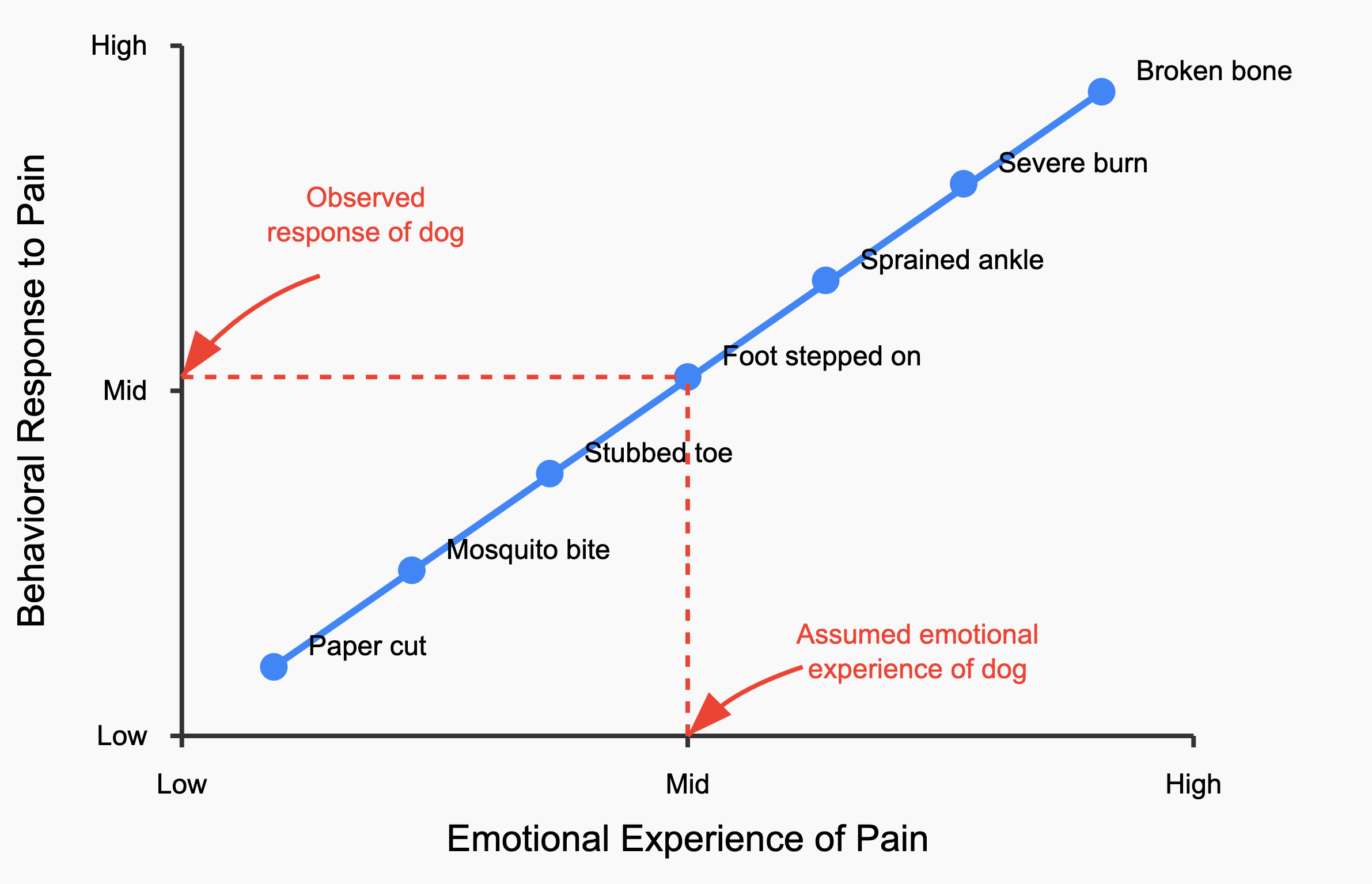
“For a human, the x-axis is the input and the y-axis the output. Yet when we sympathise with animals in pain, we use the y-axis as the input and attempt to infer cause from correlation. This is logically fallacious.”
When a vegan sees a fat chicken in a cage, they imagine what it would be like for them to be stuffed and not allowed to roam around, and they conclude that this would be distressing for them and is therefore wrong. But a chicken is not a human. It is incorrect to assert that a chicken considers such a situation to be distressing. Chickens don’t “consider” anything. And “distressing” is a term that only means something for humans. To say that something is distressing for a chicken is just a category error. Chickens don’t think like humans do at all.
This is why René Descartes, of “cogito, ergo sum” fame, also asserted that animals cannot feel pain.
Fake pain science
Humans developed emotive language to describe uniquely human experiences. Yet many now have a habit of aberrantly using these human-specific terms to describe non-human entities—from animals to LLMs. This tendency for anthropomorphism has infected our culture so deeply that even our science is marred by it.
Scientists for decades have been desperately trying to prove that animals feel pain. The problem is, until we can fully explain human consciousness, we are wholly unequipped to assess subjective experiences via objective measurements.
Despite this epistemological hurdle, scientists have pounced onwards looking for physiological or behavioural phenomena that can validate their preconceived conclusion that animals feel pain. As you might imagine with such a biased starting point, the data are extremely dodgy.
Take this 2014 paper, which tried to find evidence that Atlantic cod can feel pain. The authors subjected the lips of wild cod to a range of noxious stimuli and monitored various physiological and behavioural responses. The noxious stimuli were acetic acid injection, capsaicin injection, or fish hook puncture, with saline injection as a control.
When looking at a purely physiological response—the operculum beat rate (fish equivalent of breathing rate)—they found precisely zero effect of their noxious stimuli compared to control. Yet this didn’t stop them writing as if there was an effect!1
They also measured the blood concentration of various metabolites and—again—found zero effect of the noxious stimuli. But don’t worry, they can sweep that under the rug as being “possibly due to time of sampling” while insisting that a statistically non-significant trend in OBR implies fish pain!
The one place they did find significant effects was in behavioural responses. Despite measuring five different responses, they only found an effect of the noxious stimuli in two of the responses. It is worth noting that all of these measurements require substantial human estimation and are therefore ripe for bias.
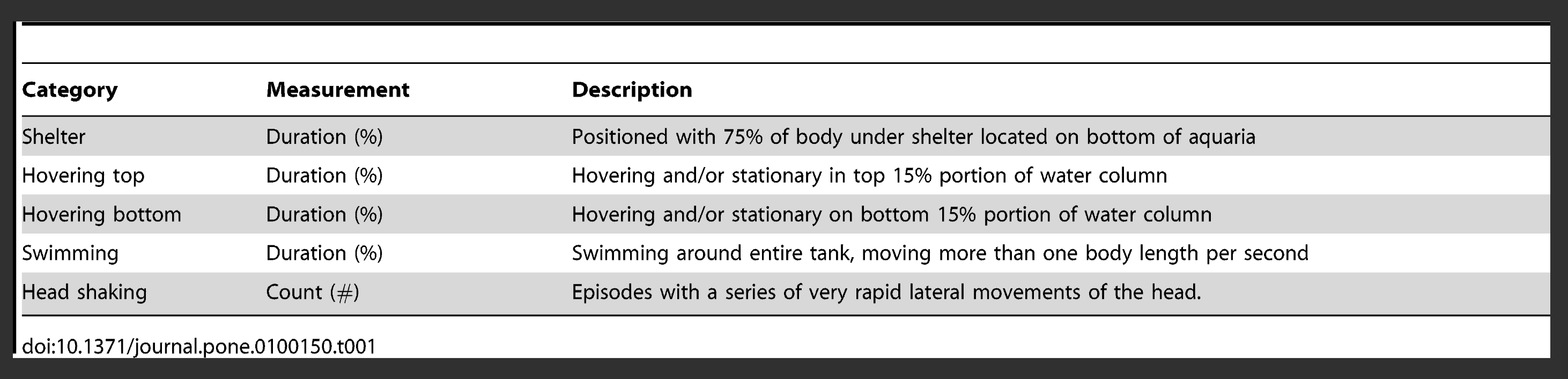
Interestingly, they found no effect of fish hooks on any fish response, which they argue might be because Atlantic cod have numb lips due to their tough diets (numb to only one stimulus?!).2
They did find an effect of acetic acid and capsaicin injection at the highest concentration. Huzzah! Fish pain! Only one problem. A year earlier, in 2013, researchers characterised the fish TRPV1 receptor, which is responsible for responding to capsaicin, and found that fish actually have mutations in key residues that render their TRPV1 receptors completely unable to respond to capsaicin.3 The authors of the 2014 paper simply missed this.
In other words, it is biochemically impossible for fish to detect capsaicin. This means that the behavioural response to capsaicin shown in the 2014 paper, whose authors include famed fish pain expert Lynne Sneddon, were completely fictitious.
This peer-reviewed paper hasn’t been retracted or anything, don’t be silly. Many other papers in this field suffer similar bias, and yet fish pain supporters don’t skip a beat in citing such papers and telling people how strong the “scientific consensus” is that fish feel pain.
There is no evidence nor any logical reason to believe that animals experience pain in any way similar to how humans experience it.4
A mightily convenient line in the sand
Even accepting that animal “pain” is really not like human pain at all, one might still be tempted to defend an animal’s life regardless of pain. Indeed, many vegans do hold this view. They believe in some “right” to life (although most vegans do not believe in God, so where exactly this right comes from is unclear). The obvious problem with inventing rights here is how do you decide who gets the right to life or not?
It is definitionally true that every extant organism is equally as evolutionarily successful and exhibits an equal “desire” for life as every other extant organism. That the bacterium that causes gonorrhoea fills a different ecological niche to antarctic orcas doesn’t change this fact. Both species have succeeded through the same length of evolutionary time. Both have adapted to their environments equally well (this is a binary—you either go extinct or you do not). Who are we as humans to assign the right to life to only a small subset of these organisms?
Vegans lean on the word “sentience” to fill in for an argument here, but nobody can really define what that means. Merriam-Webster defines sentient as “capable of sensing or feeling”, “aware”, or “finely sensitive in perception or feeling”. If you paid attention in biology class at school, you’ll recall that the S in MRS GREN stands for sensitivity, meaning that every living organism is definitionally sentient.
Indeed, scientists have uncovered many of the impressive ways in which plants display sensitivity, damage sensing, and communication. For example, plants release a wide range of volatile organic compounds in response to being eaten by insects or herbivores. These chemicals can signal to other plants to raise their defences ahead of time, or even alter herbivore eating patterns away from precious flowers and towards leaves that are more dispensable for the plant. Even the manner in which plants signal damage is remarkably similar to the way we do—using waves of membrane depolarisation to transmit electrical signals, which is exactly the mechanism by which neurons fire in us. Below is time-lapse video of plant pain in action from Aratani et al., 2023.
Most strikingly, a couple years ago researchers uncovered that plants literally scream when dehydrated or cut. The scientists suggest that farmers in the future could feasibly use microphones to pick up these gut-wrenching plant yelps and trigger irrigation systems to water the plants when they scream of thirst. Or perhaps pest infestations could be caught early just by listening to the desperate cries of pain from plants being eaten alive.
If you’re going to say a fruit fly can feel pain, why not a plant? Clearly, there is no real line to be drawn between plants and animals here in terms of what “deserves” to live or die. The reason this line in the sand is arbitrarily drawn as such is because otherwise veganism would very quickly go extinct and be obviously outed as the most moronically suicidal cult in human history. It is a necessary pausing of logic to keep their movement alive—literally.
Pt II: Yes, you should kill 10^100 shrimp if it makes you smile
Shrimp simps
A bunch of quite influential effective altruists seem to have recently become obsessed with shrimp welfare. Matthew Adelstein, aka Bentham's Bulldog, for example, has been writing for a while now about the moral imperative to donate to charities that implement shrimp stunning. The stunning is supposed to anaesthetize the crustaceans prior to them being killed. Because so many shrimp are killed for human consumption, utilitarians and effective altruists—who think that morality is some kind of arithmetic exercise—insist that paying for these stunners is just about the best thing you can do with your money.
More insistent still was a recent popular essay by Moralla W. Within titled “Yes, you should save 10^100 shrimp instead of one human”.
I’ve already shown how the presupposition here—that animals “feel pain”—is false. To appreciate the role that anthropomorphisation plays in building such a worldview, check out this emotive description of shrimp death from Adelstein:
“Imagine them struggling, gasping, without enough air, fighting for their lives, but it’s no use.”
The issue here is that susceptible readers of the vegan persuasion won’t imagine a shrimp here at all. They imagine a human struggling, gasping etc. Indeed, the author himself betrays that he is doing this because gasping requires lungs and struggling for air would be the opposite of what a shrimp—currently asphyxiating because it is in air—would require. It is impossible for a human to imagine being a shrimp, so instead we anthropomorphise. (I hope readers appreciate my deliberate attempts to do the same for plants above—two can play that game.)
It is anthropomorphisation that allows vegan utilitarians to assign a numerical moral value to shrimp. They argue that shrimp are at least a bit like humans, so let’s give a shrimp life 0.00001x the value of a human life. Well, if that’s true, then you just need more than a million shrimp until you surpass the moral worth of a human life. So the morally correct thing would be to kill one human if it meant you could save 2 million shrimp. Hah. Logic!
Obviously this isn’t quite right. To understand why, we need to dig a little deeper into morality, ethics, and meta-ethics.
What is morality?
Morality is a complex social sense that aids social decision-making in a way that directly or indirectly benefits ourselves and our close kin with whom we share a substantial amount of genetic material. Morality has only evolved in humans. Ipso facto it evolved for humans. Any application of morality that goes against this is therefore a misfiring and a perversion of morality. As such, contrary to the “rational” claims of the shrimp simps, moral worth isn’t awarded on a gradual scale proportional to how many neurons you have in your brain. Morality is an exclusively human trait and moral worth only applies to moral beings—humans and only humans.
Normative ethics vs morality
Ignoring the fact that the whole vegan argument is debased by the fact that animals don’t really feel pain at all in the sense that we do (despite our penchant for anthropomorphisation) and that the correct moral value for any non-human entity is zero, the utilitarian urge to calculate morality arithmetically is also just not at all how morality works.5
To try to describe how morality works or should work, philosophers have constructed various ethical frameworks. Consequentialism, which is the ethical framework that utilitarianism sits under, judges moral actions entirely by their consequences. You can see why this simple Excel-spreadsheet ethical worldview might be attractive to some—especially those who pride themselves on their rationalism—but it doesn’t map onto the ground truth of actual evolved morality well at all.
This mismatch is easy to demonstrate with a few examples. According to the rational utilitarian, it is not at all morally repugnant for a man to purchase a chicken carcass from his local supermarket to take home and have sex with. Necrophilia is also fine. Incest that doesn’t result in pregnancy? All good. No qualms with child pornography either if the child isn’t harmed. In fact, not only are these things not morally repugnant, but they are actually morally desirable to the utilitarian because nobody is suffering but somebody is gaining pleasure. Pleasure maximisation and suffering minimisation are the only concerns of utilitarianism.
I’d hope that most honest readers can admit that the chicken-fucker or the necrophile are obviously not paragons of morality. This is because morality is a complex emotional sense that evolved under selective pressures to do more than just maximise pleasure and minimise suffering. The single axis of morality that utilitarians focus on (the “care-harm foundation”) is only about one sixth of the story according to moral psychologist Jon Haidt. But utilitarians ignore their actual evolved sense of morality to instil their sterile, inhuman, calculated moral philosophy instead.
Utilitarianism also happens to be the ethical framework that has given rise to most of the human atrocities in the last 100 years or so, as I have written about recently.
While utilitarianism focuses on consequences, the other normative ethical frameworks focus on rules (deontology) or character (virtue ethics). I think the latter most closely models how morality actually works—by morally judging actions based on the virtues they reflect in the person, not the material consequences of the actions.
Once you stop massively overestimating the pain of animals, then holding onto a utilitarian ethical worldview leaves you in a sticky situation. If the goal is to maximise pleasure and minimize pain, then all it takes is a human who takes a lot of pleasure in harming relatively distant animals for the calculus to flip in favour of death. The utilitarian must believe that you should kill 10^100 shrimp if it makes the killer smile sufficiently strongly. That’s a little bump in pleasure being added to the universe with little increase in suffering. Or, since vegans round the pain of plants down to zero for practical but illogical reasons, killing 10^100 oak trees is highly moral if the tree killer enjoys doing so. This obviously sounds horrific and immoral, so the utilitarian tries to fix it by pretending that animals do feel a lot of pain, or by minimising the pleasure that humans get from food.6 But the solution here is to throw out utilitarianism altogether since it clearly doesn’t work.
The virtue ethicist, on the other hand, abstains from kicking a dog on the street not because of the interests of the dog, but because of the cruelty it reflects in the human. The human is the only moral entity in this equation, and the corruption of the moral character is what ought to be avoided here. This is why, even though morality didn’t evolve to protect animals, the virtue ethicist does not abuse animals willy nilly.
We can see how human moral character is a better ethical heuristic than consequences of actions by considering that a lion hunting and ripping apart a zebra limb from limb is not considered unethical by most sane people (there are some anti-predation vegans out there … seriously), yet if a human shoots a zebra for fun—a much faster and more humane death—most morally judge the human. From the anthropomorphised zebra’s perspective here, clearly the bullet to the head is preferable. So why do we consider shooting a zebra to be immoral but we don’t judge a lion for hunting for its prey? Because shooting the zebra for fun exhibits moral vice—something the amoral lion cannot exhibit.
But if killing an animal is immoral according to virtue ethics, which I seem to be so keen on, then why isn’t veganism morally virtuous in the same vein?
Pt III: Selfish veganism
Teleological causation
Psychologist Alfred Adler was a contemporary of now-disgraced and debunked, but much more famous, psychologist Sigmund Freud. While Freud pushed the idea of aetiology—explaining behaviours through psychological cause and effect all the way back to childhood—Adler disagreed. Adler, drawing on Aristotelian thought, thought that a teleological framework better encapsulates human psychology, motivations, and behaviours. Teleology involves analysing the purpose of things. It asks what the end goal of an action is and posits this to be its cause. Earlier I mentioned the baby crying not because it is traumatised, but because it desires attention and it knows that crying garners said attention. What does veganism look like through an Adlerian lens?
Who is veganism serving? Well, first and foremost, it serves vegans. Since we are both a moral species and a social species, projecting your own moral goodness to others is a very rewarding thing for humans to do. Not only do we have in-built neurological mechanisms that psychologically reward moral actions, but society has powerful social mechanisms that bolster these psychological rewards further.
Giving to charity feels good. Knowing that someone else knows that you have given to charity feels even better.
The same applies to veganism. The potent psychological reward gained by (1) persuading yourself that you are doing something morally good and (2) letting others know of your moral righteousness (either actively or—even better—passively) are the primary motivations for veganism and utilitarianism more broadly. This is most obviously true when the promised utilitarian benefit doesn’t even accompany the moral posturing, as is the case with most vegan consumer decisions. A small fraction of the population choosing to buy a mushroom burger at the supermarket does nothing to prevent the meat aisle reliably selling all of its stock every week. That no cows are saved here really doesn’t matter though, because subconsciously it is the feeling of having done something good that the vegan is after. Importantly, the fact that the vegan is not cognizant of this emotional reward driving their actions doesn’t affect the veracity of the phenomenon.
Selfish sympathy
Why don’t we like watching Gazans being bombed? It’s actually not directly because of the pain that the Gazans might be feeling. It’s because of the pain that seeing the video footage inflicts on us. This pain exists because of a genius evolutionary chess move that promotes altruism through purely selfish means in humans—sympathy.
Sympathy (not to be confused with empathy!) means that humans literally feel pain when they perceive someone or something else to feel pain too. Sympathy has the effect of tying the emotional fate of ourselves to others, so we work to protect others only because it reduces our own sympathy-induced suffering. It is important to realise that, because of sympathy, the shrimp simp is primarily alleviating their own pain and discomfort when they donate to shrimp charities. Likewise, the vegan abstaining from meat alleviates their own pain and discomfort when choosing not to eat steak. In this way, veganism—but really any utilitarian cause—is motivated purely selfishly. Selfishness dressed up as altruism—because altruism is self-serving at both the social and psychological levels.
Note: I’m not saying that this makes altruism bad. Au contraire. I’m merely pointing out that altruism has mutually beneficial outcomes for the benefactor and the recipient. That’s how it could evolve. Pretending that this is not the case, however, amounts to dishonesty, which actually is immoral.
The issue with sympathy is that it is extremely promiscuous. That we feel sympathy for animals is no indication that animals are actually feeling pain (although most of us assume that they do). We also feel sympathy for inanimate or non-biological objects like lonely bananas in a supermarket or robots being kicked by YouTubers. I have no doubt that in twenty years time we’ll have utilitarians writing essays on how its really important to defend robot “rights” because there is a tiny chance they feel pain. Some people even insist of using “please” and “thank you” when using ChatGPT … just in case. Heck, maybe the video I embedded earlier of plant calcium signalling in response to herbivory-induced volatile compounds is enough to trigger the sympathies of some readers (but what if plants actually do feel pain? We can’t rule it out for sure, right?!).
Virtue or vice?
According to Aristotelian virtue ethics, it is the motivations of the moral being that dictate the morality of an action. I’ve highlighted how the motivations for veganism are at their root selfish. The feeling of moral superiority is a good one after all. That evolution loaded selfish incentives into altruistic and moral behaviours hardly makes these things immoral though—that would be a ridiculous moral paradox. Is there a way to be vegan without being Pecksniffian then? Is sufficiently downplaying one’s moral superiority enough to turn veganism into something genuinely virtuous?
To answer this we can again turn to Aristotle, who noticed something fascinating about virtue: the golden mean.
The golden mean refers to the fact that all virtues sit between two vices at either extreme. Courage sits between recklessness and cowardice. Friendliness sits between being a people-pleaser and being rude. This is an almost frustratingly true observation from Aristotle. Anything done to excess—even if that thing is literally being morally good—becomes a vice.
Crucially for vegans: virtuous compassion is the golden mean that sits between cruelty and excessive sympathy. Most morally calibrated people intrinsically understand that unfounded sympathy for all animals is excessive and is therefore vicious.
Ultimately, the contorted pseudo-rationalism of the utilitarian, which abruptly stops at the plant’s right to life, is inferior to the raw evolved moral sense of the everyday person. Common sense trumps inaccurate ethical philosophy, no matter how deeply carved the philosophy is.
The proof is in the (non-vegan) pudding
While I am sure vegans and utilitarians will disagree with my arguments here, I actually don’t need to persuade them. My philosophical ethical framework is much more closely aligned to ground-truth human morality, while utilitarians mistake the map for the terrain by supplanting actual morality with an inadequate ethical philosophy. Proof of this can perhaps be seen in the success of the veganism movement at large.
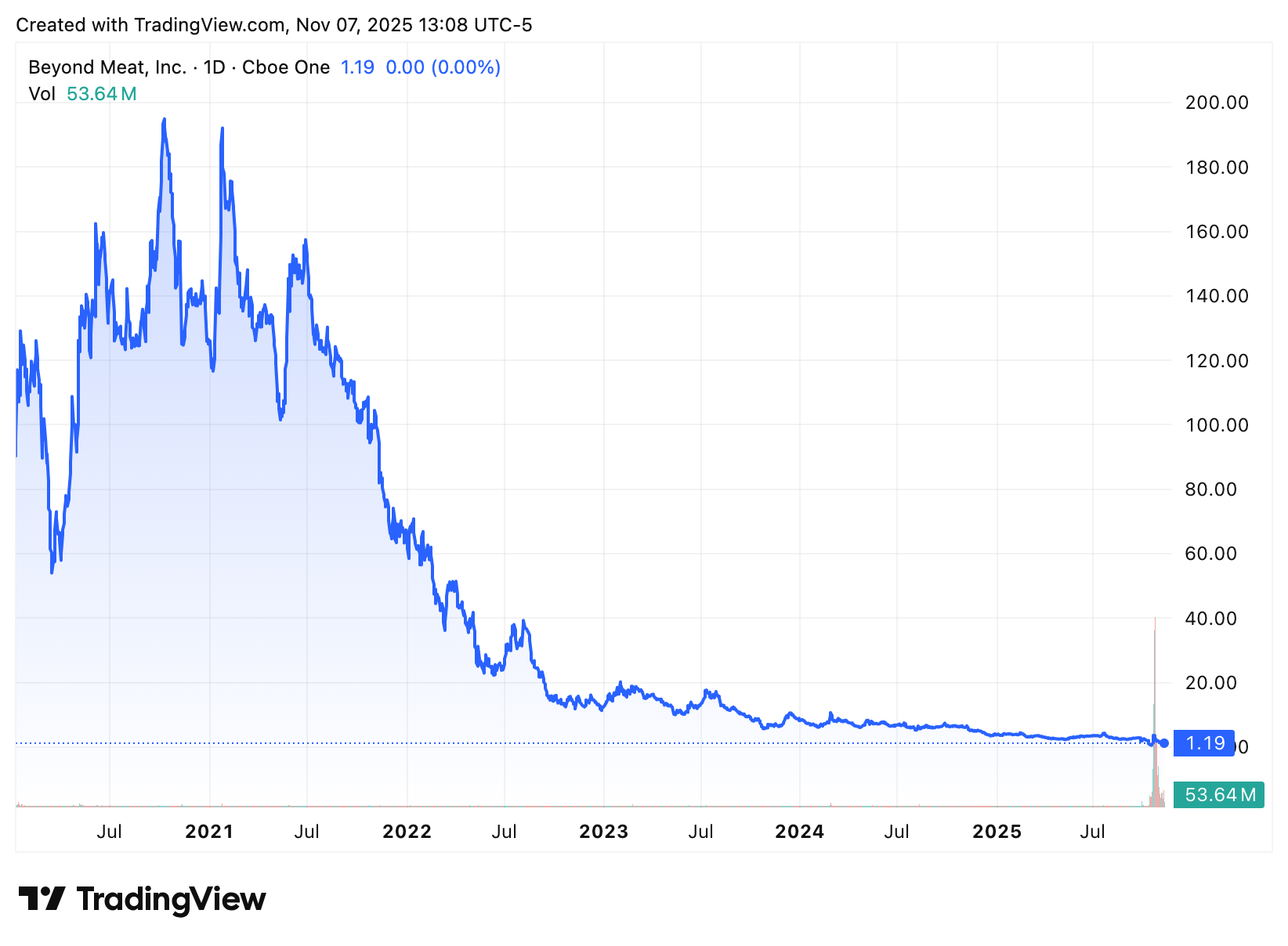
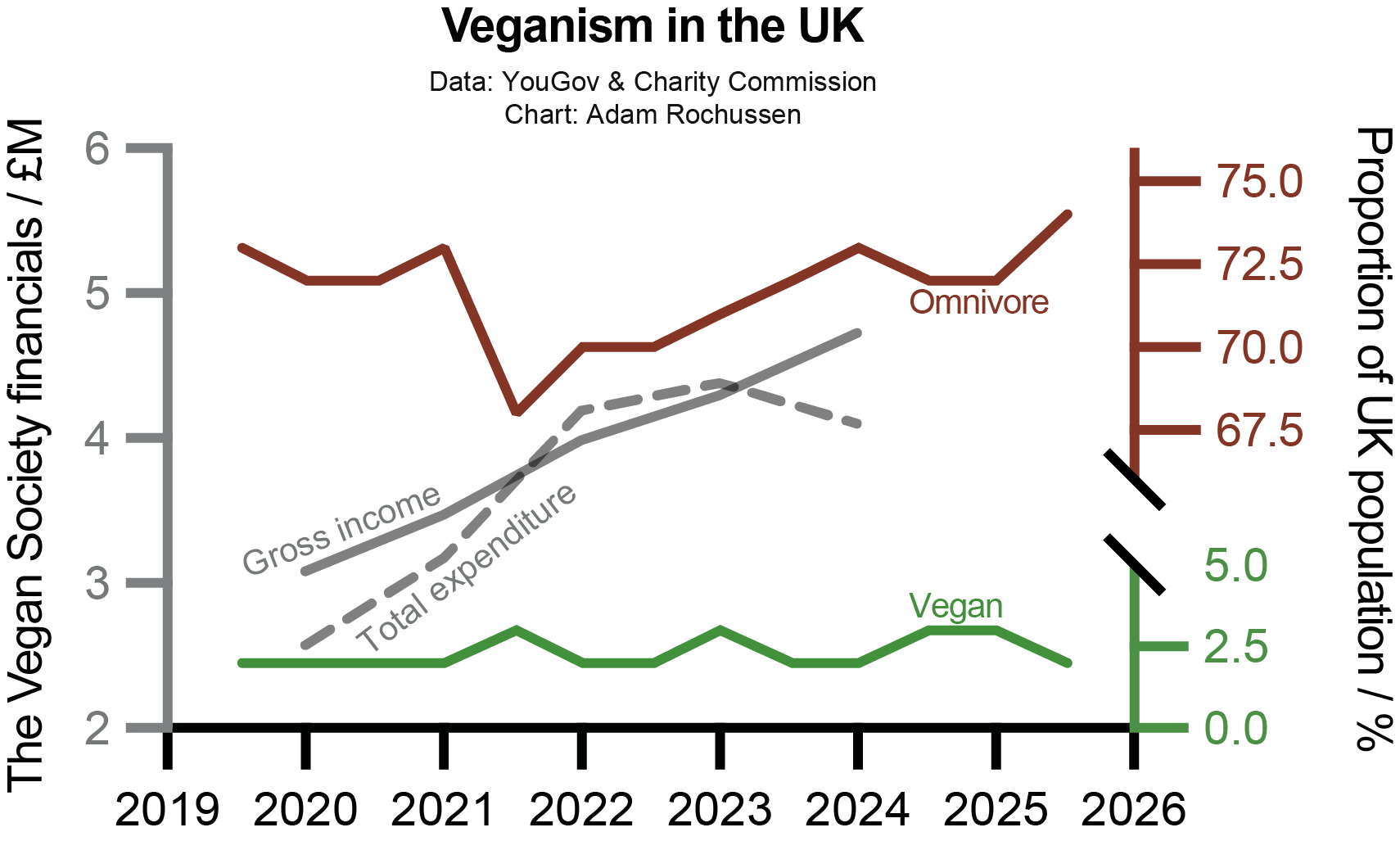
Veganism is a heavily bootstrapped movement, meaning big organisations spend a lot of money trying to evangelise for their neo-religion. Around 2% of Brits and 1% of Americans are vegan, and this percentage hasn’t really shifted upwards at all over the past 6 years or so. This is despite ever-growing efforts to convert more omnivores by non-profits like The Vegan Society, which now spends over £4 million per year.
In fact, after a nadir in omnivorous Brits mid-2021 (likely a product of desperate experimentalism during COVID lockdowns), the proportion of the UK that eats meat has risen year-on-year and is now at its highest point since polling began—at 74%.
Even Veganuary—the flagship event for vegan evangelists—saw a ~20% drop in participants between 2021 and 2024.
Clearly, the failure of the movement isn’t due to lack of trying. I think most common sensical people get a hunch for the logical fallacies that lace the vegan worldview even without being able to pinpoint or articulate them precisely. You don’t have to pin down the amino acid sequence of the Atlantic salmon TRPV1 receptor, nor trudge your way through a copy of The Nichomachean Ethics to know that the arguments for veganism are simply not persuasive. If good people aren’t persuaded of your moral worldview, its probably not because they’re stupid or evil. It’s probably because your moral worldview just isn’t any good.
The authors refer to a “delayed recovery of OBR” induced by their noxious stimuli in their conclusion, despite the caption for the relevant figure clearly stating that “[t]here were no statistically significant differences (p>0.05) in OBR evidenced between treatment groups at any time-point”.
Atlantic salmon probably do have numb lips. Just like how they have numb brains that are incapable of processing emotions or experiencing pain like humans do.
To be precise, this paper characterised the zebrafish capsaicin receptor (TRPV1), not that of Atlantic cod. But I checked the Atlantic cod TRPV1 sequence and aligned it with that of human and zebrafish and confirmed that the cod receptor also lacks the key serine and threonine residues in its transmembrane domains.
You might have an argument once you get phylogenetically very close to humans, but even chimps are drastically different to humans. A recent paper found that chimps actually share about 85% of our DNA—not the bogus 99% that is so often touted (they literally have an extra pair of chromosomes compared to us). The six million years of divergent evolution between us and chimps is more than enough to create completely distinct capacities for consciousness. This is perhaps evidenced by the fact that one species has stepped foot on the moon (allegedly), while the other can’t even communicate beyond basic grunt-like reactions to immediate events.
When I say zero moral value, I mean from the perspective of evolution. In reality, we assign plenty moral value to animals in our lives. This is typically awarded according to phylogenetic proximity to humans (ie chimps get more than fruit flies), or based on personal connection (ie a pet dog). That this is the case reflects that it is an ultimately anthropocentric and selfish endeavour—stemming from leaky sympathy that was originally evolved to serve only humans, or from protecting individual animals that offer us personal value.
It is no coincidence that many vegans didn’t like meat in the first place, and then realise adopting the vegan worldview offers them huge advantage with very little personal cost.
I've enjoyed the previous articles but this one feels like a bit of a misfire.
First, saying we can’t know animals feel pain is like asking whether the green I see is the same green you see. We can’t access another’s consciousness, human or otherwise, but if it walks, sounds, and reacts like pain, the most reasonable assumption is that it is pain.
Second, vegans don’t claim animals experience pain identically to humans. The point is that their suffering, however different in texture, outweighs the trivial pleasure of eating them. That’s a pretty low moral bar.
Third, dismissing “animal pain science” based on one fish study is weak, and the plant-suffering argument actually backfires: most crops are grown to feed livestock, so eating plants directly reduces total plant and animal death.
The sections on utilitarianism and “virtue ethics” also contradict themselves. "The virtue ethicist, on the other hand, abstains from kicking a dog on the street not because of the interests of the dog, but because of the cruelty it reflects in the human." If animals can’t feel pain, then cruelty toward them can’t exist ... yet the author appeals to cruelty as a moral vice. You can’t have it both ways.
Interested in your responses to these.
I do not have the time for a more detailed critique of this, but by the gods does it leave me uneasy. I certainly could not be bothered to defend veganism, which irritates me as well. But to start making statements about how animals can’t feel pain - really? Has the writer ever had a pet? What is this, a week after that autistic psycho Descartes said animals can’t feel pain and left the door open for unleashing heaven knows how much pain inflicted by vivisectionists?! What is this, those primitive days when surgeons decided they could operate on babies without anaesthetics because they didn’t feel pain either? This is philosophising your way into some kind of psychotic hell, it feels like to me. It feels wildly completely-left-hemisphere, as if Dr Iain McGilchrist had never written anything. As for morality only existing in humans and being based on reasoning - puh-leeze, that is so 19th century. Examples of morality at some level are found all over the animal kingdom, and quite apart from the fact that we are on a continuous spectrum with the animals we evolved from, morality is not based on anything conscious or philosophical, it is based on the foundation of compassion, which surely evolved in parent animals which had to protect and nurture infant animals, not who had some kind of “approach” to “pain” and “society”, and then from reciprocation in hunter-gatherers, even where selfish as well as unselfish. Isn’t it like the old idea that you could separate emotion and reason, when modern neuroscience teaches us you can’t do anything of the kind? People who wonder about consciousness and cognition and philosophy would, it seems to me, get something rather richer out of reading Iain McGilchrist and listening to Dr Michael Levin. Veganism doesn’t seem to contribute to a better world - but neither does the denial of animal sentience, surely. And as for whether robots will ever have their rights defended - we don’t even know how to explain consciousness yet, and even though LLMs aren’t conscious, it seems to me that listening to Dr Levin should sow at the very least a smidgen of doubt about whether we can start separating cognition and consciousness, and then phenomenology and teleology and pain and compassion, quite so “cleanly”. And I really want the quote marks around “cleanly”, because some arguments here feel anything but “clean” to me. (As for the arithmetical arguments about shrimps or prawns, that’s pure left-hemisphere madness as well. I do appreciate the writer isn’t defending the arithmetical equivalence there, but it was all just “in the mix” of “moral humans, yeah, moral animals, no”, which I think doesn’t get off the philosophical launching pad, even if just because we believe in Darwinian evolution.)