

Some time ago, in the mid-naughties, my parents gave my older brother a CD for his birthday. It was the 2002 album “Busted” by the band “Busted”. The song that got played on repeat on the CD player was “Year 3000”. An absolute banger of a tune—please go listen to it now if you are not familiar. I stumbled across it recently. Nostalgic. Whimsical. Heroic. Upbeat. Prophetic? The lyrics talk about how a buddy of the singer had built a time-machine and travelled to the year 3000 (assumed to refer to anno domini). The singer then goes with his friend to the year 3000 and describes what he observes. Thus the entire song is a positive vision for the future in ~1000 years time, encompassing future technologies and cultural norms. But how plausible are these predictions?
The first thing to note is that predictions about the future are very difficult. Seismic shifts in society can be triggered by so-called “black swan events”, which have a very low probability of happening, but an outsized impact if they do (as described by Taleb). For example, the inventions of the internet in 1983 or social media in the late 1990s have created absolute paradigm shifts in the human experience, yet no SciFi novel or film prior to these inventions even came close to predicting them. Authors of the 20th Century who wrote about the future, such as Huxley in Brave New World, had absolutely no reason to predict e-thots on TikTok (although he did predict non-e-thots, to his credit).
Predictions that are made tend to be informed by the cultural zeitgeist—heavily biased by whatever it is that people care about or think is cool at the time. Ahead of the 1900 world fair in Paris, artist Jean-Marc Côté was tasked with producing a portfolio of prints depicting predictions for the year 2000. Some were really on the money, including depictions of video messaging, news podcasts, fast fashion, and advances in astronomy and microscopy. The craze at the time, though, was underwater diving, in the wake of the invention of diving helmets in the early 19th Century. And so many of the scenes were underwater scenes, including several pretty whacky examples of harnessing sea creatures for human transportation. Flying cars / personal planes also featured heavily, possibly influenced by the nascent invention of the personal automobile. Personal flying machines are a pretty common prediction actually, also featuring in Brave New World, as well as Star Wars and Blade Runner. Given some recent progress on this front, perhaps this prediction wasn’t so bad actually, and just mistimed.
#/media/File:France_in_XXI_Century._Correspondance_cinema.jpg)
#/media/File:France_in_XXI_Century._Audio_journal.jpg)
#/media/File:France_in_XXI_Century._Latest_fashion.jpg)
#/media/File:France_in_XXI_Century._Astronomia.jpg)
#/media/File:France_in_XXI_Century._Microbes.jpg)
#/media/File:France_in_XXI_Century._Race_in_Pacific.jpg)
#/media/File:France_in_XXI_Century._Divers.jpg)
#/media/File:France_in_XXI_Century._Whale_bus.jpg)


Whilst some inaccuracies are directional, others are simply in magnitude, erring on the side of being too ambitious. So predicting 100 years into the future can yield quite accurate results it seems. Well, how about 1000 years? Let’s talk about Year 3000 and the year 3000.
Underwater habitation
The song begins with the singer describing coming home one day and hearing a “funny noise”. Upon investigation, he finds his neighbour, called Peter, has built a time machine and recently used it. Peter tells of his escapades:
He said "I've been to the year 3000
Not much has changed
But they lived underwater …”
It seems the late 19th Century obsession with underwater habitation has persisted through to the 21st Century. It’s easy to see why the underwater world captures the human imagination—the deep is an incredibly mysterious place, with fantastical creatures, a lack of light, and scarily little mapped territory. But why would we ever consider living there?

One reason would be, simply, spatial constraint. If human population fixes its current worrying trend and grows significantly in the coming centuries, it is conceivable that usable surface area becomes a limiting factor.
Whilst this is a conceivable motivation, I don’t find it that plausible. The population would have to be fairly considerable for an underwater city to become a necessity. With the current population of ~8 billion only utilising around 15% of the total land mass, a linear extrapolation would require over 53 billion humans to exceed the limits of land. Of course, this assumes that all the land would be useable, which is an an assumption I am granting, since an underwater city is probably a more difficult technological feat than a mountainous, desert-bound, or (ant)arctic one. Additionally, the relationship between land use and population size would almost certainly not follow a linear trend into the future, with technological progress increasing our efficiency of land use per capita (e.g., skyscrapers versus mud-huts). Add to this the prospect of flying cities (the logical extension of Lockheed’s CL-1201) and the human population could probably exceed 100 billion before going underwater is an absolute necessity.
I say “human population”, but I really mean “human population on Earth”, since a Martian colony is likely to be a thing this century, deo volente. Building on Mars is probably easier than building on the ocean floor (at least in the parts that aren’t pretty shallow—the average depth is ~3,600 metres). Sprinkle in some colonies on the Galilean moons or simply completely artificial pseudo-planets, and the human population required for it to be the forcing function for ocean-floor cities would be at least a couple hundred billion. Not impossible by the year 3000, given the thousand-year jumps in human population since 0 AD going from ~170,000 to ~275,000,000 to ~6,170,000,000, but not likely, based on current trends in advanced economies.
A more plausible motivation to live underwater would be the same reason that a male dog licks his bollocks: because he can. Humans are inherently exploratory and curious creatures. Whilst modern society has developed many ways to extinguish our exploratory drive by cheaply delivering dopamine (social media being the prime example of this, Justin Bieber being another), pioneers do and always will exist. Such pioneers do things that would seem completely irrational to the ordinary person (Magellan, Amundsen/Scott, Hillary/Norgay etc.), so we don’t necessarily have to rationalise an underwater city for it to be built. Who the hell would build a house on top of a tree in the middle of the Amazon, or a city in the middle of a desert? Humans. That’s who.

But the most likely driving force for human cities under the ocean, in my opinion, is astronomic or atmospheric protection. I’m talking about serious climate change here, not CO2-induced warming, which really just isn’t that bad in the grand scheme of things1. An underwater city would protect against such threats as solar radiation, nukes, asteroids, and ice ages (which could be unrelated or related to all of the above). To briefly expand on each of these (we’re only two lines into the song!):
Coronal mass ejections (CMEs) from the Sun are potentially very harmful. These proton effluxes are hard to predict and can be beautiful or devastating. One of the reasons Earth can have a life-enabling atmosphere is due to the protection our strong magnetic field (affording by our iron-rich core) provides. A particularly strong CME would destroy electronics (although I would predict photonics to replace electronics by the year 3000). But more worrying than a global EMP attack would be degradation of the atmosphere. For example, a particularly strong CME in 2012 was shown to deplete ozone substantially at the poles. The knock on effect of this would be decreased protection against high frequency UV radiation, which can sterilise the surface of the planet completely in the extreme. Seawater is much more protective against radiation than air, and thus an underwater city would be completely protected in this regard.
Nuclear war remains, in my mind, the most substantial man-made civilisational threat. The problem with nukes is that you have very little time to respond, and there isn’t much you can do to respond except retaliate. An underwater civilisation solves the WMD issue in several ways. The first thing to note is that exploding a nuke underwater does less and less the deeper you go. Secondly, the speed of a projectile under water is significantly slowed compared to in the air, giving much more time for defensive measures. If we imagine some kind of underwater dome with a nuke that explodes, then the primary threat will come from cracking of the dome which would flood and crush everything inside. Since this is the primary threat of living underwater anyways, we might imagine significant safety measures and guardrails against such a catastrophe, such as highly segmented neighbourhoods meaning that a breach in one part of the dome only impacts a small part of the underwater city at large. Of course, we might expect another leap in weapons technology, such as anti-matter bombs, that could be highly destructive at great depths. Regardless, living underwater is preferable to living on the surface from a military perspective—evidenced by the importance of nuclear submarine fleets in maintaining military dominance across the globe.
Asteroids or comets (like the one that likely ended the ice-age 12 000 years ago, giving rise to global flood myths, and causing the extinction of megafauna) are also highly unpredictable existential threats that we currently have no defence for. The benefit of an underwater society for protecting against these is obvious. Indeed one hypothesis for the underground cities of Cappadocia, Turkey, is that they were constructed by humans wishing to evade cosmic impacts either predicting or responding to the aforementioned Younger-Dryas impact 12 000 years ago. It must be said, though, that there are more straightforward defences against cosmic impacts, such as satellite-based ballistic missile systems or laser cannons. In the case of another dinosaur-killer, tracking and destroying/diverting it prior to impact is going to be a lot more successful than just hiding underwater.
Finally, any of the above could plunge us further into the ice-age (I guess we are technically still in an ice-age). Things like magnetic pole shifts, volcanic mega-eruptions, and anti-global warming measures gone wrong could also feasibly achieve such a feat, negating much of the benefit of being on the surface anyways. An underwater civilisation would be much more stable to such climactic fluctuations.
Advances in robotics will be critical to the engineering of an underwater civilisation, since we would not want to risk human life in the construction process (not that this has stopped previous engineering). Little else lies in our way though. Unlike other feats, such as interstellar space travel, which require serious fundamental advances in physics and/or material science, we have access to everything we need to make an underwater city—evidenced by the fact that we’ve done a fair bit of underwater construction and have taken many more humans to the very deepest point of the ocean than to the moon (infinitely more?).
With sufficient motivation, it seems very plausible that, by the year 3000, not much would’ve changed but we’ll be living underwater.
Age-maxxing
On his travels, Peter stumbles across one of Busted’s descendants:
“ … And your great-great-great-granddaughter
Is pretty fine, is pretty fine”
First thing to note is that this prophecy is already underway, with the lead singer of Busted’s wife giving birth to two boys—one in 2015 and one in 2018. Charlie Simpson is also a pretty good-looking fella, and his wife is as attractive as you might imagine the wife of a handsome, famous, and successful musician to be. One might imagine that Charlie’s financial success and stable lifestyle creates long-lasting generational wealth that will boost the sociosexual desirability of his descendants in the future, increasing their chances of aesthetically hypergamous mating. The stage is set for a “pretty fine” great³-granddaughter.
The other thing to note here is the number of generations mentioned. The skeptics amongst you might think that this was a prosodic decision, rather than prophetic one. But let’s think about the implications of five generations across one thousand years. This implies a mean intergenerational distance of 200 years, which sounds completely implausible, but the median intergenerational distance will probably be much shorter, with the gaps becoming progressively larger over each generation. Current longevity research is still in its absolute infancy, with the trailblazers just about catching up to the centuries-old wisdom of vampires. We still don’t really know what ageing is, with groups of scientists favouring an epigenetic, genetic, or proteomic basis for ageing. Once we can sort this out, we might be able to slow ageing down to a crawl.
This process will be highly exponential, since advances in ageing research cannot be retroactively applied to the generation that makes the discoveries (meaning we’ll see a lag in lifespan relative to where our potential lifespan could be based on the scientific progress at any given time). To illustrate this lag effect, consider the fact that the egg which gave you half of your genetic information was created during your mother’s embryogenesis. This means that the environmental conditions of your pregnant grandmother dictate your lifespan to a certain degree (assuming genetic and epigenetic bases for ageing). That’s remarkable. By the same mechanism, a perfect anti-ageing protocol now will only manifest its true potential on human lifespan in two generations time.
Our grandmothers were basking in all sorts of environmental toxins (second-hand smoke, alcohol, asbestos, lead, mercury, et cetera), and we (health-conscious Gen Z in advanced economies) will still likely all reach one hundred. Fifty more years of longevity research and I think potential human lifespan could readily exceed 200 years. There are also some technologies—currently restricted to SciFi—that would prolong human lifespan indefinitely, such as complete somatic replacement (transferring consciousness into a fresh body). Pair this with advances that allow for reproduction late into life (as is the desire in the West), and an intergenerational gap of a couple centuries does not seem all that far-fetched.
Sex (& Drugs) & Rock & Roll
In the second verse, the protagonist gets a chance to validate the findings of Peter and to see what else is happening in the year 3000:
He took me to the future in the flux thing
And I saw everything
Boy bands, and another one, and another one
And another one
Triple-breasted women swim around town
Totally naked
In general, I would argue that music and sex are pretty solid bets for “things that will stick around”. Mix in some kind of mind-altering substance and you have the age-old trifecta of Wein, Weib und Gesang aka drugs, sex, and rock’n’roll. But what about the specific claims here? We’re told that male musical troupes are even more common in the 3000s than they were in the 2000s. How likely is this?
Music probably culturally evolved at the same time that human societies did, with the earliest direct evidence coming from bone flutes in some German cave dated to > 35,000 years ago. The earliest known written song is from ~3,400 BC Assyria, emerging about as early as writing itself (sorry if you clicked that link… the song is disappointingly shit). Why humans created and love music is a huge mystery, but it seems to be a permanent feature of any human society.
The production of music and its propagation amongst the masses has also become easier and easier over time, enabled by technology. Its accessibility and propagation can be visualised by looking at the revenue of music from different sources over the past 50 years (below). Interestingly, the revenue shrinks as better technologies develop and then rises as accessibility increases. As this dance between supply and demand oscillates, the number of people both producing and listening to music ever increases. Simply put, nowadays many more people are paying to listen to music, but they pay much less per song than 50 years ago—the value of music has degraded whilst its total consumption has increased, leading to a more or less stable total revenue over time.
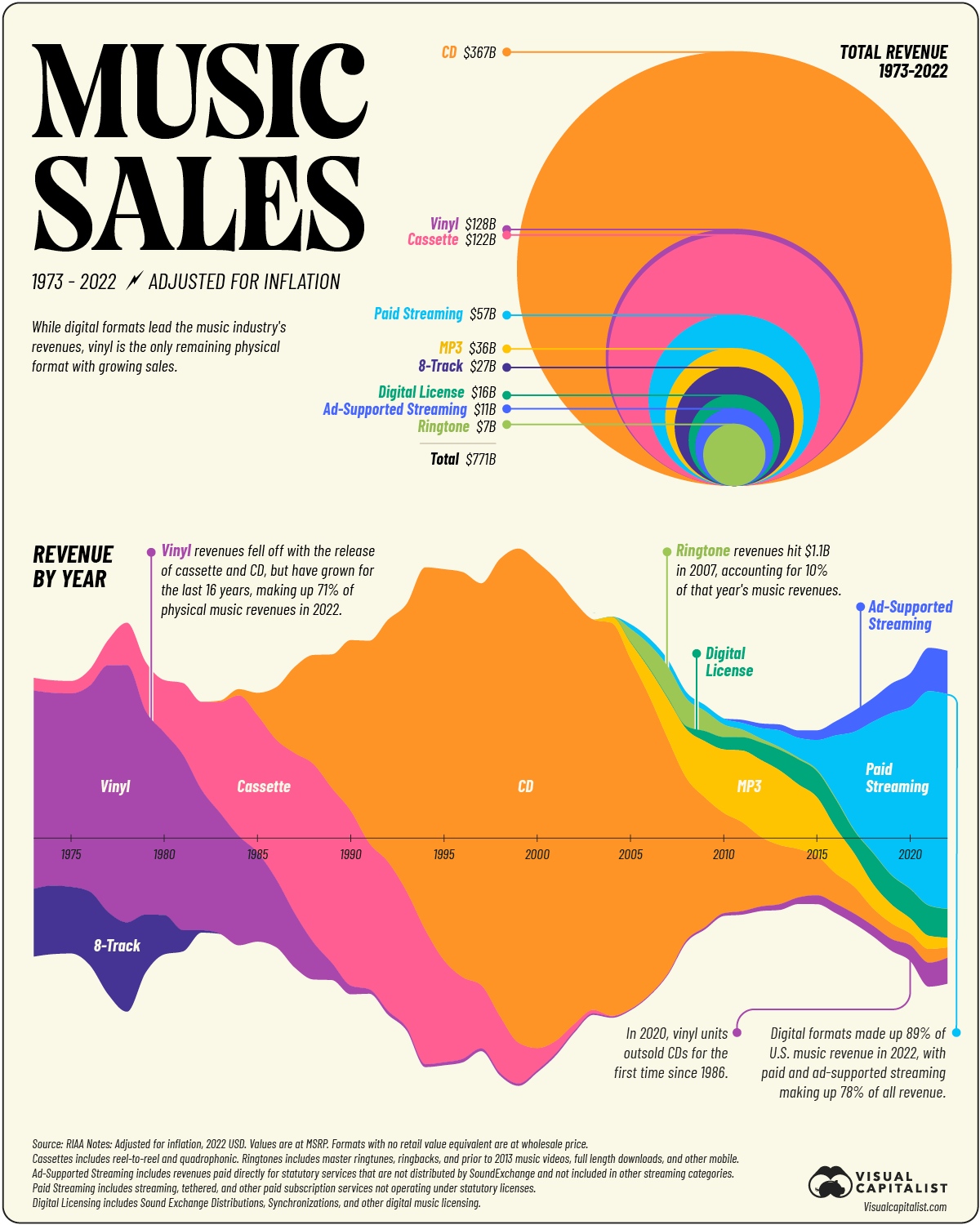
As for boybands specifically, one could make a decent argument that they have been on the decline since the naughties. It’s hard to get stats on these things, but off the top of my head, I can’t think of many recent non-Korean boybands since One Direction. To me, this doesn’t imply that the industry is heading in one direction, though, and is simply demonstrative of our position in the current cultural cycle. Music, like fashion, architecture, and other forms of art, tends to be cyclical. Music also follows cultural shifts: Country saw a huge resurgence leading up to Trump’s historic 2nd (3rd?) election win, whilst boybands in Korea are immensely popular at the same time that women and men in Korea have never been further apart ideologically and socially, carving a perfect niche for proxy-romance via musical artist. Given huge growth of musical artists and human population expected by the year 3000, it makes sense that boybands, too, would proliferate considerably.
What about “triple-breasted women swim[ming] around town totally naked”? Sexual hedonism is an incredibly constant feature of human societies across millennia, so we have good reason to assume that it will persist into the year 3000. There are numerous examples of pornographic cave art, sculptures, and even Palaeolithic dildos (although interpretation is debated) going back tens of thousands of years.

Sexual hedonism is probably also a cyclical element of human societies, with prosperity giving rise to hedonism, which in turn breaks down social order and productivity. This destroys prosperity, which then expunges excessive hedonism from society. When sexual hedonism does rise, though, even the most authoritarian attempts to remove it from society are no match for horny people: despite porn being completely illegal in many middle eastern countries, fewer than 5% of people surveyed in these authoritarian nations have never watched porn, and over 40% of men watch it weekly (and that’s just the honest ones).
So an appetite for sexual hedonism will likely remain for another thousand years, but what about the tritties? This example of drastic body modification for sexual titillation (pardon the pun) was obviously inspired by Total Recall (1990), but science has a terrible habit of catching up with SciFi. Advances in plastic surgery within the 20th and 21st Centuries have set the precedent for this sort of thing already, with body modifications ranging from mundane lip filler jobs to extreme autogynephilic transition surgeries. With the idea of the triple-breasted woman planted in the human collective consciousness, it doesn’t surprise me to find out that one woman (falsely) claimed to have had it done, and it wouldn’t surprise me if, by the year 3000, women will actually have it done.
Fulfilling the prophecy
If you’ve ever googled your own name, you’ll appreciate what Busted did next on their trip back to the future2. They checked in on their own legacy:
I took a trip to the year 3000
This song had gone multi-platinum
Everybody bought our seventh album
It had outsold Michael Jackson
I took a trip to the year 3000
This song had gone multi-platinum
Everybody bought our seventh album
Seventh album, seventh album
Year 3000 has already “gone multi-platinum” as of 3rd January this year. A pretty cool achievement 20+ years after its release. As for a seventh album, it is yet to be released. They’re sitting on four or five studio albums at the moment (their 2023 album “Greatest Hits 2.0” is a compilation album but with significant re-workings and one new song, so some classify it as a studio album). This continued output, alongside active touring, implies that they are not done just yet.
If they do produce a seventh album, “everyone” buying is actually not that implausible due to changes in the way that we purchase music. Now that we largely stream music, one could argue that anyone who uses a streaming service, such as Spotify or Apple Music, has essentially bought the album (via a license to stream). This is a semantic point but I’m going to grant it. Alternatively, if we ever experience a full-on communist revolution between now and the year 3000, then everyone will own the album (although they wouldn’t have necessarily “bought” it with money… perhaps with freedom though)3.
For this future seventh album to outsell Michael Jackson, the bar isn’t actually that high. Busted’s top selling album, “Busted”, sold around 1.3 million copies, whilst Michael Jackson’s 1972 album “Ben”, for example, only sold around 60,000 copies. If I raced Usain Bolt and he sprained an ankle off the blocks, leading to his DNF and my victory, I’d argue it’s totally fair for me to claim to have run 100m faster than Bolt, even though I know he has raced much better at other times. Thus, it is fair to say that a Busted album has already outsold a Michael Jackson album, making this goal for a potential seventh album pretty attainable.
To conclude, I think Busted might be onto something with the following claims:
living underwater
pretty fine great-great-great-granddaughter
lots of boybands
triple-breasted women walking around naked
going multiplatinum (already the case)
The lowest-confidence claim is the seventh album, and this is the one claim that is under the most direct control of Busted. This essay, and others like it4, might do its part in spreading the good word, but fulfilment of this aspect of the prophecy is very much in the hands of the band members. Godspeed fellas.
I can write more extensively about present day climate change another time—but for now let me just leave you with the fact that even if all of the ice on earth melted (which would take an insane amount of warming—like 15 degrees Celsius), this would only add around 70 metres to the global sea level, and this in turn would only decrease land surface area by around 8 % at most. Now if this happened overnight, it might be problematic, but a slow change would be fine, as demonstrated by historic precedent.
This film is referenced throughout the song as the inspiration for the time machine: “He told me he built a time machine/ Like the one in a film I've seen”.
For people that criticise the current asymmetries between record labels and artists under capitalism, consider that artists will get zero compensation at all under communism and there will be no incentive at all to produce music other than just for the fun of it.
Tragically, when writing these final paragraphs I stumbled across an article with the same premise from 2018. I thought it was a pretty original idea after obsessively listening to the song recently. Kinda bummed actually, although I think mine is way better. Also—for the record—I came up with “tritties” by myself and was again pretty proud, until I found an urban dictionary entry for it :(