

This is the third of a series of essays focused on enhancing scientific progress by rethinking how we do academic science. Throughout my fellowship with the Roots of Progress Institute, I will be writing several more. Thank you to Mike Riggs for assistance editing this essay and to other RPI fellows for valuable feedback.
The physicist Max Planck wrote in his 1950 autobiography:
“An important scientific innovation rarely makes its way by gradually winning over and converting its opponents: it rarely happens that Saul becomes Paul. What does happen is that its opponents gradually die out, and that the growing generation is familiarized with the ideas from the beginning: another instance of the fact that the future lies with the youth.”
If the future lies with the young, why do we place it in the hands of the old?
Around 21% of all NIH-funded PIs were under 35 in 1980, compared to around 3% in 2015 (and presumably even less today). Meanwhile, the number of very old professors has crept upwards. Among U.S. medical schools, the average age of faculty was 43.1 in 1980, rising to 49.6 in 2015, but the upper tail shows a very sharp rise—particularly after the 1994 abolition of mandatory retirement for tenured professors in the U.S. By 2015, the Association of American Medical Colleges recorded 22 90-year-old full-time professors!
The age distribution of US biomedical faculty over time (1980 - 2015). Source
This reduction of independent young scientists and increase in old scientists is bad because, to put it bluntly, the old are simply worse at science than the young.
Cognitive decline with age
It is unlikely that a 90-year-old professor (or a 70-year-old, for that matter) has salient technical discussions with their grad students in the same way that a 35-year-old professor would. Cognitive decline with age is a real phenomenon that the tenure system seems to completely ignore. I’m not just referring to age-related cognitive diseases like Alzheimer’s disease (although that, too, is very real). Rather, I mean one’s actual intellectual horsepower—their intelligence—declines with age, starting surprisingly early.
How much and when intelligence peaks and troughs over a lifetime is best answered by longitudinal (rather than cross-sectional) studies. The Virginia Cognitive Aging Project (VCAP) and the Betula Project tested the same people multiple times over their lives to extract within-person insights. After adjusting for the boosting effect of retesting (if you take 8 identical IQ tests across your life, you tend to get better each time), a 2022 analysis found that perceptual speed and visuospatial reasoning declined monotonically from age 18 onwards, while abstract reasoning and memory peaked in the mid-to-late 20s per the U.S.-based VCAP cohort data. These facets of cognitive ability can be described as fluid intelligence; they are crucial for scientific ingenuity, problem-solving, and ideation. Another subcomponent of intelligence, crystallised intelligence, rose through adulthood in both datasets. Crystallised intelligence is a measure of accumulated knowledge (e.g., vocabulary tests with no time limit), and so it might be expected to increase with experience. In the VCAP cohort, this peaked at age 68, while in the Swedish Betula dataset it peaked at age 49.
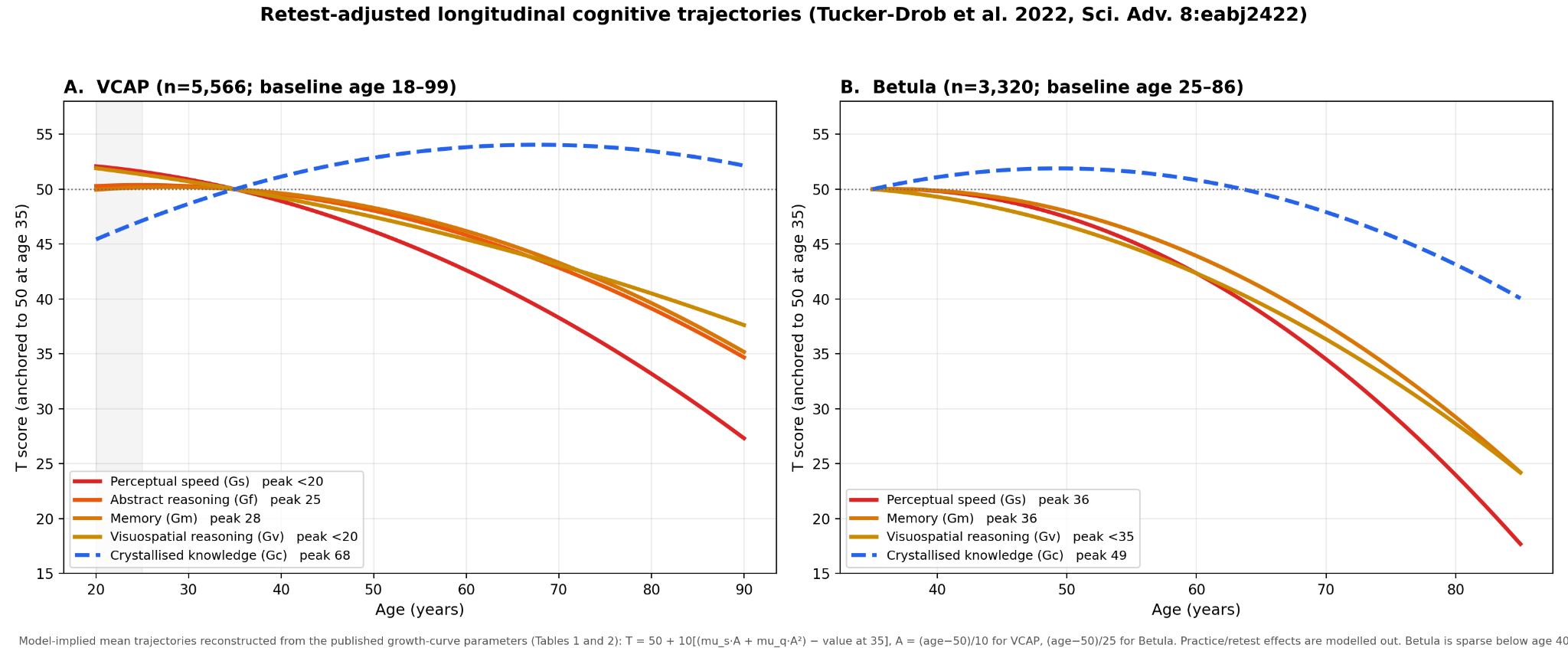
With this cognitive backdrop, the senescing of the professoriate becomes even more alarming. Over the last few decades, we seem to have systematically reduced the collective fluid intelligence of independent academic scientists. The faculties of the scientific faculty are slipping.
Scientific decline with age
Okay. So what? Is fluid intelligence really that important for scientific discovery? While crystallised intelligence (or other less objective traits like experience and wisdom) might be valuable for teaching or mentoring, it does seem that youthful mental agility is predictive of scientific progress.
Isaac Newton was 22 years old when he invented calculus. Darwin was the same age when he boarded HMS Beagle, upon which he would spend the next several years conceiving of evolution by natural selection. Einstein’s annus mirabilis occurred when he was just 26. During this year, he came up with the idea of the photon and thereby explained the photoelectric effect (which later won him a Nobel Prize), mathematically explained Brownian motion, invented special relativity, and discovered mass-energy equivalence (that’s E = MC2). It is unclear whether these scientists would have been equally capable of producing such leaps of genius later in life, when their fluid intelligence would have been lower. It’s probably a good thing they didn’t have to waste their twenties working as a research assistant on someone else’s banal project to buff up their CVs enough to make it into grad school!
You may read of these young achievements and think, “Well of course they discovered stuff early—they were geniuses!” Except their achievements then broadly declined with age. Newton published the laws of motion in his early 40s (after seeding the thought of gravity in his early 20s), but retreated from active research in his 50s. Einstein came up with general relativity at 36, but then petered out and famously turned his nose up at much of quantum mechanics in his later years. Darwin had done all his conceptual work by 30, then spent the rest of his long life worrying about what other people would think of his theory. Ingenuity clearly coincided with peak fluid intelligence for these geniuses.
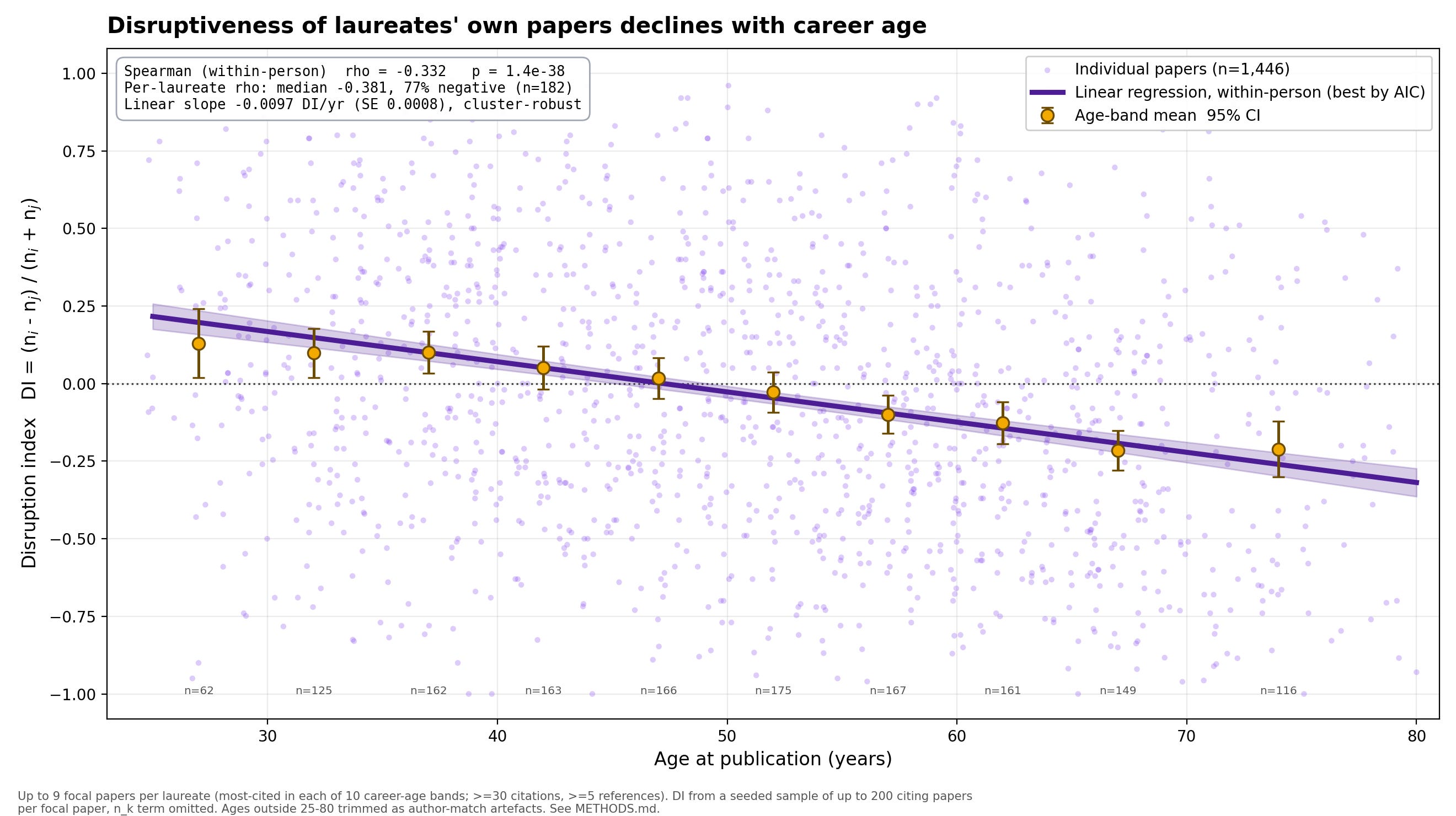
The prime age for groundbreaking discovery being young seems to be a generalisable trend. Scraping bibliometric data from OpenAlex, I computed the disruption index for the most impactful papers across the publishing lifetimes of 208 Nobel laureates (n = 1,446 papers).1 This revealed a monotonic decline in scientific disruptiveness with age that is approximately linear (within-person Spearman’s ρ = -0.332). Top scientists seem to do their most ingenious work when they are young.
The exclusion of young scientists
The ticket to scientific freedom for a life scientist in the US is known as the R01. This NIH grant often gives budding biomedical PIs their first independent funding, allowing them to pursue their own scientific vision. In 1980, the average age of first-time R01 recipients was 35.7. In 2025, this average age of first-time grantee was 43.1. A seven-year delay may not seem catastrophic, but we have already seen how one’s cognition can shift over such a period. Further, the impact on human experience is large.
True scientists want independence and the freedom to pursue their own interests. Being forced to spend half of one’s life working beneath the academic hierarchy punishes the soul—a 36-year-old who has worked hard and been rewarded for it is a different person from a 43-year-old who has been grinding for over a decade since completing their PhD, being paid a pitiful postdoc salary all the while.
Further, if one wishes to commit to the academic career path, coasting through one’s thirties isn’t an option. The crucial years between finishing a PhD and starting one’s own lab don’t offer much respite. The coincidence of this period with women’s fertile years is particularly tragic. Female scientists will either have to juggle parenthood during a postdoc—and risk falling behind peers before establishing independence—or postpone having kids until their forties, when having them at all is less likely. Back in 1980, when scientific independence was often secured at a younger age, the battle between work and family was less existential.
If this postponement of scientific independence is so bad, why did it happen in the first place?
One possible explanation for the aging of researchers is the “burden of knowledge” hypothesis, put forward by the economist Benjamin Jones in 2009. It is a persuasive idea: as the total volume of human knowledge expands, successive generations require more time in education to reach the edge of human knowledge in their field. Thus, expertise is reached later in life. According to this hypothesis, gerontocracy in science is inevitable and necessary.
While there may be a kernel of truth to the “burden of knowledge” as a phenomenon, I am skeptical that it adequately explains scientific gerontocracy. It is implausible that the advances in biomedical science over the 35 years between 1980 and 2015 equate to an extra 6.5 years of learning time for the average faculty-level scientist. Something else must be going on. We get a clue as to what when we consider theoretical versus experimental scientists. Via the Nobel Prize official API, I compared the age-at-discovery for experimental versus theoretical physics laureates from the last century and a half. This revealed a clear gap: theoreticians can make groundbreaking discoveries at a younger age than experimentalists.
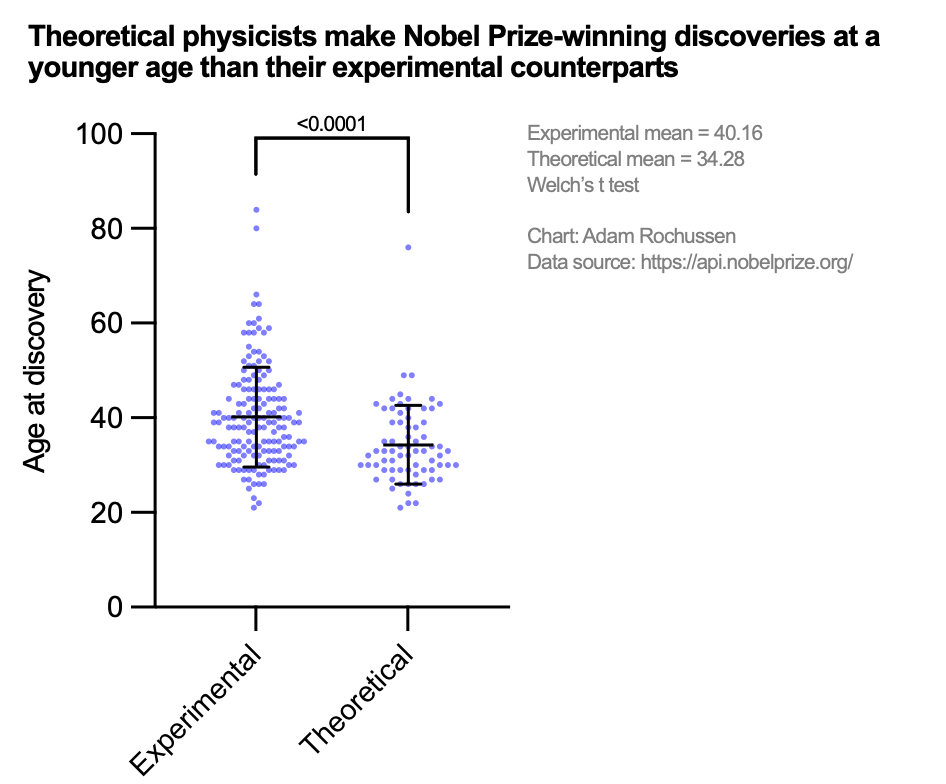
This would not be predicted by the “burden of knowledge” hypothesis, since the burden would be equally great for both branches of physics. So why does this gap exist? Well, theoretical physicists require less in order to begin discovering things. They need no institutional position, no laboratory resources, no funding. Without those brakes, their average age-at-discovery occurs when fluid intelligence and accumulated knowledge are at a more optimal nexus.
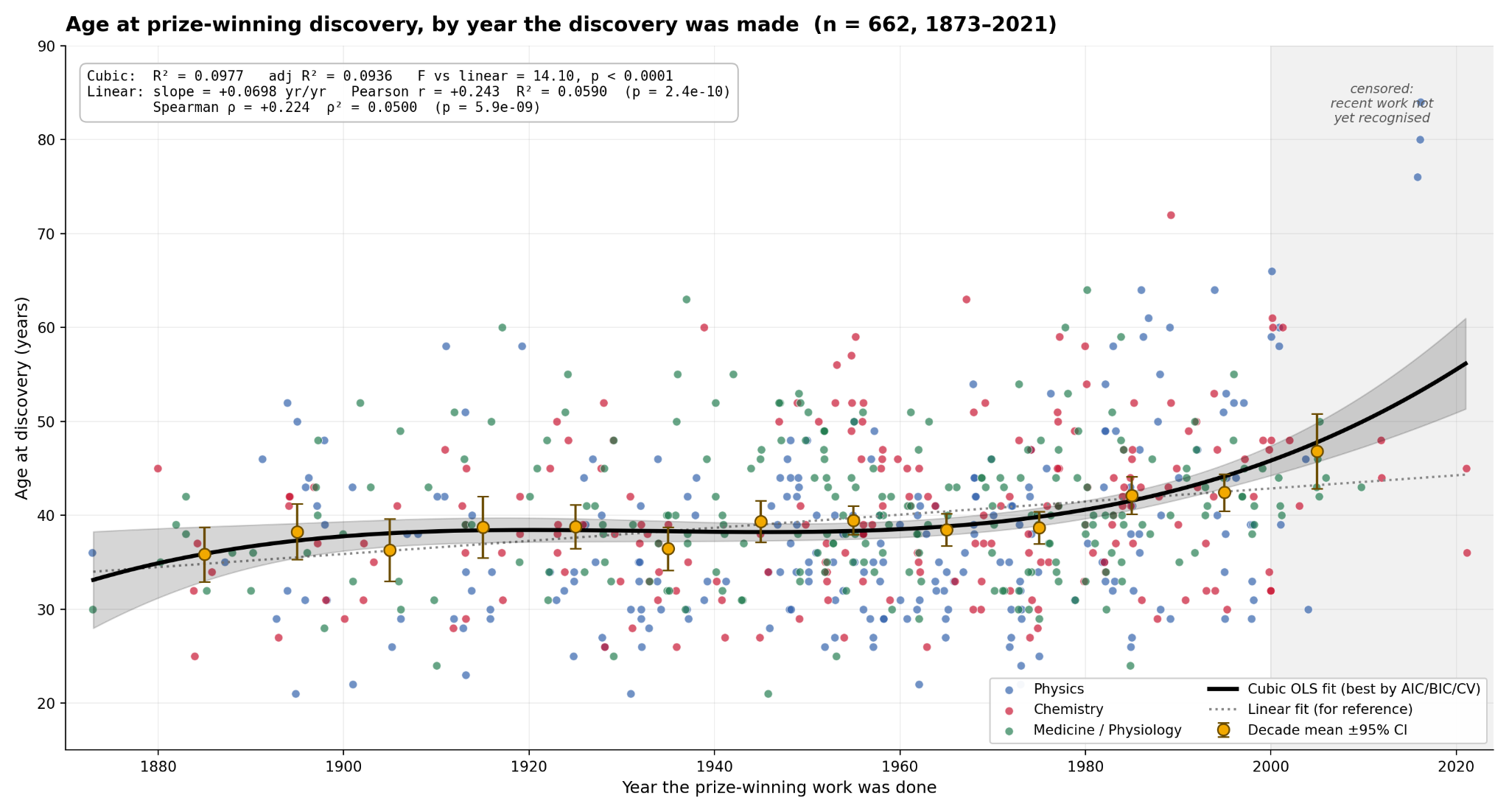
The average age-at-discovery for all Nobel Prize winners is relatively young. Further, it has been flat for most of the 20th Century—below 40 on average. Only since 1980 have we seen signs of an increase in age-at-discovery, though this still trails behind the rising trend in age of scientific independence in general. A more likely explanation, then, for the rising age of scientists is a systematic and structural exclusion of young scientists.
The source of anti-young bias
I turned 29 the other day. Old, I thought. My fluid intelligence has probably already peaked. I’m about 10 years into my scientific career, but by the metrics that faculty search committees and funding bodies use, I’ve got barely anything to show for it. By “metrics”, I of course mean publication record. This and Letters of Recommendation are the key inputs that will persuade academic committees that you are worth funding as a scientist. More often than not, these assessments of the scientist are more important than any scientific ideas being proposed in a funding application—particularly prior to running your own lab. The fundamental problem with getting an academic career off the ground faster is that this readout of scientific prowess lags behind reality by several years. It can also be a rather crude proxy for actual scientific ingenuity.
Let me use myself and an illustrative example here. I did several mildly cool things with T cells during my PhD at the University of Cambridge. By the time I had wrapped up my PhD in December 2024, none of my main work had been published. Had I not been lucky enough to persuade someone to employ me as a postdoc, I likely would have had to stay in my PhD lab for another year or so waiting for publications to come out (this 1-2-year add-on on top of an already-long PhD is extremely common). I spent the first year of my postdoc applying to 8 different fellowships—all rejected due to my meagre CV. I’m now 20 months into my postdoc and have made what I consider to be quite a cool discovery. I filed a provisional patent in May this year and will submit a paper to a journal in the coming months based on this work. Despite having, in reality, done quite substantial work at this point (four first-author papers’ worth), I only have a single first-author paper published at time of writing. My main PhD paper isn’t even submitted yet. The postdoc paper I’m currently writing will likely take at least another year to be published.
So what should I do? Well, I’ll just bide my time, I suppose. I’ll let my fresh, cool ideas go untested until I can finally get the independence and resources to be able to test them—at which point I’ll be old wise enough to consider them too silly to bother testing. The thing about the academic career path is, it just gets easier and easier over time, even as you do less and less as a scientist. Funding history becomes another metric for future funding, so a flywheel effect begins. Awards also follow publications and grants, perpetuating this lagged acceleration of a career. But these all come too late.
Fast-forward five years, when independence and resources will finally be a reality for me, and I’ll probably want to start having kids. And then my parents will be getting old. Life gets in the way of science, but it doesn’t get in the way of my publication record and academic network expanding. It’ll get easier and easier for me to get more funding, attract more talent to my future lab, publish in top-tier journals, and win the game of academic science. Eventually I’ll get tenure. From that point onwards, the pressure to take risks and drive scientific progress really eases off.
The slowness of publishing and the use of publishing record as a metric are both responsible for anti-young bias in academia, but they aren’t the only sources of the problem. Academia is deeply hierarchical, and young researchers are simply not given the respect that older ones are. Some of this comes from the young researchers themselves—academia selects for timid conformists—but this cultural deprioritisation of young scientists is also upheld by self-serving bias from established professors (who also are the ones who sit on review panels and search committees).
Fixing gerontocracy
Sclerosis of academic departments is not an unknown issue. Many funding bodies have been trying to create more opportunities specifically aimed at “early career researchers”. This hasn’t done much—not least because the window of time that is “early career” is far too large and based on PhD graduation, not actual age (so people well into their forties qualify). Actively hiring young researchers has seemed to work in some settings. The Laboratory for Molecular Biology in Cambridge, UK, traditionally focuses on hiring young talent. In 2011, a journalist at Science interviewed its then-director, Hugh Pelham, and learned the following:
“One way to run a successful research center is buying in what Pelham terms “empire builders” — established scientists already running large research groups elsewhere. But most of LMB’s recruits are promising young researchers. “Ideally, we’d like to hire people in their early 30s or occasionally even younger,” Pelham says. Some new heads of research teams have come straight from earning a Ph.D.”
Such a policy might work for a while, but it only addresses one end of the pipeline. You still need to create new positions in the first place. Some institutions, like the Universities of Oxford and Cambridge, have been toying with forced retirement to address the back end of the pipeline. Their original cut-off at age 67 has now risen to 69, after pushback from advocacy groups who, rightly, point out the ageism.
Such top-down fixes are bandaids. They are anti-meritocratic, and I consider them to be both unjust and ineffective. If there is a 70-year-old professor at Cambridge with better ideas than a scientist half their age, they should be able to compete fairly for the position and resources to pursue those ideas. Yet that is not how it currently works. To really fix the issue, we need to be better at scientific triage and remove barriers to meritocracy. I have some suggestions.
Firstly, we should abolish tenure. While ostensibly designed to protect academic freedom, academic institutions seem to have no difficulty working around the rules to remove tenured academics that they don’t like regardless.2 The real effect of tenure, then, is to simply clog up the academic job market. Competition between younger scientists is exaggerated because the number of available faculty spots is minuscule. If established professors have to actually compete to keep their positions, then we might see a healthier turnover and a more motivated senior faculty. Rolling 3-year contracts for everyone would be a good place to start. Science without tenure isn’t the catastrophe that some defensive professors may have you believe. Staff scientists (an often-ignored role within academic labs) have been operating without it perfectly fine—often competing for their own grants and publishing papers as the corresponding author just as capably as tenured professors do.
For this to work, though, we need to fix how we assess scientists. It’s a pipe dream, but there is no career path in which standardized cognitive testing makes more sense than in academic science. If we want objective meritocracy, a scientist’s cognitive ability should be measured objectively. The reasons why people are afraid of such a notion are wide-ranging, but include being misinformed about the validity of IQ tests and being personally insecure about their own intellect. Forcing cognitive testing through the Overton window would also allow for longitudinal tracking. A 70-year-old professor coming up to their next 3-year performance review will have to demonstrate that they have the same cognitive horsepower as the person whom was originally hired for the professorship.
Of course, the key to scientific discovery is not just good hardware, but also good software. Once we have identified scientists with the best brains, we can then assess them on their ideas. Grant, fellowship, and faculty applications should all use blind assessment of the scientific proposal in a manner that is completely de-identified and segregated from the assessment of the scientist. Triage of scientific proposals is an area that LLMs can probably be useful for too, which might increase the objectivity of the process.
We don’t need DEI for young scientists. We just need to level the playing field so young scientists can compete fairly with older scientists. A purer meritocracy across age that actually triages science and scientists appropriately would surely produce a more productive and disruptive scientific enterprise. I posit that such a system would probably reverse scientific gerontocracy too.
cf: Nathan Cofnas, Jason Locasale, and other such undesirables who, irritatingly for their respective former universities, seem to have clean records of conduct.
Oh my goodness you kinda buried the lede, abolishing tenure and IQ-testing and retesting for profs!! not necessarily personally opposed though, would like to hear more about this in future pieces. Am now 40yo myself and can feel my memory slowing a touch, it's horrifying.
I think old men are, as usual, an easy target. Of course, people of any age group doing bad science will negatively impact science quality. Your thesis here I don't totally disagree with - I just think the ideal time to argue that would have been half a decade ago. Because right now with underqualified AI-assisted students being awarded doctorates I really don't think you can argue young people are the demographic making the best science.