

Humans measure things. Alongside language, it can be argued that the ability and tendency to measure things is one of the purest manifestations of human intelligence. Measuring has allowed us to understand the world around us incredibly well, and with that understanding comes the ability to manipulate reality to our advantage. Science, engineering, and any technology you can think of relies on the ability to measure things. Measurement is inarguably valuable and arguably invaluable. Why, then, do some people—including scientists—reject endeavours to measure certain things?
Measurements, metrics, fear
Some physical things are hard to measure. We seem to have a knack for inventing methods and devices that overcome this difficulty, though. We’ve developed space telescopes that can measure things at the beginning of the universe. We’ve developed DNA sequencing technologies that have let us read the entire genetic code of thousands of humans. We’ve developed reliable data collection and storage apparatus to track economic activity across billions of humans worldwide. In each case, being able to detect and measure things has been at the fundament of human progress in a certain field of knowledge. These kinds of measurements are not that controversial. There are some people who fear simple physical measurements (creationists might reject radiocarbon dating, for example), but this isn’t really the focus of this essay.
Sometimes we want to measure complex, nebulous, or abstract things. Phenomena that we might consider to be inherently qualitative. While it is rare for one single, clean measurement to be able to do this, we can still measure these things and quantify them. Doing so requires the construction of metrics.
If you’re into sports, you might find yourself wanting to compare different athletes. Who is the best, Messi or Ronaldo? Was prime Federer better than prime Djokovic? Which golfer will go down as the GOAT?1 You may even want to compare between disciplines: who is a more impressive athlete overall, Michael Phelps or Usain Bolt? These are questions that require quantification of complex phenomena, and so any discussion here requires the construction of metrics.
Most simply, you could count total Olympic gold medals won by Phelps and Bolt. This would give you some quantitative understanding of their respective abilities, but you could argue that swimming has many more events that all basically test the same underlying ability, so swimmers have inflated medal counts. Thus, raw medal count is a bad metric here. To overcome this, you could then normalise medal count relative to other champions within the swimming and sprinting disciplines. Or perhaps you could ignore medal count and look at something like career earnings, time at number one, or some other well thought-out metric. One thing you can’t say is “well it’s just impossible to say, and we just shouldn’t be trying to make this sort of comparison”.
There can be good metrics and bad metrics, but there is no denying that the existence of some metric is useful if you want to know something about anything. And yet, there are many people who reject quantitative interrogation of phenomena full stop. This is surprising, given the utility and benignity of metrics, yet this fear of metrics, which I am terming posophobia, from the greek πόσος + φόβος , is extremely prevalent.2
I can’t be wrong, so the metric must be wrong
To explain the phenomenon with a benign example, let’s stick with athletes. There are many ways to quantify soccer ability.3 Below are some simple career statistics for Lionel Messi and Cristiano Ronaldo, taken from a website dedicated to their comparison.
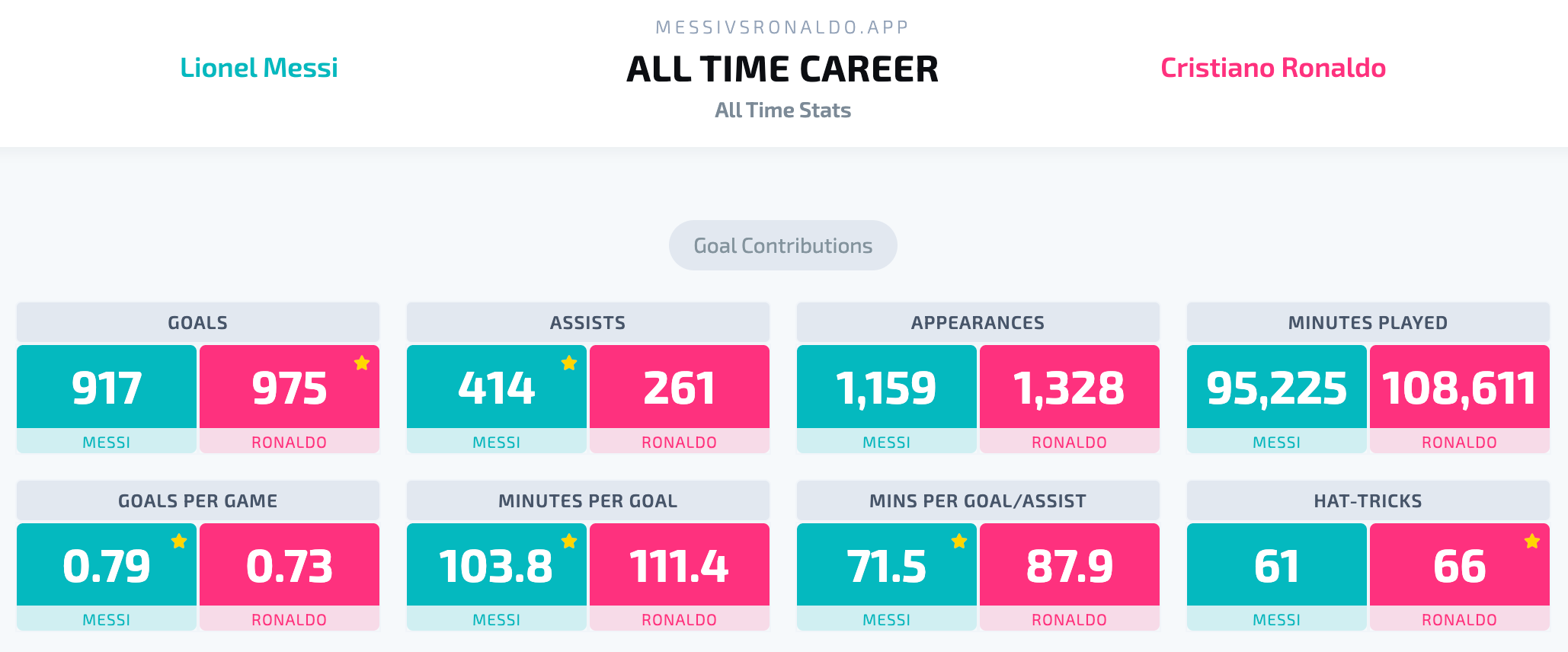
It would be possible to aggregate many such statistics and create a composite soccer ability metric. This would then allow you to finally determine who is the better player between Messi and Ronaldo. The problem is, if a Messi fan designed the metric, they would likely bias it in favour of Messi (by, for example, weighting goal assists more highly), and vice versa for a Ronaldo fan. It is possible to create biased metrics, but it is also possible to neutrally benchmark metrics, to validate them against large cohorts of other players, to detect bias, and to eliminate bias in metrics.
This “your metric is biased” rebuke is a key weapon in the arsenal of the posophobe, and it is used even in instances where the metric is, in fact, very good. If a perfect soccer ability metric was designed using data from thousands of other players, validated to be comprehensive, and shown to be unbiased, you can guarantee that fans of the player who was deemed only second best by the metric would criticise the metric, rather than admitting that their favourite player may not be the best in the world.
Thus, refusal to be wrong and tribal allegiance are strong generators of posophobia.
Intelligence and tabula rasa
Intelligence, while quite a complex trait, is a very familiar one. Hard to pin down, but very obviously real nonetheless. To quantify this trait, psychometricians and intelligence researchers have developed batteries of tests that can be aggregated to form an intelligence quotient. IQ is an incredibly good proxy for the actual underlying “general factor of intelligence”, referred to as g.
Intelligence is just another of the many human traits that varies across and between populations. You get taller humans and shorter humans—likewise smarter and dumber humans. Despite the validity of cognitive tests and the lack of intrinsic moral valence of the resulting metrics, intelligence is the focus of intense posophobia.
Similarly to the Messi/Ronaldo example, there are ideological reasons for this flavour of posophobia. As with any other human trait, it is unlikely that psychological traits like intelligence do not differ between human ethnic groups. Nobody is pretending that Yugoslavians aren’t, on average, taller than indigenous Andeans. Insisting a priori that this isn’t the case for psychological traits would require an irrational and unscientific belief that evolution only applies from the neck down. This “blank slate” proposition, first put forward by John Locke in the late 17th century, has by now concretised itself as a foundational axiom of egalitarian political philosophy. This is why, despite no supporting evidence emerging with modern measurement, the tabula rasa dogma continues to pervade elite liberal circles, including within scientific institutions.
Just as a Messi fan holds “Messi is the best” as an axiomatic truth—and any empirical metric that refutes this must be rejected—many egalitarians reject empirical findings of psychometric differences between groups of humans. Since doing so is quite transparently ideological and unscientific, the superior strategy for the blank slatist is to reject the very notion of quantitative inquiry into intelligence to begin with. If they can persuade people that the metrics aren’t valid, then they never have to wrestle with any empirical findings that shatter their ideology. The irony here is that John Locke formulated the tabula rasa theory based on his broader belief in empiricism. Were he alive today, his obsession with empirical evidence would no doubt have led him to completely reject blank slatism.
My feelings don’t care about your facts
Another reason for intelligence-focused posophobia is less to do with tribal ideology and more to do with ego and personal insecurity.
Unlike height, humans tend to view intelligence as the very essence of being human. To say that someone is stupid is to imply that they are less of a human (whereas nobody thinks short people are any less human than tall people—even though they are literally lesser humans). For this reason, discussion of intelligence is heavily emotionally weighted, and rarely rational. If I suspect that I might not be that smart, and if I place intense emotional weight and moral valence in intelligence as a human trait, then a quantifiable intelligence metric represents a grave threat to my ego. Nobody wants to be told that they are—objectively speaking—a moron.
To prevent ego death, we come up with any number of posophobic excuses to protect ourselves from the truth. We’ll pretend that IQ tests aren’t valid, we’ll pretend that intelligence itself is not that important, or we’ll invent new things like “emotional intelligence” and pretend that it isn’t highly correlated with actual intelligence. We might also try to claim that our intelligence is uniquely non-quantifiable because we simply don’t test well. This, too, is posophobic cope.
These coping strategies are not robust. There is only so long we can kid ourselves and others around us before the cold, hard reality of intelligence comes a-knocking. There are many people on this earth who are smarter than me. Unless I want to broadcast insecurity to the world, I try to do less of this kind of coping. Instead, I try to simply care less about intelligence because there is nothing I can do to change it. I’d recommend working with what we have and focusing on pursuing a fulfilling, happy life, which requires releasing any envy we might have for people who are smarter than us.
Posophobia is the purest form of avoidance of comparison and competition, because it prevents the possibility of competition in the first place. In a world where technology has connected us more than ever, more and more people feel threatened by competition because there are more and more people to lose to. This has created a reflexively anti-competition society. Everyone compares themselves to each other more than ever, at the same time as pretending that the opposite is true—that metrics aren’t valid and comparison is not sometimes required. To alleviate the discomfort attached to quantification and comparison, we see things like grade inflation (which deliberately distorts metrics), the removal of the class lists at Cambridge University, the option to remove public “like” counts on Instagram posts, the disregard of health related metrics (e.g., BMI and the “healthy at any size” movement), et cetera.
It has been stated that “comparison is the thief of joy”. Generations of parents and teachers have told kids “it’s not a competition!” or “it’s the taking part that counts”. It is important to bear in mind that these platitudes are not true—they’re just useful coping strategies. You cannot escape competition. You cannot escape empirical quantitative inquiry.
Meta-science: h-index and the QED Score
Similar motivations for posophobia affect other criteria too. One surprising focus of posophobia is the notion of quantifying and comparing science or scientists. You’d think that people whose job it is to measure things would see the value in measuring science and would be keen to measure themselves and their colleagues objectively. Indeed, many scientists (myself included) welcome these quantitative inquiries. Metrics like the h-index have been formulated to measure the output of academics whose publications get catalogued on Google Scholar. My h-index is a whopping five, which means that five of my publications have been cited at least five times each. Of course, this metric isn’t perfect. People can be added to a long author list for doing relatively little, meaning lots of middle authorships inflates one’s h-index. Review articles are also cited far more often than primary research (probably because scientists are too lazy to find the original research for a particular finding), and so they, too, inflate one’s h-index.
These imperfections are all that some need to completely reject the notion of quantifying the quality of a scientist. Cynical meta-scientists like Michael Eisen love to find niche instances whereby h-index doesn’t perfectly match scientific quality. The Eisens of the world aren’t making rational, balanced criticisms of the pitfalls of a particular metric, though—they are just posophobes through and through. This is evidenced by the fact that they get their feathers ruffled when such metrics are improved upon! When a genomics professor improved upon h-index by creating a plug-in for Google Scholar that removes bias from middle authorships, this is what Eisen had to say:


Michael has spent much of his career railing against traditional publishing models. I’ve written extensively agreeing with him on much of this.


One thing that journals succeed in, and Eisen’s own attempts to replace traditional journals have failed in, is the triaging of interesting science from uninteresting science. There is simply too much research being published for everyone to read everything. You need to be able to separate the wheat from the chaff, and doing so requires metrics.4 We can make specific criticisms of any given metric, but we can also improve upon any given metric. Rejecting the notion of quantification in the first place is just posophobia, and it is untenable.
The same posophobia has recently led to a furore in response to QED Science, a company that has created a tool with which to review papers with AI, releasing the QED Score. This is essentially a ranking of your paper relative to other papers, based on the quality of the science and not on author names or institutional affiliations. The full details of the proprietary AI tool are not open source, but the output is very transparent—you can see why the tool gives a paper a certain rank, since it goes through the paper claim by claim and identifies gaps in logic or evidence.
They validated their tool and published a white paper. I think it’s pretty good. They could obviously do more to validate the QED Score, but the white paper already acknowledges lots of limitations and insists that this tool is just a first pass and doesn’t replace expert peer review. Cue angry reactions from posophobes!
One of the criticisms of the QED Score was that no papers published by African authors emerged in the top 1% of papers. This point was pushed by many, including a professor of computational biology at CalTech, as being evidence that the score is biased (racism is the implication).

I pointed out to Lior that this outcome does not indicate bias necessarily and could simply be the result of the fact that America and Europe produce more and better science than Africa. This seems an obvious point unless you are a die-hard blank slatist. To prove my point to Pachter, I asked him the following:
The Global Cities Index ranks the world's 1000 largest cities across the world by a number of meaningful metrics related to human flourishing (https://oxfordeconomics.com/global-cities-index/). Zero African cities appear in the top 5%. Do you think this indicates that the Index is biased?
I underestimated the power of posophobia here, because he came back insisting that yes of course it is biased, and included a hyperlink to a LinkedIn article that argued it is biased because:
Indicators that reflect Western urban ideals—orderly streets, high-quality public services, transparent governance, low crime rates—are foregrounded. Meanwhile, qualities that define cities outside the Western tradition, such as dense social networks, informal economies, vibrant street life or shared spaces born of necessity, are rarely captured.
Apparently low crime rates aren’t a universally good thing. The extents the posophobe will go to in order to deny quantification and comparison are astounding.5
Treating posophobia
I have empathy (but not sympathy) for the posophobe. Sometimes it is just nice to ignore metrics. Some things we should do not to compete with others but because we enjoy doing them. There are also, as I have mentioned many times in this essay, bad metrics. There is also Goodhart’s Law:
“When a measure becomes a target, it ceases to be a good measure.”
This is obviously true. If someone wants to lose weight, but cares only about the metric, they’ll find that amputation is a highly effective strategy. The game-ification of metrics does diminish their value, and so well-designed metrics include defences against this kind of thing (the difference between GScholarLENS and h-index is a good demonstration of this).
That being said, let’s not throw the baby out with the bathwater. Metrics are both necessary and an inevitable consequence of human nature. If we want to understand things, allocate resources appropriately, and solve challenges, quantifying and comparing things is essential. Most people understand the value of measurement some of the time, but there are a few areas which trigger an irrational posophobia in some people. This either stems from an aversion to being proven wrong by empirical data, an unscientific blank slate worldview, or a personal psychological barrier to protect one’s ego.
If being worse than others at something, or observing that one group is worse than another, makes you feel uncomfortable, then perhaps it is prime time for some introspection and the dissolution of some ego. We should learn to detach our sense of self-worth from our rank in the pecking order, rather than pretending that rank cannot be accurately determined or that the pecking order doesn’t exist at all.
this one isn’t really up for debate, to be fair
“posos” means “how much?” or “how many?”. I think this is better than “metrophobia” because it more precisely evokes an aversion to quantitative inquiry, rather than an aversion to the measurement itself. “Metro” is also too frequently used as an abbreviation for “metropolis” (e.g., a metrosexual isn’t an autistic numbers guy).
even though I’m British, I’m going to insist on “soccer” over “football” because it is more precise. Football is the umbrella term that can describe rugby (full name: Rugby Union Football), Australian Football, Gaelic Football, American Football, and finally Association Football (which got abbreviated to “assoc-er” and eventually “soccer”). The name soccer also originated in Oxford, so really I’m reclaiming it on behalf of my fellow brits.
and yes, wheat and chaff exist. Stop listening to John Lennon, wake up, and smell the roses. This reminds me of someone in my previous lab who refused to agree to the statement that “some people are better at some things than other people”. She insisted that talent basically doesn’t exist, and different outcomes simply stem from the fact that “some people are more interested in certain things than others are”. Amazing stuff.
It’s probably worth noting here that both Eisen and Pachter (and Pachter’s ex-student, who wrote an X article against the QED score, which Pachter then boosted) have intense personal beef with the founder of QED, Oded Rechavi. This stems from the fact that Oded (who lives in Tel Aviv) expressed pleasure at the fact that Michael Eisen was fired from his role as editor-in-chief at the journal eLife because of this post on X in the wake of the October 7th attacks in Israel.