

“I would take a thread and a needle and I would interweave love into our society”
“This is my command: love each other”
He was the spearhead of a growing progressive religious sect that was obsessed with the importance of compassion and “love” (used under a nebulous definition). Not only did he spread the teachings of this growing religion, but he exemplified its fundaments in the way he lived his life. Wherever he went, he was accompanied by an aura that seemed to magically persuade people of his stories and philosophy. Not only did lots of people believe his stories (to the bafflement of most rational observers), but they proudly and loudly proselytised for him—spreading word of his miraculous achievements and living their lives in accordance with the new religion. But some did not buy the schtick. Some disliked the fact that this man was being elevated above everyone else as some god-tier thought-leader and activist. They doubted the miracles. They rejected the teachings. They denied his claimed authority. In the end, he was killed as a result of his unremitting dedication to his own mythos.
The above paragraph can be applied equally to both Jesus Christ and Jason Arday. The first quote at the top of the article is Arday’s, and the second is from Jesus (John 15:17). The parallels between these two men are fascinating.
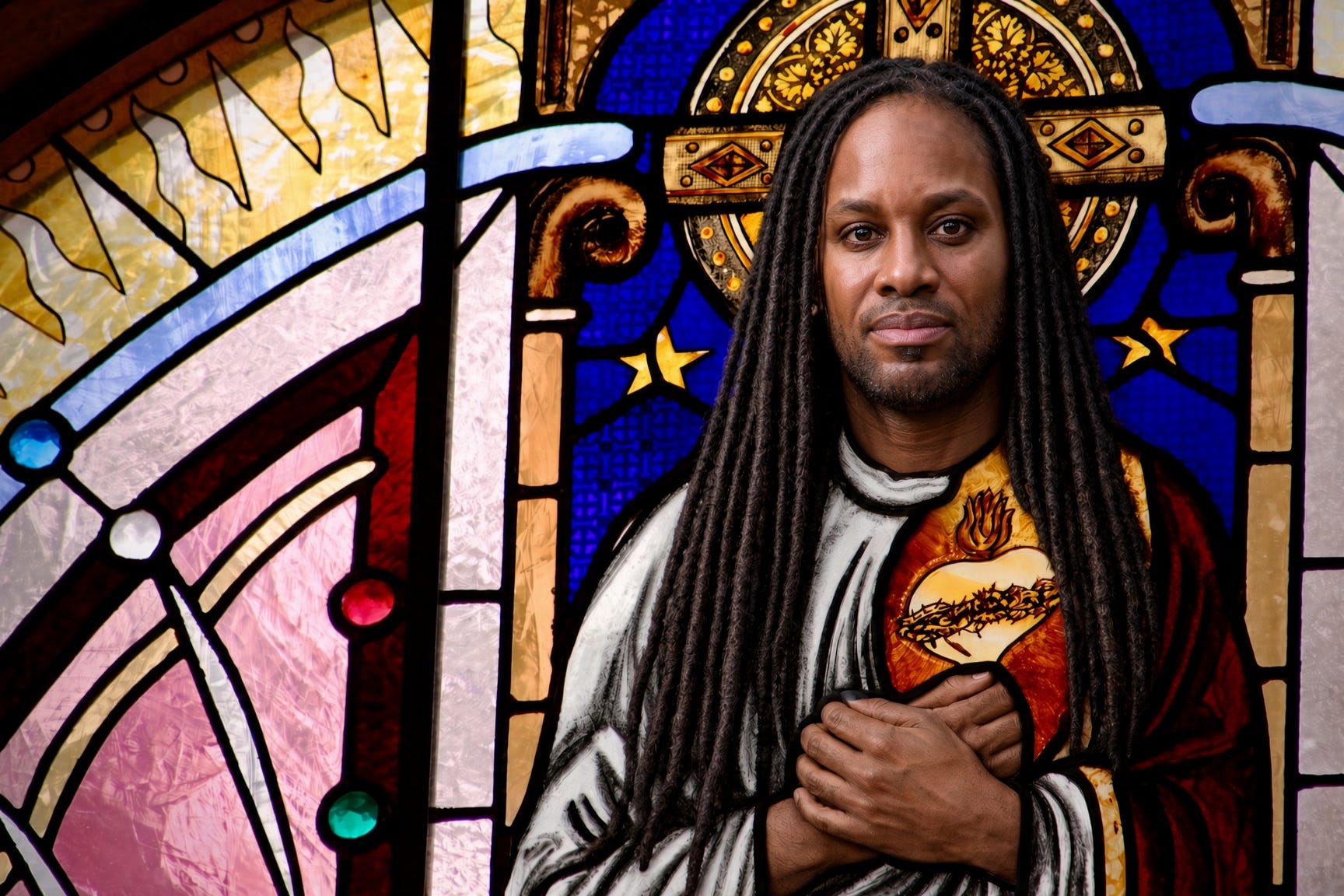
Similarities
Jesus Christ was a proto-Marxist who followed in the footsteps of John the Baptist—another apocalyptic Jewish activist/preacher.1 Arday was a neo-Marxist, who followed in the footsteps of other DEI prophets (like Claudine Gay—the former president of Harvard who was also elevated to a rank beyond her ability and was also found to have plagiarised much of her academic work).
Fabulous tales followed both men around. One is claimed to have fed 5000 people with a couple small fish and five loaves of bread. The other claimed to have raised millions for charity and to have run 30 marathons in 35 days. There’s a claim of healing a leper with the touch of a hand from one; and a claim of treating a fractured leg bone with ice baths and painkillers mid-600-mile ultramarathon from the other. Perhaps the tales of Arday will have crossed into the realm of the supernatural by the year 4000 AD (that’s 2016 AA).
There are also inconsistencies in the timelines of their life stories. In one account, Jesus is claimed to have been born during the reign of Herod the Great (i.e., before 4 BC) and for his family to have fled to Egypt after he was born. The “Escape to Egypt” was crucial for prophetic reasons, as it assists his divine claims.2 In another account, he was born in 6 AD and his family went straight to Nazareth from Bethlehem—never stepping foot in Egypt.
Arday’s life story is equally murky and full of contradictions. He was apparently illiterate until 18, but also managed to pass his GCSE exams at age 16. He also claims to have travelled to Brazil, where he helped install water pumps. The “escapade to Brazil” was crucial for prophetic reasons—a woman there told him: “I can tell you’re destined to do great things. But I also believe you’re destined for very sad and difficult things as well”. The charity that he was supposedly working for on the trip has since said that it does not send workers abroad at all.
Jesus met his demise after the Jewish religious elites grew intolerant of the divine claims that were floating around him (whether he himself ever claimed to be God is somewhat unclear and debatable), and after the Romans grew intolerant of his anti-Roman political activism. In the end, he was publicly executed for sedition. Arday, according to one of his fellow religious leaders, was lynched by the media for the crime of being a prominent and successful black scholar.
I could go on here, drawing more and more parallels, but religious readers may already be getting agitated my blasphemy.3 More interesting than their similarities, in my view, is their differences. Why was Jesus Christ’s death the catalyst for the acceleration of his new religion, and why do I think Jason Arday’s might be the opposite—an inflection point marking the death of his neo-religion?
Differences
In the case of Jesus, we read of his life not from his own perspective, but from his followers’. The Bible wasn’t written by the big man himself. As such, even if you disbelieve many of the stories in the New Testament gospels, you can’t pin the alleged misinformation on Christ himself. There is no reason to believe that he ever lied in order to promote himself. Indeed, as mentioned, it’s unclear whether he ever even claimed to be God.
The story of Jason Arday, by contrast, is told by Arday himself. The source of the tall tales is always Arday, and these are then promulgated by those motivated to believe the nonsense—including his wife and white liberal elites looking for an idol to pedestalise for their religion. Thus, while Christ wasn’t a liar, Arday lied throughout his adult life for his own gain.
Further, many of Arday’s claims are verifiably false. Per a Guardian report, he claimed to be a visiting professor at Ohio State and Glasgow universities, but both universities directly denied this. He also claimed to have got a master’s degree in “psychodynamic practice” from Birkbeck, University of London, but the university reported no record of him attending at all. His claims to have published a book were also denied by the publisher who he was supposed to have published it with.
Claims of miracles performed by Jesus, on the other hand, can only be refuted based on the rational inference that supernatural events cannot occur in reality. There are no contemporary claims directly contradicting feats like walking on water or turning water into wine. If there was a contemporary text that described the wedding at Cana from a different perspective that said, “we were running out of wine, but luckily this guy Jesus had his friend bring in a barrel and we filled up the water jugs with it last minute, which surprised the host as he was expecting water”, then the miracle could be easily refuted as a nonsense fabulation. Had someone tried to pass off normal events as biblical miracles today, smart phones, social media, and journalists would probably be able to quickly snuff it out. Conversely, had Arday been claiming to have run a bajillion miles in under a week in ancient Roman Palestine, he might have had better luck at persuading people compared to in the present day.
Another key difference between Arday and Christ is who their disciples were. Christ was disfavoured by the elites of his time. His followers were working-class men and he communicated directly with the downcast, the poor, and the disabled. Arday would espouse the same rhetoric, but his primary audience was liberal elites. Professors and university administrators, the entertainment industry, and the news media absolutely lapped him up (until his fraud was too obvious to deny, and then same level of attention was applied in the reverse direction). Arday was fully welcomed and celebrated by the elites of his time. Christ was a radical populist whom was wholly rejected by the political and religious elites of his time.
Most importantly, Christ, at least according to the texts we’ve inherited, had a fairly unblemished record.4 He lived a sinless life. Arday, on the other hand was a liar, a fraud, a manipulator, and a plagiarist. His memoir, for which he claimed to have been paid £1.4 million, was full of proven falsehoods. He could have pulled the book from being published at any point, but did not. After being caught red-handed plagiarising, fabricating data, and lying about academic appointments and achievements, he could have apologised and retreated from public life. Instead, in an AI-generated resignation letter, he repeated lies about his life, framed himself as the real victim, rejected the notion that he was guilty of any academic misconduct, and promised to “return stronger, wiser and with the same determination that has always defined my journey”, which turned out to be a false promise.
Dying to be like Jesus
Both Arday and Jesus preached a message of love. Arday was a Christian, is purported to have attended Sunday school growing up, and is on record speaking on how his hope for humanity is fuelled by his belief in God. To my knowledge, he never directly attributed his platitudes of love and compassion to Jesus, but that didn’t stop him paraphrasing Christ without attribution to spellbound secular pundits who didn’t know any better.
I think Arday may have fancied himself as the Christ of our era. The way he manipulated those around him with his lies while ostensibly showing immense humility and softness revealed a deep communal narcissism focussed on projecting Christian ideals. For those not under the spell, his media interactions come across as too on the nose—too sickly sweet.
Of course, pretending to be charitable is not the same as actual charity. And even if Arday had not faked his charitable acts, he would still have fallen short of the Christian ideal. In his sermon on the mount, Christ instructs:
“Be careful not to practice your righteousness in front of others to be seen by them. If you do, you will have no reward from your Father in heaven. / So when you give to the needy, do not announce it with trumpets, as the hypocrites do in the synagogues and on the streets, to be honoured by others.”5
The most important way in which Arday falls short of Christ, though, is the manner of his death. Christ was publicly executed in the most horrific manner the Roman empire could muster. When nailed to the cross, he purportedly called out to God to pardon the mob that had called for his crucifixion without valid charges: “Father, forgive them, for they do not know what they are doing”.6
Conversely, Arday wasn’t killed by judicial decree and his death wasn’t called for by a mob of angry people falsely accusing him of crimes he did not commit. Arday was guilty of lying, fraud, and plagiarism, but none of the critical voices wished him any harm because of it. Most criticisms I’ve read skip blaming Arday at all—instead directing ire at the university administrators who used Arday as a tool with which to advance their neo-religious agenda.
Rather than being killed, Arday killed himself. I consider suicide to be a cowardly, selfish, and narcissistic act in general, and this isn’t any less true in the case of Arday.7 Many right wingers—rightly or wrongly—have been subject to media onslaughts that make the media storm around Arday look tame by comparison. Further, some of these personae non gratae have suffered much more than just having had articles published about them—some have been dubiously arrested, de-banked, and stripped of their voices via social media bans. Yet none of these people killed themselves. While Christ died at the hands of others so that others’ sins may be forgive, Arday killed himself so that he could escape the consequences of his own sins.8
Ironically, Dr Nathan Cofnas, who first brought Arday’s plagiarism under a public spotlight, is much more Christ-like than Arday was. Cofnas didn’t even want Arday to lose his job after his fraud and lies had been exposed. Instead, he called for Arday to remain a professor at Cambridge as an accurate symbol of what the institution has become. A recent public vigil for Arday in London swiftly turned into a large mob of people falsely accusing Cofnas of crimes he did not commit. His inbox has been flooded with racist death threats. Pontius Pilate, despite never finding probable cause for executing Christ, gave in to the desires of the bloodthirsty Jerusalem mob. Time will tell whether politicians and academics in positions of power will uphold the rule of law or the rule of the mob when it comes to Cofnas. Cambridge’s track record doesn’t inspire confidence here.9
Ultimately, I do not think that Arday will be to woke-ism what Christ was to his neo-Judaic cult that became Christianity. It is entirely possible that Christ was a fibber, or that his disciples fibbed on his behalf, and the absence of iPhones and x-dot-com prevented the fact-checkers from being able to set the record straight. More likely, by my estimation, is that Christ was a good person with an original message. Arday, despite his efforts to appear as such, was not.
I’m not sure whether others have written about the fact that Christ was a communist 1850 years before communism was a thing. There is abundant evidence for this claim and I’ll be glad to compile it in a future essay.
I’m not just talking about Christians here, by the way. In fact, I imagine Christian readers are probably far less offended by my critique of Jesus Christ than radical progressive readers are by my critique of Jason Arday.
Him crashing out at the temple comes close to sinning though, and him instructing his disciples to steal a horse I think is pretty inarguably wrong.
I say “purportedly” here because early versions of the Gospel of Luke do not have this line.
If anyone I know personally reads this, know that if you committed suicide I would be angry at you for bestowing grief upon us and for abandoning those that depend on you. Suicide doesn’t end your suffering—it just transfers it to other people. I find sympathetic attitudes towards suicide only incentivise the act and encourage narcissists to fantasise about the emotional manipulation their grand exit from the world of the living will create. I reject this completely.
The most plausible motive for Arday’s suicide that I have encountered is that he might have been made aware that he was facing complete financial ruin and jail time for his (very real) crimes. It is possible that he broke the terms of his publishing deal and defrauded the University of Cambridge while violating the UK’s Fraud Act 2006. Media articles seem totally insignificant in comparison to these impending charges.
My husband and I enjoy your unusual takes. 😊
A huge difference, though, is that Jason Arday is a person who existed